THE ADVENTURE COLLECTIVE® · Independent discovery and booking for outdoor travel

Traverse the High Atlas, explore Aït Ben Haddou, and ride camels across Erg Chebbi on a 3-day immersion from Marrakech to Merzouga. Expect dramatic landscapes, Berber hospitality, and two nights under Moroccan skies.
Traverse the High Atlas, explore Aït Ben Haddou, and ride camels across Erg Chebbi on a 3-day immersion from Marrakech to Merzouga. Expect dramatic landscapes, Berber hospitality, and two nights under Moroccan skies.
The sun is a wide coin sinking behind rippled dunes as a caravan of camels threads a path toward a scattering of white tents. On this three-day loop from Marrakech to Merzouga, travelers move from cedar-scented passes to ochre kasbahs and finally into the breathing emptiness of the Sahara.
Verified experiences and guided adventures in the surrounding area.
Operated by Marrakech Activities Expert · Merzouga, Drâa-Tafilalet
The sun is a wide coin sinking behind rippled dunes as a caravan of camels threads a path toward a scattering of white tents. On this three-day loop from Marrakech to Merzouga, travelers move from cedar-scented passes to ochre kasbahs and finally into the breathing emptiness of the Sahara.
The route follows a long Moroccan story: Tizi n’Tichka, the High Atlas pass carved at 2,260 m, opens to plateaus that were once caravan corridors. Aït Ben Haddou, the fortified ksar along the way, preserves mud-brick architecture used for centuries and later for international cinema. Geologically, the drive traces folded sedimentary layers and alluvial fans that give way to the wind-sculpted sands of Erg Chebbi. Culturally, the trip punctuates mornings with local markets, afternoons with Todra Gorge’s sheer limestone walls, and nights with Berber music around a campfire.
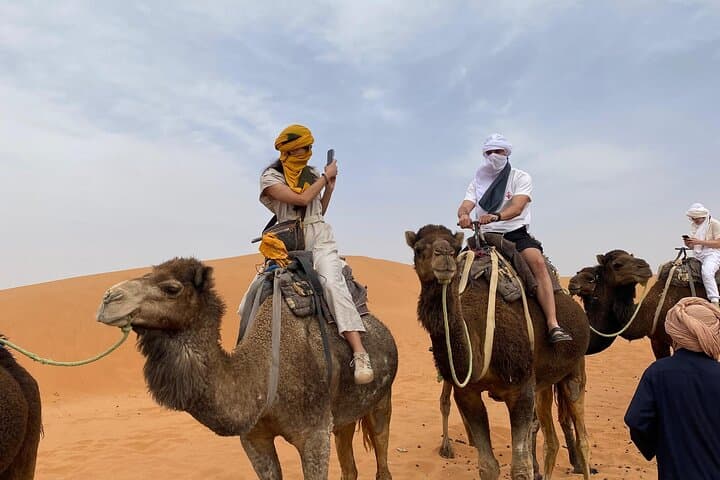
Practically, expect long but scenic drives (Marrakech to Merzouga is roughly 9–10 hours of road time spread across the itinerary), two overnight stays—one in a valley hotel and one in a desert camp—and guided camel rides at sunset and sunrise. Camps vary from standard to luxury tents; showers are usually available at camp base before the night.
Pack sun protection, warm layers for cold desert nights, and a small daypack. Hydrate before camel rides and move at the pace of the dunes; sand demands deliberate steps. Bookings typically include transport, selected meals, local guides, and camel transfers; confirm pickup location and luggage limits in advance.
moderate.
3 days (approx. 72 hours).
Suitable for travelers in light-to-moderate fitness who can handle several hours of driving, short walks on uneven ground, and camel saddles.
Camel transfers to and from the desert camp are typically about 45–75 minutes each (sunset and sunrise), covering several kilometers across the dunes.
Camps range from standard shared tents to upgraded private tents; basic camps have mattresses, blankets, and sometimes showers at a nearby facility—confirm level at booking.
Reception is intermittent around Merzouga and generally absent once deep in the dunes; the tour is designed for low-connectivity experiences.
Two dinners and two breakfasts are included—typically traditional Moroccan fare at the hotel and camp; carry snacks for long travel legs if you have dietary needs.
The route follows historic trans-Saharan corridors and features Aït Ben Haddou, a UNESCO ksar that guarded caravan traffic and became a film location in modern times.
The Sahara’s dune systems are fragile—stick to established camel tracks and local-camp footprints, avoid disturbing wildlife, and reduce single-use plastics.
Marrakech Activities Expert operates guided outdoor trips and adventures with an emphasis on safety, stewardship, and memorable experiences.
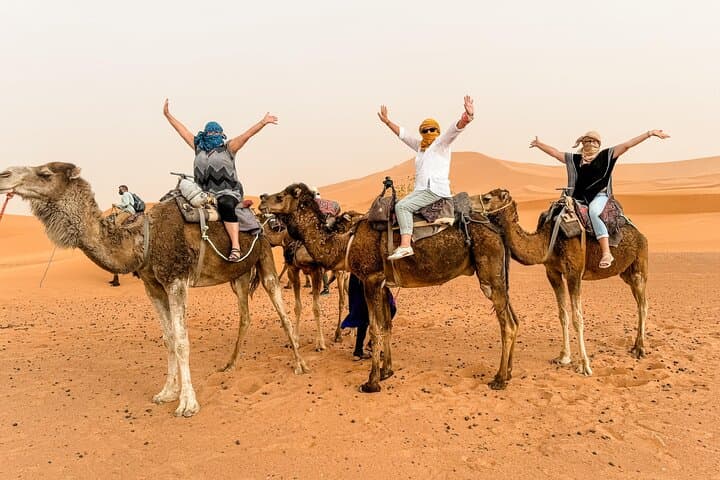
The sun is a wide coin sinking behind rippled dunes as a caravan of camels threads a path toward a scattering of white tents. On this three-day loop from Marrakech to Merzouga, travelers move from cedar-scented passes to ochre kasbahs and finally into the breathing emptiness of the Sahara.
The sun is a wide coin sinking behind rippled dunes as a caravan of camels threads a path toward a scattering of white tents. On this three-day loop from Marrakech to Merzouga, travelers move from cedar-scented passes to ochre kasbahs and finally into the breathing emptiness of the Sahara.
The route follows a long Moroccan story: Tizi n’Tichka, the High Atlas pass carved at 2,260 m, opens to plateaus that were once caravan corridors. Aït Ben Haddou, the fortified ksar along the way, preserves mud-brick architecture used for centuries and later for international cinema. Geologically, the drive traces folded sedimentary layers and alluvial fans that give way to the wind-sculpted sands of Erg Chebbi. Culturally, the trip punctuates mornings with local markets, afternoons with Todra Gorge’s sheer limestone walls, and nights with Berber music around a campfire.
Practically, expect long but scenic drives (Marrakech to Merzouga is roughly 9–10 hours of road time spread across the itinerary), two overnight stays—one in a valley hotel and one in a desert camp—and guided camel rides at sunset and sunrise. Camps vary from standard to luxury tents; showers are usually available at camp base before the night.
Pack sun protection, warm layers for cold desert nights, and a small daypack. Hydrate before camel rides and move at the pace of the dunes; sand demands deliberate steps. Bookings typically include transport, selected meals, local guides, and camel transfers; confirm pickup location and luggage limits in advance.