THE ADVENTURE COLLECTIVE® · Independent discovery and booking for outdoor travel

Spend three days tracking the Big Five across Etosha National Park from a comfortable lodge base. Early-morning and late-afternoon drives bring close-up encounters with elephants, lions, leopards, rhinos and buffalo while guides share ecological and cultural context.
Spend three days tracking the Big Five across Etosha National Park from a comfortable lodge base. Early-morning and late-afternoon drives bring close-up encounters with elephants, lions, leopards, rhinos and buffalo while guides share ecological and cultural context.
Dust lifts from the safari vehicle as dawn pries open the horizon over Etosha’s pale pan. The air is cool, the grass hard and low; a giraffe blinks across a scrubby ridge while a distant lion silhouette melts back into mopane trees. This is a place where water dictates movement and the land itself seems to watch.
Verified experiences and guided adventures in the surrounding area.
Operated by Knap Tours · Etosha National Park, Oshikoto Region
Dust lifts from the safari vehicle as dawn pries open the horizon over Etosha’s pale pan. The air is cool, the grass hard and low; a giraffe blinks across a scrubby ridge while a distant lion silhouette melts back into mopane trees. This is a place where water dictates movement and the land itself seems to watch.
Etosha National Park sits on a shallow depression carved by geological shifts and inland drainage; the central salt pan is one of Africa’s largest, visible from space and home to a seasonally shifting ecology. European exploration and colonial hunting transformed the park in the early 20th century, but today Etosha is managed for conservation and community tourism, with camps like Okaukuejo serving as bases for guided game drives.
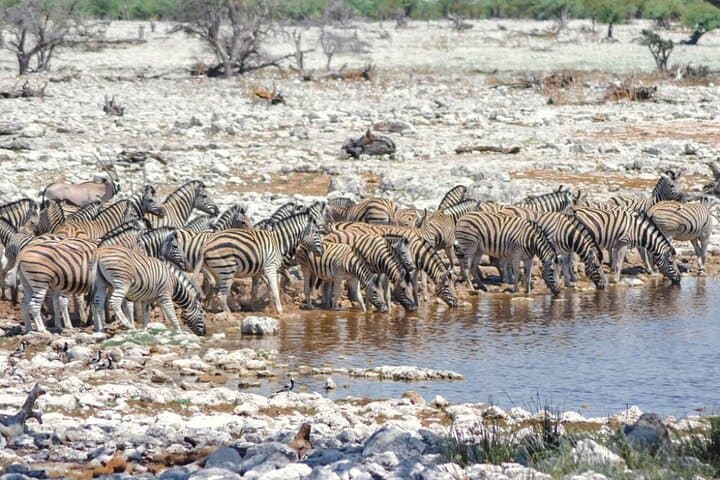
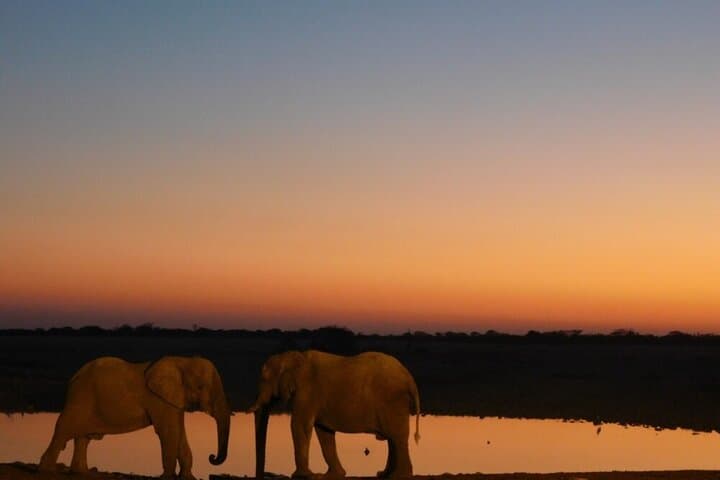
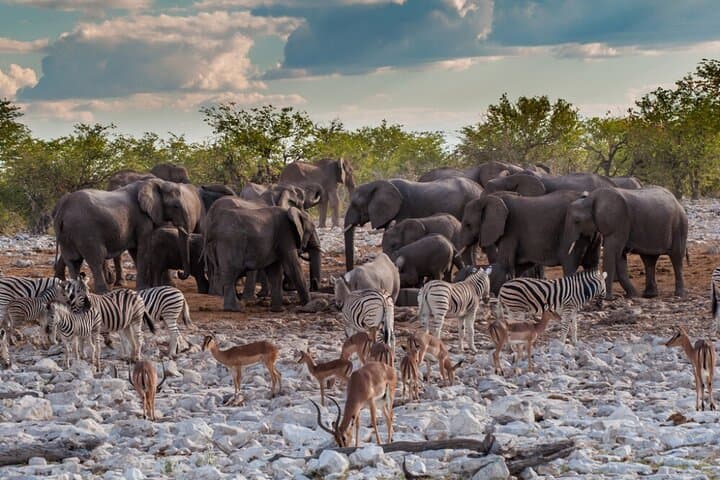
Culturally, this region links to Ovambo and Herero communities whose livelihoods and knowledge shape local guiding practices. Expect open savannah, scattered acacia and mopane woodland, and dramatic waterholes that attract elephants, lions, leopards, rhinos and buffalo—the Big Five—especially at dusk.
Practically, this multi-day safari combines two game drives per day (early morning and late afternoon), lodge nights at Okaukuejo, and transfers to/from Windhoek. Drives cover 20–80 km per outing across gravel roads; elevation hovers around 1,000–1,200 m, and terrain is generally flat but rough. Bring a telephoto lens or binoculars, layer for temperature swings, carry sun protection and at least 2 liters of water per person per day. Follow guides’ instructions around wildlife, keep noise low at waterholes, and plan photo batteries and memory cards—wildlife encounters can be sudden and sustained. With basic preparation, this three-day window delivers concentrated, accessible safari experience in one of Namibia’s signature reserves.
easy.
3 days.
Minimal fitness required—able to board vehicles and manage short walks; expect some dusty, bumpy travel.
Visa requirements depend on your nationality—check Namibia Immigration guidelines and ensure passport validity and any visa are sorted before travel.
This itinerary includes lodge stays and guided drives; confirm whether park entrance fees are included at booking or paid locally.
Routine vaccinations should be current; consult a travel clinic about hepatitis A, typhoid, and malaria prevention for northern Namibia.
Guides maintain safe viewing distances; you’ll observe from vehicles or designated viewpoints—never exit the vehicle without explicit permission.
Established in 1907 as a game reserve, Etosha’s name comes from the Oshindonga word for 'great white area' referring to the salt pan at its center, and the park has been central to Namibia’s conservation evolution.
Etosha’s management emphasizes anti-poaching, waterpoint management, and community partnerships; visitors help by following park rules and minimizing waste.
Knap Tours operates guided outdoor trips and adventures with an emphasis on safety, stewardship, and memorable experiences.

Dust lifts from the safari vehicle as dawn pries open the horizon over Etosha’s pale pan. The air is cool, the grass hard and low; a giraffe blinks across a scrubby ridge while a distant lion silhouette melts back into mopane trees. This is a place where water dictates movement and the land itself seems to watch.
Dust lifts from the safari vehicle as dawn pries open the horizon over Etosha’s pale pan. The air is cool, the grass hard and low; a giraffe blinks across a scrubby ridge while a distant lion silhouette melts back into mopane trees. This is a place where water dictates movement and the land itself seems to watch.
Etosha National Park sits on a shallow depression carved by geological shifts and inland drainage; the central salt pan is one of Africa’s largest, visible from space and home to a seasonally shifting ecology. European exploration and colonial hunting transformed the park in the early 20th century, but today Etosha is managed for conservation and community tourism, with camps like Okaukuejo serving as bases for guided game drives.
Culturally, this region links to Ovambo and Herero communities whose livelihoods and knowledge shape local guiding practices. Expect open savannah, scattered acacia and mopane woodland, and dramatic waterholes that attract elephants, lions, leopards, rhinos and buffalo—the Big Five—especially at dusk.
Practically, this multi-day safari combines two game drives per day (early morning and late afternoon), lodge nights at Okaukuejo, and transfers to/from Windhoek. Drives cover 20–80 km per outing across gravel roads; elevation hovers around 1,000–1,200 m, and terrain is generally flat but rough. Bring a telephoto lens or binoculars, layer for temperature swings, carry sun protection and at least 2 liters of water per person per day. Follow guides’ instructions around wildlife, keep noise low at waterholes, and plan photo batteries and memory cards—wildlife encounters can be sudden and sustained. With basic preparation, this three-day window delivers concentrated, accessible safari experience in one of Namibia’s signature reserves.