THE ADVENTURE COLLECTIVE® · Independent discovery and booking for outdoor travel

A compact three‑day circuit that pairs Angkor’s major temples with Phnom Kulen’s sacred riverbed and waterfall. Expect sunrise at Angkor, banyan‑entwined ruins, and a refreshing swim beneath Kulen’s falls.
A compact three‑day circuit that pairs Angkor’s major temples with Phnom Kulen’s sacred riverbed and waterfall. Expect sunrise at Angkor, banyan‑entwined ruins, and a refreshing swim beneath Kulen’s falls.
You step from the tuk‑tuk into a cool predawn haze and Angkor Wat’s silhouette slices the horizon—stone towers catching early light while the moat holds the sunrise like a mirror. Over three days the route moves from that hush to the banyan-strangled corridors of Ta Prohm, the carved pink faces of Banteay Srei, and up to Phnom Kulen where a riverbed of carved lingas and a roaring waterfall demand attention.
Verified experiences and guided adventures in the surrounding area.
Operated by Angkor Focus Travel · Siem Reap, Siem Reap Province
You step from the tuk‑tuk into a cool predawn haze and Angkor Wat’s silhouette slices the horizon—stone towers catching early light while the moat holds the sunrise like a mirror. Over three days the route moves from that hush to the banyan-strangled corridors of Ta Prohm, the carved pink faces of Banteay Srei, and up to Phnom Kulen where a riverbed of carved lingas and a roaring waterfall demand attention.
These sites span centuries: Rolous Group marks the 9th‑century beginnings of Khmer stone architecture; Angkor Wat and the Bayon showcase 11th–12th century imperial scale and relief work; Phnom Kulen (a forested massif rising to roughly 400–500 m) served as a sacred mountain where Khmer kings consecrated water and carved hundreds of lingas under the river. Local crafts thrive around Siem Reap—stone and wood carving traditions date back generations and are visible at Artisan D’Angkor.
Practical side: the itinerary includes long days in a private A/C vehicle, short climbs (Phnom Bakheng, viewpoints) and uneven temple steps. Expect 60+ km round trips to Kulen from Angkor Park and several hours on foot across temple complexes. Bring a valid Angkor pass (sold locally), sun protection, refillable water, and comfortable, grippy shoes for wet stone and root-strewn paths. Respect active shrines—cover shoulders and knees.
Timing matters: sunrise at Angkor is crowded but still worth the effort; waterfalls and the Kulen riverbed are best after light rain when the carvings are visible and pools are deeper. Your guide handles permits and navigation, leaving you to read the carvings and feel the current pull you toward the next discovery.
moderate.
3 days.
Moderate fitness: multiple hours of walking each day, short uphill climbs and uneven steps; comfortable pace provided.
The Angkor Park pass is purchased locally; this tour stops at the pass office so you can buy the required 1‑, 3‑ or 7‑day ticket before entry.
Swimming at Phnom Kulen is common after rains but follow your guide’s advice—currents and rocks can be hazardous after heavy rain.
Phnom Kulen is roughly 50–70 km from central Angkor/Siem Reap depending on route; expect a 1.5–2 hour drive each way by vehicle.
Many temple sites have uneven stone surfaces and steps; some areas are accessible by car but full access to central sanctuaries may be limited.
The Angkor complex grew from 9th–13th century Khmer capitals; Angkor Wat and Bayon reflect shifts from Hindu to Buddhist royal patronage.
Visitor numbers and water usage around Angkor and Kulen are managed through permit systems; stick to paths and avoid climbing fragile carvings to protect sites.
Angkor Focus Travel operates guided outdoor trips and adventures with an emphasis on safety, stewardship, and memorable experiences.
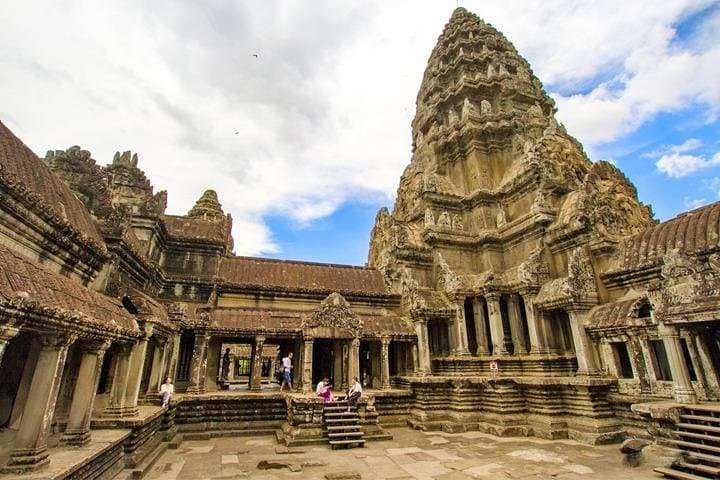


You step from the tuk‑tuk into a cool predawn haze and Angkor Wat’s silhouette slices the horizon—stone towers catching early light while the moat holds the sunrise like a mirror. Over three days the route moves from that hush to the banyan-strangled corridors of Ta Prohm, the carved pink faces of Banteay Srei, and up to Phnom Kulen where a riverbed of carved lingas and a roaring waterfall demand attention.
You step from the tuk‑tuk into a cool predawn haze and Angkor Wat’s silhouette slices the horizon—stone towers catching early light while the moat holds the sunrise like a mirror. Over three days the route moves from that hush to the banyan-strangled corridors of Ta Prohm, the carved pink faces of Banteay Srei, and up to Phnom Kulen where a riverbed of carved lingas and a roaring waterfall demand attention.
These sites span centuries: Rolous Group marks the 9th‑century beginnings of Khmer stone architecture; Angkor Wat and the Bayon showcase 11th–12th century imperial scale and relief work; Phnom Kulen (a forested massif rising to roughly 400–500 m) served as a sacred mountain where Khmer kings consecrated water and carved hundreds of lingas under the river. Local crafts thrive around Siem Reap—stone and wood carving traditions date back generations and are visible at Artisan D’Angkor.
Practical side: the itinerary includes long days in a private A/C vehicle, short climbs (Phnom Bakheng, viewpoints) and uneven temple steps. Expect 60+ km round trips to Kulen from Angkor Park and several hours on foot across temple complexes. Bring a valid Angkor pass (sold locally), sun protection, refillable water, and comfortable, grippy shoes for wet stone and root-strewn paths. Respect active shrines—cover shoulders and knees.
Timing matters: sunrise at Angkor is crowded but still worth the effort; waterfalls and the Kulen riverbed are best after light rain when the carvings are visible and pools are deeper. Your guide handles permits and navigation, leaving you to read the carvings and feel the current pull you toward the next discovery.