THE ADVENTURE COLLECTIVE® · Independent discovery and booking for outdoor travel

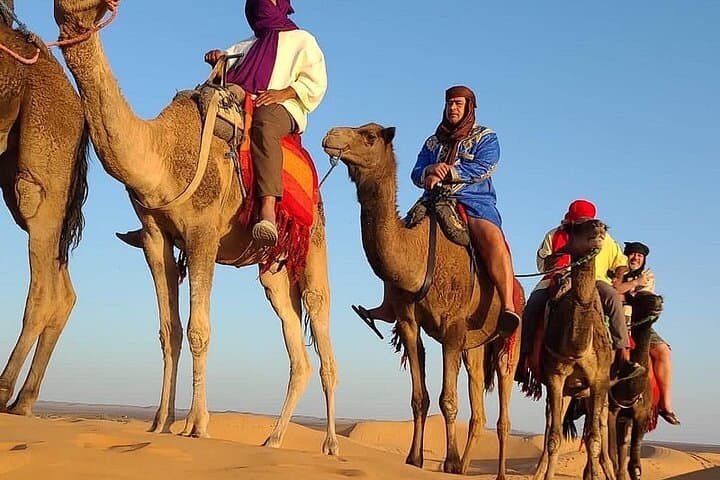
Two days from Marrakech carry you across the High Atlas to the ochre kasbah of Ait Ben Haddou and into the Zagora dunes for sunset and sunrise camel treks. Expect a night in a private Berber camp, simple meals, and photo-ready vistas.
Two days from Marrakech carry you across the High Atlas to the ochre kasbah of Ait Ben Haddou and into the Zagora dunes for sunset and sunrise camel treks. Expect a night in a private Berber camp, simple meals, and photo-ready vistas.
The minibus leaves Marrakech before dawn and pushes up into the High Atlas, where the road peels open to long, terracotta valleys and villages clinging to slopes. By midday the stone kasbahs of Ait Ben Haddou rise like an ancient film set; by sunset the dunes of Zagora sharpen into wind-scored ridges that invite a slow, deliberate pace.
Verified experiences and guided adventures in the surrounding area.
Operated by Morocco Daily Trip · Zagora, Drâa-Tafilalet
The minibus leaves Marrakech before dawn and pushes up into the High Atlas, where the road peels open to long, terracotta valleys and villages clinging to slopes. By midday the stone kasbahs of Ait Ben Haddou rise like an ancient film set; by sunset the dunes of Zagora sharpen into wind-scored ridges that invite a slow, deliberate pace.
Ait Ben Haddou sits on the old trans-Saharan route and has been rebuilt in mud-brick across centuries—its towers and alleys show traditional kasbah construction, adobe layers drying in the sun. The Draa Valley that follows is a green artery of date palms and ksour (fortified villages), shaped by the river that still whispers through oasis groves. Geologically, the journey crosses folded Atlas formations into the Saharan foothills where sand and sandstone replace the region’s earlier metamorphic rocks.
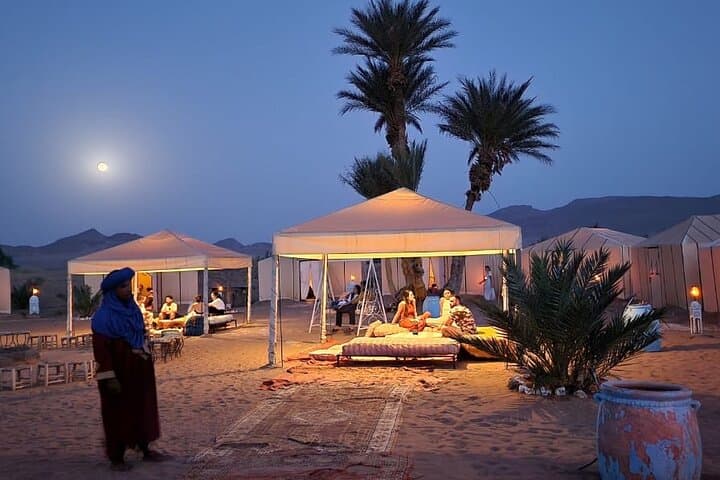
Culturally the tour offers a practical window: short guided time at the UNESCO site, a night in a private Berber camp under a wide sky, and two camel treks timed to sunset and sunrise. Expect simple tents, communal meals of tagine and mint tea, and vocal evening storytelling under stars.
Practical guidance: pack sun protection and a warm midlayer for desert nights, bring at least 2 liters of water for the day, and choose closed-toe shoes for dune walking. The camel rides are gentle but require mounting assistance; motion sensitivity can make the hour-long treks tiring. Mobile reception is intermittent; cash is useful for small purchases or tips. This two-day loop is compact—immersive desert time with logistical ease for travelers based in Marrakech.
moderate.
2 days (1 night).
Light to moderate fitness—able to walk on sand and tolerate 1–1.5 hour camel rides
Camel rides are paced and suitable for most travelers; expect 1–1.5 hours of sitting with occasional standing to mount/dismount.
Visits typically include free time to explore the UNESCO kasbah independently with photo stops; guided options vary by operator.
Accommodation is in a private Berber tented camp with shared facilities; expect simple bedding and communal dining.
Operators usually can handle basic dietary requests if informed at booking; communicate allergies or restrictions in advance.
Ait Ben Haddou guarded a key trans-Saharan caravan route and later became a frequent film location—its mud-brick architecture reflects centuries of fortified village building.
The Sahara’s dune ecosystems are fragile—avoid trampling vegetated areas, use packed campsites, and minimize water waste; support local communities by hiring licensed guides.
Morocco Daily Trip operates guided outdoor trips and adventures with an emphasis on safety, stewardship, and memorable experiences.


The minibus leaves Marrakech before dawn and pushes up into the High Atlas, where the road peels open to long, terracotta valleys and villages clinging to slopes. By midday the stone kasbahs of Ait Ben Haddou rise like an ancient film set; by sunset the dunes of Zagora sharpen into wind-scored ridges that invite a slow, deliberate pace.
The minibus leaves Marrakech before dawn and pushes up into the High Atlas, where the road peels open to long, terracotta valleys and villages clinging to slopes. By midday the stone kasbahs of Ait Ben Haddou rise like an ancient film set; by sunset the dunes of Zagora sharpen into wind-scored ridges that invite a slow, deliberate pace.
Ait Ben Haddou sits on the old trans-Saharan route and has been rebuilt in mud-brick across centuries—its towers and alleys show traditional kasbah construction, adobe layers drying in the sun. The Draa Valley that follows is a green artery of date palms and ksour (fortified villages), shaped by the river that still whispers through oasis groves. Geologically, the journey crosses folded Atlas formations into the Saharan foothills where sand and sandstone replace the region’s earlier metamorphic rocks.
Culturally the tour offers a practical window: short guided time at the UNESCO site, a night in a private Berber camp under a wide sky, and two camel treks timed to sunset and sunrise. Expect simple tents, communal meals of tagine and mint tea, and vocal evening storytelling under stars.
Practical guidance: pack sun protection and a warm midlayer for desert nights, bring at least 2 liters of water for the day, and choose closed-toe shoes for dune walking. The camel rides are gentle but require mounting assistance; motion sensitivity can make the hour-long treks tiring. Mobile reception is intermittent; cash is useful for small purchases or tips. This two-day loop is compact—immersive desert time with logistical ease for travelers based in Marrakech.