THE ADVENTURE COLLECTIVE® · Independent discovery and booking for outdoor travel

A compact private itinerary that pairs Jerash’s Roman streets, the buoyant Dead Sea and Petra’s carved rose-red façades into two action-packed days. Travel in comfort with a private driver and custom pacing for history, geology and desert panoramas.
A compact private itinerary that pairs Jerash’s Roman streets, the buoyant Dead Sea and Petra’s carved rose-red façades into two action-packed days. Travel in comfort with a private driver and custom pacing for history, geology and desert panoramas.
You step into morning light on a quiet Amman street and, within an hour, the Roman columns of Jerash rise like a staged scene — columns aligned, theaters catching the echo of your footsteps. The driver eases the air-conditioned vehicle along Highway 35; the Dead Sea shimmers low and metallic on the horizon, daring you to float where the land itself falls away.
Verified experiences and guided adventures in the surrounding area.
Operated by Elegant Limo Jordan · Wadi Musa, Ma'an Governorate
You step into morning light on a quiet Amman street and, within an hour, the Roman columns of Jerash rise like a staged scene — columns aligned, theaters catching the echo of your footsteps. The driver eases the air-conditioned vehicle along Highway 35; the Dead Sea shimmers low and metallic on the horizon, daring you to float where the land itself falls away.
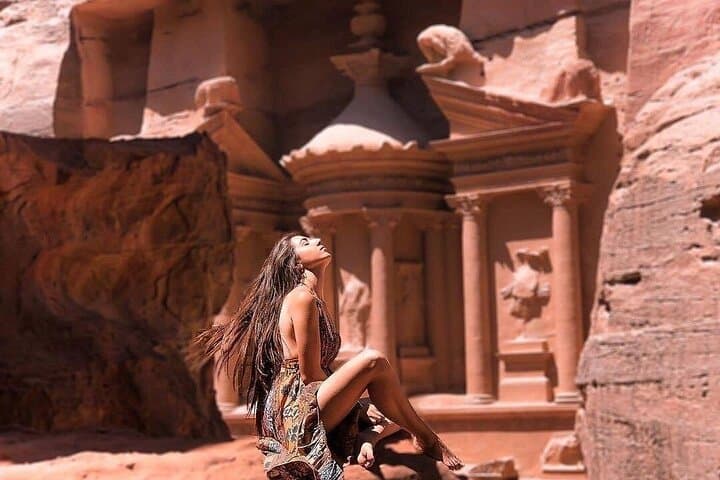
Jerash is a story of stone and empire: broad cardo and oval plazas that map Roman urban life across roughly 1–2 km of excavated ruins. Geology takes over southbound — the route drops toward the Dead Sea at about 430 meters below sea level, a basin of dense, salty waters and mineral muds used for centuries for therapeutic bathing. Day two shifts to Petra, the Nabataean city carved into sandstone. The Siq narrows for about 1.2 km before the Treasury reveals itself; for a fuller circuit to the Monastery expect steep stone stairways and roughly 200–300 m of ascent if you climb higher viewpoints.
Cultural notes: Jerash’s columns and Petra’s façades reflect two very different engineering traditions, while local Bedouin communities around Wadi Musa keep oral histories and craft traditions alive.
Practical guidance: carry sun protection and a 1–2 liter water bottle per person, wear good treaded shoes for uneven carved rock and steps, and plan early starts to avoid midday heat. Bring swimwear for the Dead Sea and a small fee for site entrances (Jordan Pass can simplify admissions). Expect moderate walking with many photo stops, a private driver for comfort, and flexible drop-off back to Amman or the airport.
moderate.
2 days.
Suitable for travelers with basic fitness who can walk 3–6 km over uneven ground and climb stone steps; not a technical trek.
Entrance fees are typically not included; purchasing the Jordan Pass in advance can cover Petra admission and streamline entry.
Driving time from Amman to Petra is about 3 to 3.5 hours (approximately 230–260 km) depending on traffic and route.
The private format allows customization—note dietary restrictions and mobility requirements when booking so the operator can arrange suitable hotels and shorter walking options.
Spring (March–May) and fall (September–November) offer milder temperatures for walking; summers are hot and winters can be cool, especially at night.
Jerash preserves one of the largest Roman provincial cities while Petra represents the Nabataean mastery of carving monumental facades into sandstone cliffs over 2,000 years ago.
High visitor numbers and fragile sandstone mean stick to marked paths, avoid touching carved surfaces, and support local guides and conservation fees when offered.
Elegant Limo Jordan operates guided outdoor trips and adventures with an emphasis on safety, stewardship, and memorable experiences.


You step into morning light on a quiet Amman street and, within an hour, the Roman columns of Jerash rise like a staged scene — columns aligned, theaters catching the echo of your footsteps. The driver eases the air-conditioned vehicle along Highway 35; the Dead Sea shimmers low and metallic on the horizon, daring you to float where the land itself falls away.
You step into morning light on a quiet Amman street and, within an hour, the Roman columns of Jerash rise like a staged scene — columns aligned, theaters catching the echo of your footsteps. The driver eases the air-conditioned vehicle along Highway 35; the Dead Sea shimmers low and metallic on the horizon, daring you to float where the land itself falls away.
Jerash is a story of stone and empire: broad cardo and oval plazas that map Roman urban life across roughly 1–2 km of excavated ruins. Geology takes over southbound — the route drops toward the Dead Sea at about 430 meters below sea level, a basin of dense, salty waters and mineral muds used for centuries for therapeutic bathing. Day two shifts to Petra, the Nabataean city carved into sandstone. The Siq narrows for about 1.2 km before the Treasury reveals itself; for a fuller circuit to the Monastery expect steep stone stairways and roughly 200–300 m of ascent if you climb higher viewpoints.
Cultural notes: Jerash’s columns and Petra’s façades reflect two very different engineering traditions, while local Bedouin communities around Wadi Musa keep oral histories and craft traditions alive.
Practical guidance: carry sun protection and a 1–2 liter water bottle per person, wear good treaded shoes for uneven carved rock and steps, and plan early starts to avoid midday heat. Bring swimwear for the Dead Sea and a small fee for site entrances (Jordan Pass can simplify admissions). Expect moderate walking with many photo stops, a private driver for comfort, and flexible drop-off back to Amman or the airport.