THE ADVENTURE COLLECTIVE® · Independent discovery and booking for outdoor travel

Drive the High Atlas, walk the ramparts of Aït Benhaddou and spend a night in a private bivouac on the Zagora dunes. This 2-day trip pairs cultural stops with a short camel trek and stargazing in the southern Moroccan desert.
Drive the High Atlas, walk the ramparts of Aït Benhaddou and spend a night in a private bivouac on the Zagora dunes. This 2-day trip pairs cultural stops with a short camel trek and stargazing in the southern Moroccan desert.
You leave Marrakech before dawn and the city’s ochre walls fall away as the 4x4 claws up Tizi n’Tichka. The pass breathes cold air at roughly 2,260 m, then the road descends into a sharper light: the Draa Valley opens with palm groves, mud-brick villages and the silhouette of Aït Benhaddou on the skyline.
Verified experiences and guided adventures in the surrounding area.
Operated by KARIM SAHARA PRESTIGE · Zagora, Drâa-Tafilalet
You leave Marrakech before dawn and the city’s ochre walls fall away as the 4x4 claws up Tizi n’Tichka. The pass breathes cold air at roughly 2,260 m, then the road descends into a sharper light: the Draa Valley opens with palm groves, mud-brick villages and the silhouette of Aït Benhaddou on the skyline.
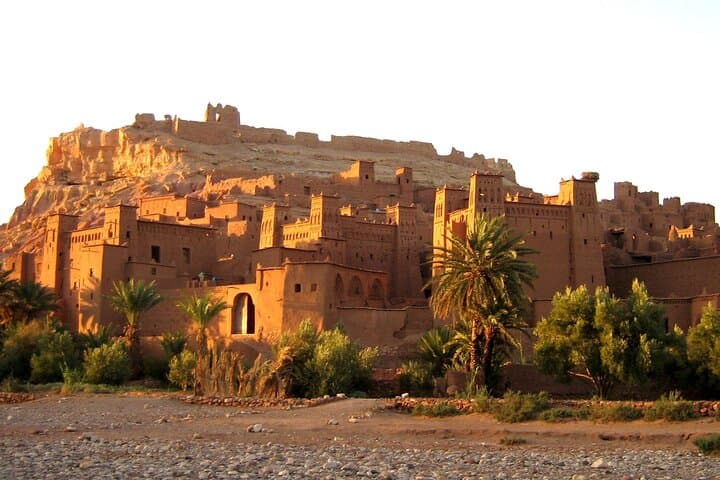
Aït Benhaddou is more than a film set — it’s an ancient ksar on the caravan route between the Sahara and the Atlas. Geologically the route traces folded High Atlas strata; to the south the landscape softens into alluvial terraces and the red-gold ridges of the Erg N’Khila outside Zagora. Culture here is Berber and Saharan: tents, tea rituals and evening drummers set a steady pace for desert time.
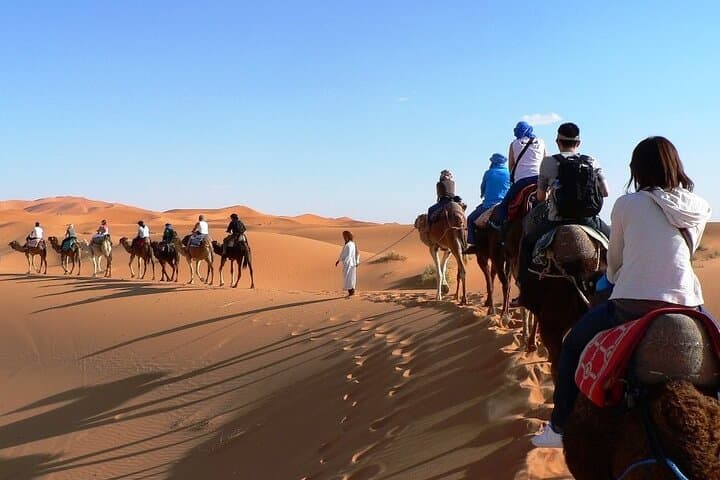
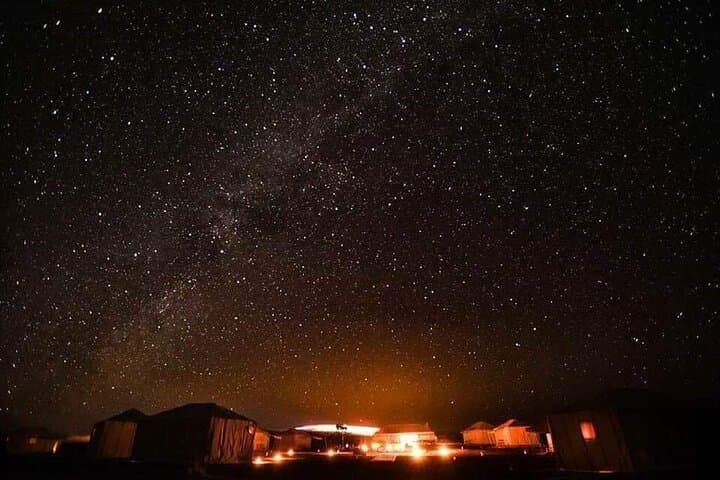
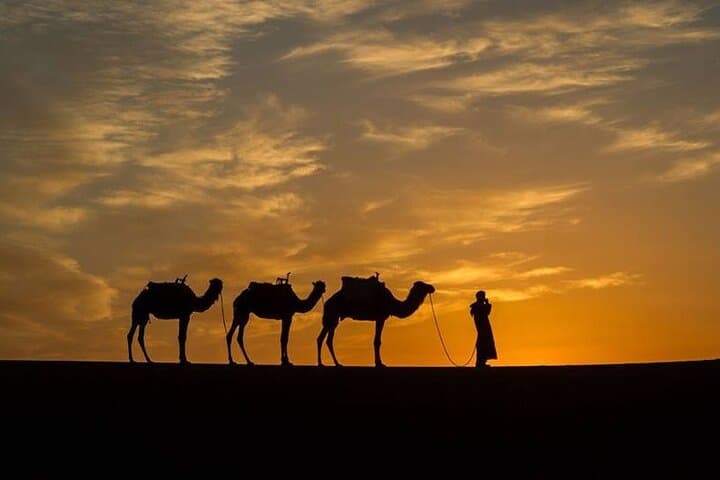
You’ll arrive at a private bivouac to stake out a canvas tent, then climb a gentle dune for a one-hour camel trek at sunset. Dinner is communal under a big tent; later, the sky is surprisingly close — a clean, jeweled bowl of stars.
Practical notes: the drive is long (6–8 hours each way with stops) so plan for a full two-day rhythm rather than a brisk outing. Temperatures swing widely — hot daytime sun, chilly nights — so bring layers, sun protection and at least 2–3 liters of water per person. Footing on dunes is soft; good closed-toe shoes make short walks easier. Mobility-friendly transport is offered, but sand and camels require moderate mobility. Carry cash for tips and small purchases in villages. With basic planning the trip is an accessible, atmospheric overnight that combines Atlas scenery, UNESCO heritage and a genuine desert bivouac.
easy.
2 days / 1 night.
Suitable for travelers in basic physical condition; requires getting on/off a camel and short walks on soft sand
Expect about 6–8 hours of driving each way with stops, crossing the Tizi n’Tichka pass and the Draa Valley; itineraries include scheduled breaks.
Yes—this tour includes lunch on both days, dinner at the bivouac and breakfast the following morning as described in the itinerary.
The camel trek provided is typically around one hour and suitable for beginners; mounting a camel requires basic mobility and staff assistance is usually available.
Signal is intermittent in the dunes and at rural bivouacs; most camps do not offer reliable Wi‑Fi—treat this as an opportunity to disconnect.
Aït Benhaddou grew as a fortified ksar on trans-Saharan caravan routes and later attracted film crews; the Zagora region sits at the edge of Saharan trade and cultural exchange.
The desert is ecologically fragile—stick to marked tracks, minimize campfire impact and pack out waste; water is a precious local resource so conserve and source locally where possible.
KARIM SAHARA PRESTIGE operates guided outdoor trips and adventures with an emphasis on safety, stewardship, and memorable experiences.
You leave Marrakech before dawn and the city’s ochre walls fall away as the 4x4 claws up Tizi n’Tichka. The pass breathes cold air at roughly 2,260 m, then the road descends into a sharper light: the Draa Valley opens with palm groves, mud-brick villages and the silhouette of Aït Benhaddou on the skyline.
You leave Marrakech before dawn and the city’s ochre walls fall away as the 4x4 claws up Tizi n’Tichka. The pass breathes cold air at roughly 2,260 m, then the road descends into a sharper light: the Draa Valley opens with palm groves, mud-brick villages and the silhouette of Aït Benhaddou on the skyline.
Aït Benhaddou is more than a film set — it’s an ancient ksar on the caravan route between the Sahara and the Atlas. Geologically the route traces folded High Atlas strata; to the south the landscape softens into alluvial terraces and the red-gold ridges of the Erg N’Khila outside Zagora. Culture here is Berber and Saharan: tents, tea rituals and evening drummers set a steady pace for desert time.
You’ll arrive at a private bivouac to stake out a canvas tent, then climb a gentle dune for a one-hour camel trek at sunset. Dinner is communal under a big tent; later, the sky is surprisingly close — a clean, jeweled bowl of stars.
Practical notes: the drive is long (6–8 hours each way with stops) so plan for a full two-day rhythm rather than a brisk outing. Temperatures swing widely — hot daytime sun, chilly nights — so bring layers, sun protection and at least 2–3 liters of water per person. Footing on dunes is soft; good closed-toe shoes make short walks easier. Mobility-friendly transport is offered, but sand and camels require moderate mobility. Carry cash for tips and small purchases in villages. With basic planning the trip is an accessible, atmospheric overnight that combines Atlas scenery, UNESCO heritage and a genuine desert bivouac.