THE ADVENTURE COLLECTIVE® · Independent discovery and booking for outdoor travel

Two compact days connect Giza’s monumental pyramids with Alexandria’s seaside history. A private guide, air-conditioned transport and planned visits make this a high-value cultural loop for first-time visitors to Egypt.
Two compact days connect Giza’s monumental pyramids with Alexandria’s seaside history. A private guide, air-conditioned transport and planned visits make this a high-value cultural loop for first-time visitors to Egypt.
Standing on the Giza plateau, the air carries sand and a distant hum of the city; the three great pyramids rise like weathered architects, their faces catching the sun while the Sphinx watches the slow parade of visitors. By the next day the Mediterranean replaces the desert—salt wind and seagulls at the Citadel of Qaitbay—offering a sharp change in atmosphere that defines this two-day private circuit.
Verified experiences and guided adventures in the surrounding area.
Operated by HorizonTravel · Cairo, Cairo Governorate
Standing on the Giza plateau, the air carries sand and a distant hum of the city; the three great pyramids rise like weathered architects, their faces catching the sun while the Sphinx watches the slow parade of visitors. By the next day the Mediterranean replaces the desert—salt wind and seagulls at the Citadel of Qaitbay—offering a sharp change in atmosphere that defines this two-day private circuit.
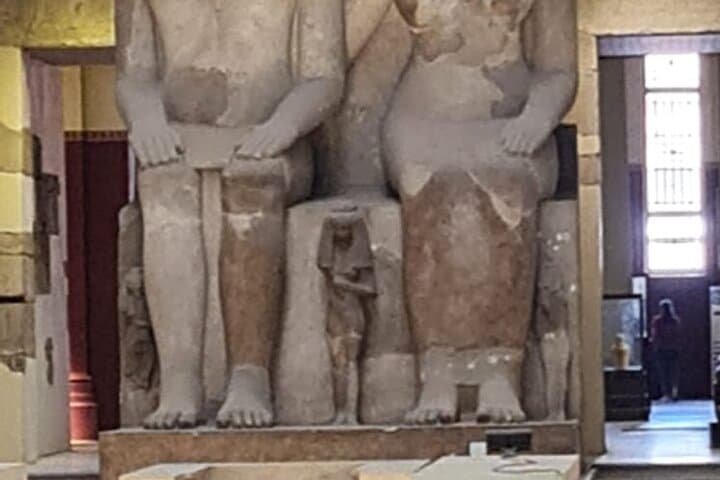
This itinerary threads together Egypt’s long arc: Old Kingdom stonework at Giza, pharaonic treasures in the Egyptian Museum from millennia of burials, medieval trade routes winding through Khan El-Khalili, and Alexandria’s Greco-Roman and later Mamluk layers at Pompey’s Pillar and Qaitbay. Geologically, the Giza stones are limestone beds quarried locally; Alexandria sits on an erosive Mediterranean coast overlaying Hellenistic ruins.
Culturally the days move from public monuments to intimate markets—expect vocal bargaining and small tea houses where everyday Cairo life shows itself. The drive to Alexandria takes roughly 2.5–3 hours each way by highway; in-city transfers are by air-conditioned vehicle. Walking surfaces vary: compacted sand and uneven limestone at Giza, museum floors and crowded bazaar alleys, and narrow staircases in Kom el Shoqafa catacombs.
Practical guidance: start early to beat heat and crowds, wear sturdy closed-toe shoes, carry a refillable water bottle, and keep a photocopy of your passport for museum entry. Plan for long periods standing and short walking bursts between sites; comfortable pacing and a private guide make the difference between a checklist and an actual understanding of centuries of history.
easy.
2 days (approx. 8–10 hours per day).
Suitable for most fitness levels; involves walking on uneven surfaces, standing for extended periods, and short stair descents in catacombs.
Expect about 2.5–3 hours each way on the desert highway, depending on traffic and stops.
Some admissions (like the Khan El Khalili visit listed) are included; check booking details and bring cash or card for any additional site tickets or optional entries.
Yes—this private tour is rated easy and suitable for most ages, though it involves walking and some staircases; inform the operator of mobility needs in advance.
Bring a passport copy, modest clothing for mosque visits (shoulders and knees covered), and small bills for photography fees or donations.
The Great Pyramid of Khufu dates to circa 2560 BCE and exemplifies Old Kingdom funerary architecture; Alexandria later grew into a major Hellenistic hub with a famed ancient library.
High visitor numbers can stress fragile archaeological sites—follow barriers, avoid touching ancient stonework, and use licensed guides to support responsible tourism.
HorizonTravel operates guided outdoor trips and adventures with an emphasis on safety, stewardship, and memorable experiences.


Standing on the Giza plateau, the air carries sand and a distant hum of the city; the three great pyramids rise like weathered architects, their faces catching the sun while the Sphinx watches the slow parade of visitors. By the next day the Mediterranean replaces the desert—salt wind and seagulls at the Citadel of Qaitbay—offering a sharp change in atmosphere that defines this two-day private circuit.
Standing on the Giza plateau, the air carries sand and a distant hum of the city; the three great pyramids rise like weathered architects, their faces catching the sun while the Sphinx watches the slow parade of visitors. By the next day the Mediterranean replaces the desert—salt wind and seagulls at the Citadel of Qaitbay—offering a sharp change in atmosphere that defines this two-day private circuit.
This itinerary threads together Egypt’s long arc: Old Kingdom stonework at Giza, pharaonic treasures in the Egyptian Museum from millennia of burials, medieval trade routes winding through Khan El-Khalili, and Alexandria’s Greco-Roman and later Mamluk layers at Pompey’s Pillar and Qaitbay. Geologically, the Giza stones are limestone beds quarried locally; Alexandria sits on an erosive Mediterranean coast overlaying Hellenistic ruins.
Culturally the days move from public monuments to intimate markets—expect vocal bargaining and small tea houses where everyday Cairo life shows itself. The drive to Alexandria takes roughly 2.5–3 hours each way by highway; in-city transfers are by air-conditioned vehicle. Walking surfaces vary: compacted sand and uneven limestone at Giza, museum floors and crowded bazaar alleys, and narrow staircases in Kom el Shoqafa catacombs.
Practical guidance: start early to beat heat and crowds, wear sturdy closed-toe shoes, carry a refillable water bottle, and keep a photocopy of your passport for museum entry. Plan for long periods standing and short walking bursts between sites; comfortable pacing and a private guide make the difference between a checklist and an actual understanding of centuries of history.