THE ADVENTURE COLLECTIVE® · Independent discovery and booking for outdoor travel

Ride camels into an erg, sleep in a fixed bivouac or beneath open sky, and wash in a traditional hammam on this accessible two-day Saharan escape. It’s a short, sensory immersion in Sahrawi culture and sweeping desert landscapes.
Ride camels into an erg, sleep in a fixed bivouac or beneath open sky, and wash in a traditional hammam on this accessible two-day Saharan escape. It’s a short, sensory immersion in Sahrawi culture and sweeping desert landscapes.
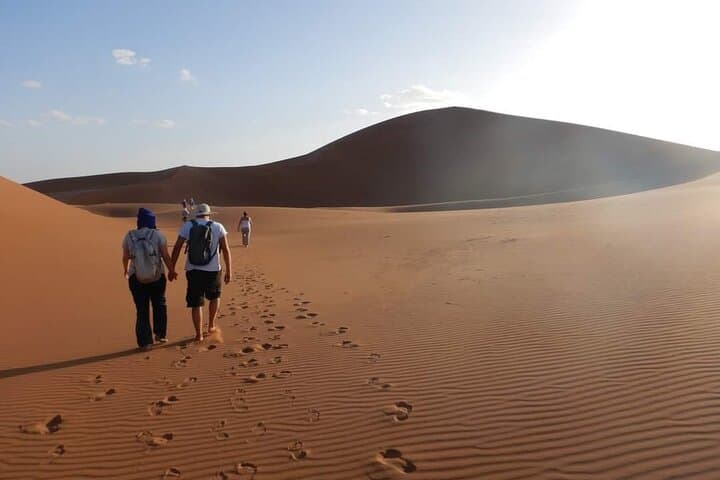
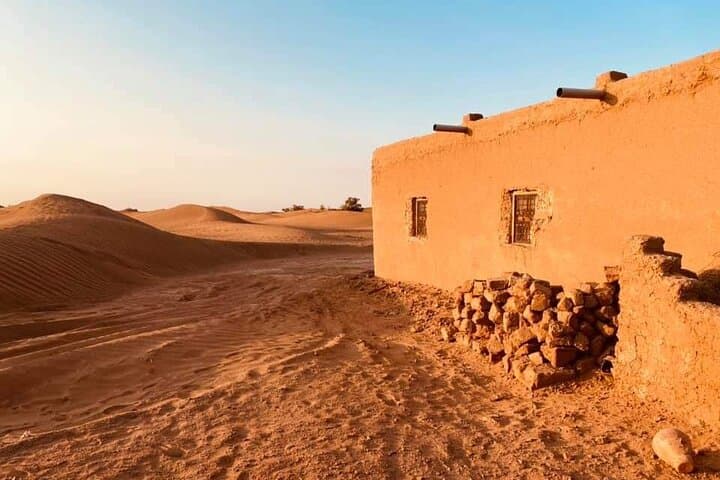
Late-afternoon light thins to gold as camels file out of Mhamid El Ghizlane and the village shrinks behind a line of date palms. The first slow climb onto an erg—an ocean of wind-sculpted sand—sets the rhythm: measured steps, a low creak of saddles, and a silence that seems to listen back. At the fixed bivouac, tent doors open onto a horizon that empties into stars; a small group gathers around a fire while local musicians sing Sahrawi songs.
Verified experiences and guided adventures in the surrounding area.
Operated by Mélodie du désert · Mhamid El Ghizlane, Drâa-Tafilalet
Late-afternoon light thins to gold as camels file out of Mhamid El Ghizlane and the village shrinks behind a line of date palms. The first slow climb onto an erg—an ocean of wind-sculpted sand—sets the rhythm: measured steps, a low creak of saddles, and a silence that seems to listen back. At the fixed bivouac, tent doors open onto a horizon that empties into stars; a small group gathers around a fire while local musicians sing Sahrawi songs.
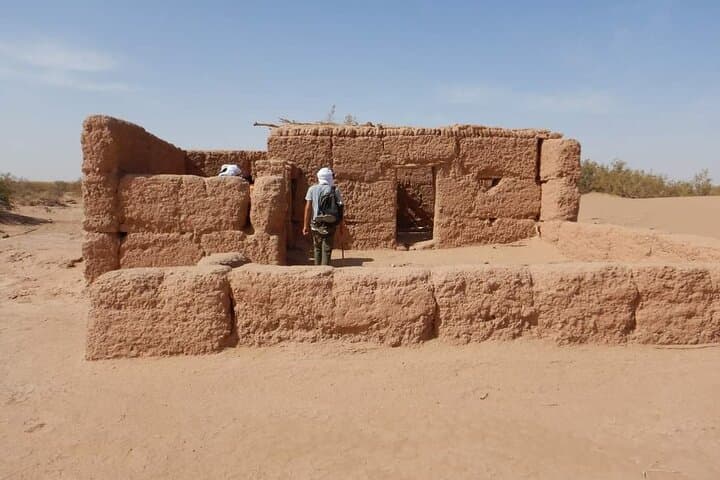
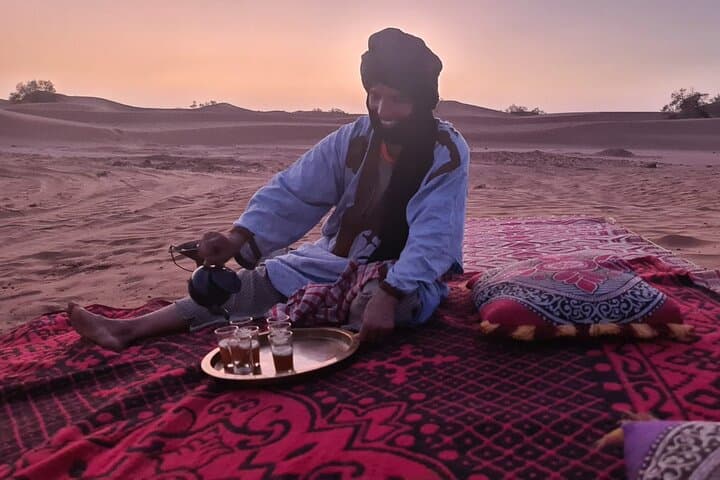
This two-day excursion follows routes once used by nomadic caravans along the Drâa corridor. Geologically, the erg is recent in Saharan terms, a field of mobile dunes shaped by persistent trade winds that continue to push and re-form ridgelines. Culturally, the trip is a compact introduction to Sahrawi hospitality—shared meals, a traditional hammam at the bivouac, and stories exchanged beside the flame.
Practicalities are straightforward: departures from Mhamid are mid-afternoon with return the next day around 2 p.m., and options to ride or walk are built into the itinerary. Expect soft-sand walking and short dune hikes (roughly 2–4 km across uneven, yielding sand). The bivouac offers basic comforts—showers, toilets, electricity—and choices between tented accommodation or sleeping under the stars. Bring sun protection, ample water, and sturdy shoes for sand travel; evenings can be cool.
For photographers and slow walkers, sunrise and sunset are the focus; for those craving cultural context, the hammam and campfire songs provide a direct line to local life. This is an accessible, low‑technical two-day slice of the Sahara designed for easy immersion rather than endurance.
easy.
2 days.
Suitable for most fitness levels; brief walks on soft sand require basic mobility and balance
Both options are offered—participants may choose camel rides for travel between village and bivouac or walk alongside the caravan for a more active experience.
The fixed bivouac provides showers, toilets, electricity, a hammam, and tented accommodation or the option to sleep under the stars.
Yes—departures from Marrakech and Ouarzazate are possible on request, though travel time to Mhamid varies and may require additional logistics.
The itinerary is described as suitable for all fitness levels; children and older travelers should consider camel comfort and sand walking but can participate with basic mobility.
Mhamid sits at the terminus of historic caravan routes that connected Saharan trade across the Drâa valley; Sahrawi culture remains central to camp life and music.
The erg’s dunes are ecologically fragile—avoid driving on vegetated areas, minimize water use, and follow hosts’ waste‑management practices to reduce impact.
Mélodie du désert operates guided outdoor trips and adventures with an emphasis on safety, stewardship, and memorable experiences.
Late-afternoon light thins to gold as camels file out of Mhamid El Ghizlane and the village shrinks behind a line of date palms. The first slow climb onto an erg—an ocean of wind-sculpted sand—sets the rhythm: measured steps, a low creak of saddles, and a silence that seems to listen back. At the fixed bivouac, tent doors open onto a horizon that empties into stars; a small group gathers around a fire while local musicians sing Sahrawi songs.
Late-afternoon light thins to gold as camels file out of Mhamid El Ghizlane and the village shrinks behind a line of date palms. The first slow climb onto an erg—an ocean of wind-sculpted sand—sets the rhythm: measured steps, a low creak of saddles, and a silence that seems to listen back. At the fixed bivouac, tent doors open onto a horizon that empties into stars; a small group gathers around a fire while local musicians sing Sahrawi songs.
This two-day excursion follows routes once used by nomadic caravans along the Drâa corridor. Geologically, the erg is recent in Saharan terms, a field of mobile dunes shaped by persistent trade winds that continue to push and re-form ridgelines. Culturally, the trip is a compact introduction to Sahrawi hospitality—shared meals, a traditional hammam at the bivouac, and stories exchanged beside the flame.
Practicalities are straightforward: departures from Mhamid are mid-afternoon with return the next day around 2 p.m., and options to ride or walk are built into the itinerary. Expect soft-sand walking and short dune hikes (roughly 2–4 km across uneven, yielding sand). The bivouac offers basic comforts—showers, toilets, electricity—and choices between tented accommodation or sleeping under the stars. Bring sun protection, ample water, and sturdy shoes for sand travel; evenings can be cool.
For photographers and slow walkers, sunrise and sunset are the focus; for those craving cultural context, the hammam and campfire songs provide a direct line to local life. This is an accessible, low‑technical two-day slice of the Sahara designed for easy immersion rather than endurance.