THE ADVENTURE COLLECTIVE® · Independent discovery and booking for outdoor travel

A compact two-day circuit from Marrakech to Zagora that blends High Atlas passes, the fortified ksar of Ait Ben Haddou, the palm-lined Draa Valley and an overnight bivouac with camel transfer. Ideal for travelers seeking an accessible desert night without a long expedition.
A compact two-day circuit from Marrakech to Zagora that blends High Atlas passes, the fortified ksar of Ait Ben Haddou, the palm-lined Draa Valley and an overnight bivouac with camel transfer. Ideal for travelers seeking an accessible desert night without a long expedition.
You step out of an air-conditioned van and the desert stretches like an idea you can walk into: dunes rippling gold, a line of rust-red kasbahs on the horizon, and the Kasbah of Ait Ben Haddou keeping watch over the road.
Verified experiences and guided adventures in the surrounding area.
Operated by Gouaghdime Tours · Zagora, Drâa-Tafilalet
You step out of an air-conditioned van and the desert stretches like an idea you can walk into: dunes rippling gold, a line of rust-red kasbahs on the horizon, and the Kasbah of Ait Ben Haddou keeping watch over the road.
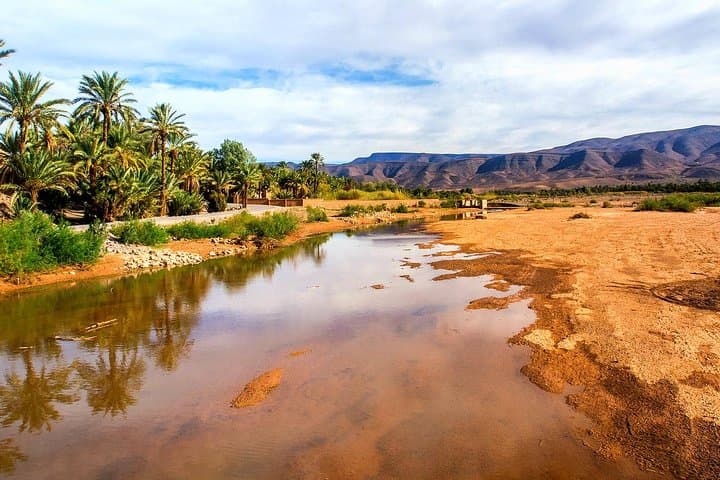
The route follows centuries-old caravan corridors. Tizi n’Tichka, a high Atlas pass carved through folded Precambrian and Mesozoic rock at 2,260 m, gives way to the ochre architecture of Telouet and the mud-brick granaries of Ait Ben Haddou — a UNESCO ksar that guarded trans-Saharan trade. Descending into the Anti-Atlas and the Draa Valley, the landscape softens into palm-lined irrigation channels where Berber villages cluster and date palms march along the riverbed.
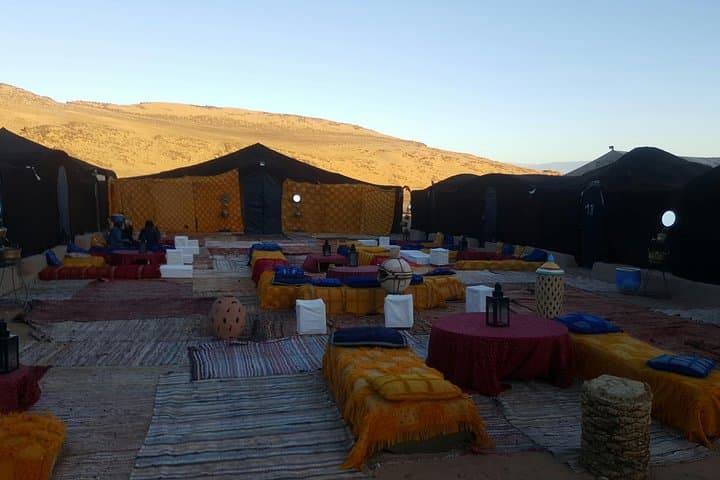
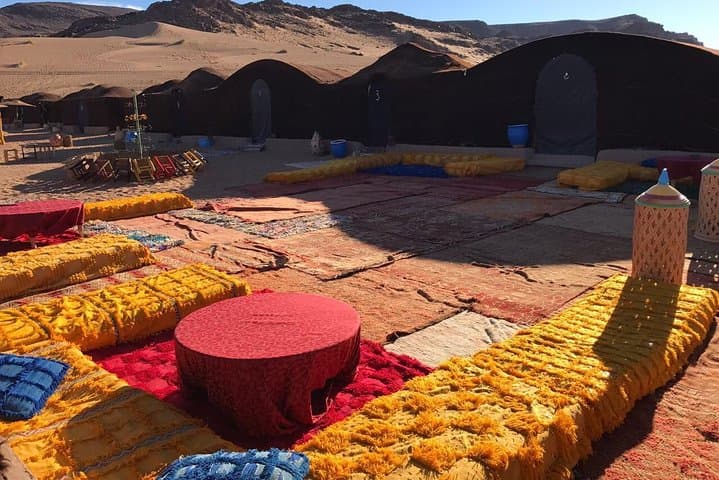
Culture here is practical and hospitable: Berber guides and families run the bivouacs, serving tagine and mint tea beneath a sky that goes cold fast after sunset. Geologically the valley is fertile because of alluvial deposits from the High Atlas; ecologically it’s an arid mosaic of oasis and scrub.
Practical guidance: the tour is a lot of road time balanced with short walks and a camel transfer to the bivouac. Expect long drives (roughly 10–12 hours total across two days), dusty conditions, and big temperature swings — bring layered clothing, sun protection and plenty of water. If you want photos, plan sunrise or the hour before sunset for the best light and cooler conditions.
This itinerary suits travelers who want a compact exposure to Atlas passes, kasbah architecture and an authentic desert night under tented skies.
moderate.
2 days (approx. 48 hours).
Suitable for travelers in average fitness: mostly long drives with short walks and a camel ride—not strenuous but expect uneven sand and steps.
Yes — the tour includes half-board at the bivouac: dinner the first night and breakfast the next morning; lunch is typically on the road or at stops like Ait Ben Haddou.
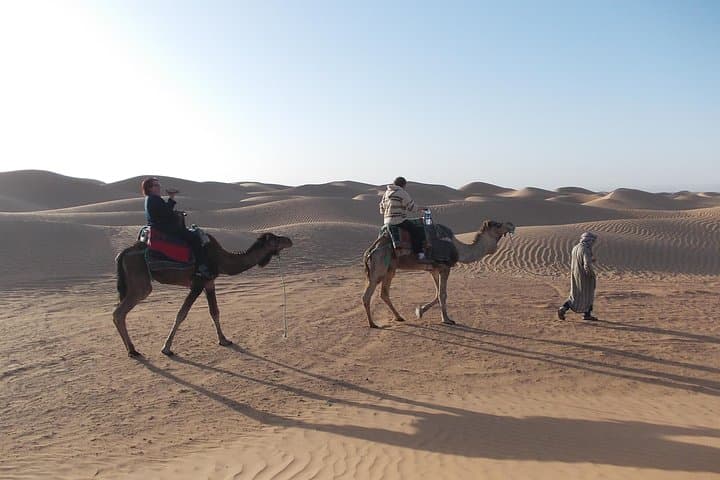
The camel ride is part of the desert transfer to the bivouac and is included; participants who prefer may walk short stretches or ride in a support vehicle when available.
Pickup and drop-off are provided from central Marrakech hotels as part of the tour; specific pickup points are confirmed after booking.
Bring a small overnight bag for the bivouac; larger suitcases should remain in the vehicle for safety and comfort.
The route traces trans-Saharan trading arteries; Ait Ben Haddou served as a fortified caravan stop and many kasbahs reflect centuries of Berber and Saharan commerce.
Water is scarce in the Draa Valley—follow local guidance about waste and avoid using single-use plastics; support community-run bivouacs to help local economies.
Gouaghdime Tours operates guided outdoor trips and adventures with an emphasis on safety, stewardship, and memorable experiences.
You step out of an air-conditioned van and the desert stretches like an idea you can walk into: dunes rippling gold, a line of rust-red kasbahs on the horizon, and the Kasbah of Ait Ben Haddou keeping watch over the road.
You step out of an air-conditioned van and the desert stretches like an idea you can walk into: dunes rippling gold, a line of rust-red kasbahs on the horizon, and the Kasbah of Ait Ben Haddou keeping watch over the road.
The route follows centuries-old caravan corridors. Tizi n’Tichka, a high Atlas pass carved through folded Precambrian and Mesozoic rock at 2,260 m, gives way to the ochre architecture of Telouet and the mud-brick granaries of Ait Ben Haddou — a UNESCO ksar that guarded trans-Saharan trade. Descending into the Anti-Atlas and the Draa Valley, the landscape softens into palm-lined irrigation channels where Berber villages cluster and date palms march along the riverbed.
Culture here is practical and hospitable: Berber guides and families run the bivouacs, serving tagine and mint tea beneath a sky that goes cold fast after sunset. Geologically the valley is fertile because of alluvial deposits from the High Atlas; ecologically it’s an arid mosaic of oasis and scrub.
Practical guidance: the tour is a lot of road time balanced with short walks and a camel transfer to the bivouac. Expect long drives (roughly 10–12 hours total across two days), dusty conditions, and big temperature swings — bring layered clothing, sun protection and plenty of water. If you want photos, plan sunrise or the hour before sunset for the best light and cooler conditions.
This itinerary suits travelers who want a compact exposure to Atlas passes, kasbah architecture and an authentic desert night under tented skies.