THE ADVENTURE COLLECTIVE® · Independent discovery and booking for outdoor travel

Travel from Lima to the Supe Valley on a compact archaeological journey to Caral and Peñico, two of the Americas’ oldest citadels. This 2-day tour pairs expert guides and a lodge stay for an accessible, immersive look at 5,000-year-old urban life.
Travel from Lima to the Supe Valley on a compact archaeological journey to Caral and Peñico, two of the Americas’ oldest citadels. This 2-day tour pairs expert guides and a lodge stay for an accessible, immersive look at 5,000-year-old urban life.
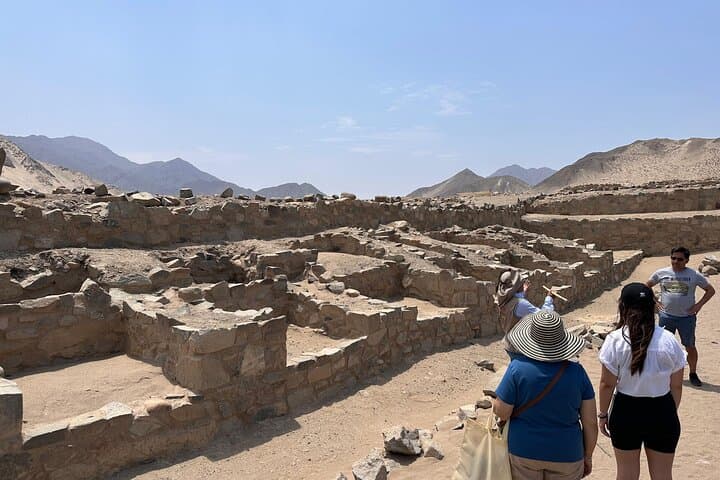
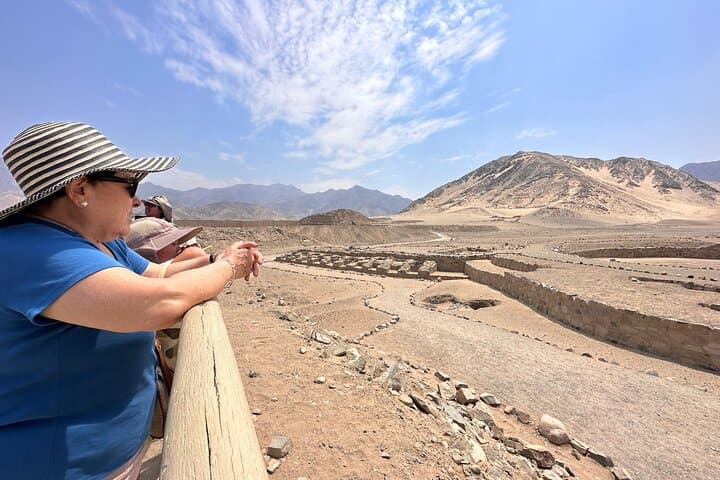
You leave Lima before dawn and the city’s noise thins into the steady hum of the Pan-American Highway. Coastal cliffs and small fishing towns slide past the window while the desert plain opens into the Supe Valley; the air tastes of salt and dust. At Caral, stepped platforms and broad plazas rise from the sand—stones arranged with intent, stairways that still invite a measured climb.
Verified experiences and guided adventures in the surrounding area.
Operated by VIPAC Travel · Supe, Lima
You leave Lima before dawn and the city’s noise thins into the steady hum of the Pan-American Highway. Coastal cliffs and small fishing towns slide past the window while the desert plain opens into the Supe Valley; the air tastes of salt and dust. At Caral, stepped platforms and broad plazas rise from the sand—stones arranged with intent, stairways that still invite a measured climb.
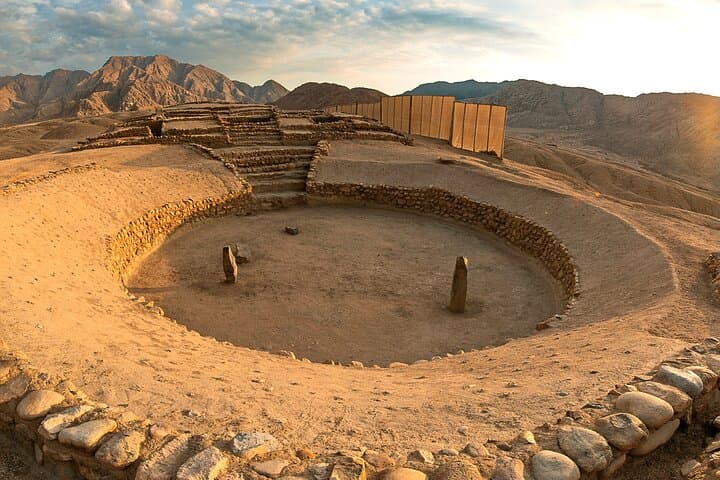
Caral is one of the earliest urban centers in the Americas, occupied more than 5,000 years ago and recognized as a UNESCO World Heritage Site. Its architecture—amphitheater, circular altars, and residential sectors—reveals a society organized around ritual, agriculture, and trade. Nearby Peñico, a more recent find, is rewriting regional timelines with ceremonial platforms and ordered urban layouts that suggest advanced planning and astronomical awareness.
Guides interpret pottery fragments, irrigation remnants, and the spatial logic of plazas so the landscape reads like an archive. Evenings at Empedrada Lodge offer simple comforts: a pool, citrus groves, and a chance to watch light fall across pyramid faces.
Practicalities: expect long but scenic drives (road surfaces vary), limited cell signal, and uneven walking at sites. Best months are the dry season (May–September) for clearer skies and easier travel. Bring sun protection, a light jacket for cool nights, and comfortable closed-toe shoes for sandy terraces. The trip pairs slow archaeology with rural landscapes—ideal for travelers who want tangible history and quiet country time without strenuous hiking.
easy.
2 days.
Suitable for travelers with basic mobility; involves short to moderate walks on uneven, sandy terrain.
Driving time is typically about 3.5–4.5 hours each way depending on Lima traffic and road conditions; expect a mix of highway and local roads.
Yes—it's rated suitable for all fitness levels, but sites have uneven ground and some steps, so mobility limitations may be challenging.
Carry some Peruvian soles for incidentals; card acceptance at the lodge may be limited and connectivity is spotty.
Breakfast is included; other meals or beverages at the lodge may not be; check the booking details for the specific inclusions.
Caral is one of the oldest urban centers in the Americas, with monumental architecture dating back more than 5,000 years; Peñico is a newly studied site that expands our understanding of early coastal societies.
Sites are archaeologically fragile—stay on designated paths, avoid touching structures, and support local guides and the lodge to ensure community benefit and site protection.
VIPAC Travel operates guided outdoor trips and adventures with an emphasis on safety, stewardship, and memorable experiences.
You leave Lima before dawn and the city’s noise thins into the steady hum of the Pan-American Highway. Coastal cliffs and small fishing towns slide past the window while the desert plain opens into the Supe Valley; the air tastes of salt and dust. At Caral, stepped platforms and broad plazas rise from the sand—stones arranged with intent, stairways that still invite a measured climb.
You leave Lima before dawn and the city’s noise thins into the steady hum of the Pan-American Highway. Coastal cliffs and small fishing towns slide past the window while the desert plain opens into the Supe Valley; the air tastes of salt and dust. At Caral, stepped platforms and broad plazas rise from the sand—stones arranged with intent, stairways that still invite a measured climb.
Caral is one of the earliest urban centers in the Americas, occupied more than 5,000 years ago and recognized as a UNESCO World Heritage Site. Its architecture—amphitheater, circular altars, and residential sectors—reveals a society organized around ritual, agriculture, and trade. Nearby Peñico, a more recent find, is rewriting regional timelines with ceremonial platforms and ordered urban layouts that suggest advanced planning and astronomical awareness.
Guides interpret pottery fragments, irrigation remnants, and the spatial logic of plazas so the landscape reads like an archive. Evenings at Empedrada Lodge offer simple comforts: a pool, citrus groves, and a chance to watch light fall across pyramid faces.
Practicalities: expect long but scenic drives (road surfaces vary), limited cell signal, and uneven walking at sites. Best months are the dry season (May–September) for clearer skies and easier travel. Bring sun protection, a light jacket for cool nights, and comfortable closed-toe shoes for sandy terraces. The trip pairs slow archaeology with rural landscapes—ideal for travelers who want tangible history and quiet country time without strenuous hiking.