
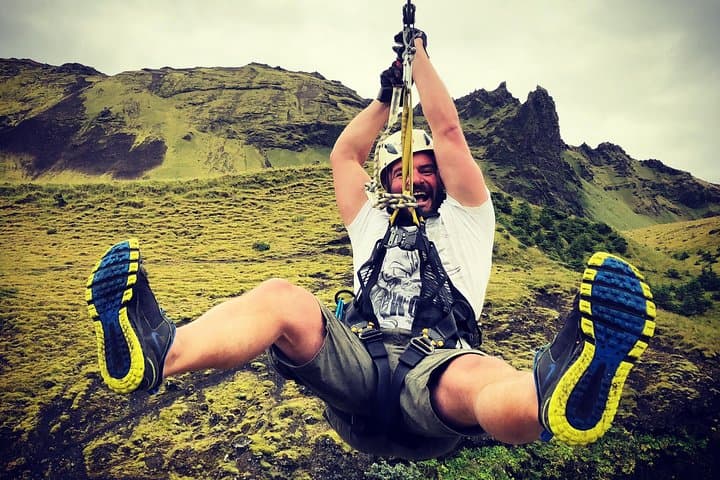
What the day feels like
Thirty meters up a steel cable, the world sits arranged like a landscape painting—brittle black sand beaches receding to the west, basalt sea stacks thin as cathedral spires, and Mýrdalsjökull, a white, patient giant, laced with crevasses and the dark shadow of Katla beneath. The first zipline takes your weight and sends you forward with a soft whoosh; the air feels colder and clearer, and the canyon below seems to lean in to watch. This is not fantasy—this is a 90–120 minute loop that stitches together two ziplines, a short but lively hike through Grafargil canyon, and a few well-placed moments of theatrical exposure that make Vík feel both intimate and immense.
The tour begins a three-minute drive from Vík's cluster of colorful houses. From the roadside overlook you can see why locals in South Iceland grow used to scale—mountain, glacier, sea and sand are all in conversation. Then you walk: a moderate hike through a river-cut canyon where layered lava and glacial till narrate Iceland's volcanic and glacial history. Moss cushions the rocks in places, and water dares you with shallow crossings. Guides clip you into a harness, check your helmet and your belay one last time. Between the harness checks and the 'Leap of Faith'—a brief, grin-demanding scramble—the guides set a pace that keeps the experience accessible to adventurous families and practiced travelers alike.
Geologically, this corner of Iceland reads like a field guide. Mýrdalsjökull is an ice cap that conceals Katla, one of Iceland's most active subglacial volcanoes; the glacier has carved and re-carved valleys and fed the rivers that excavated Grafargil. The canyon's exposed rock shows ancient flows and more recent eruptions, while the black sand below—brought by basalt and waves—reminds you how quickly the island's identity is remade by fire and water.
Culturally, Vík is a small, resilient village that earned its keep from fishing, sheep, and lately, tourism. Takeaways from a short adventure here are not only vertical thrills; there's also a sense of place: the stoicism of local people who have lived with eruptions and storms for centuries, and a humble culinary scene that pairs lamb and whey cheese with tourist-friendly charm. Guides who run the zipline tours are local or long-time residents; their knowledge is as much about reading weather windows and glacier moods as it is about belays and ropes.
Why go? The ziplines deliver an uncommon vantage point over waterfalls and canyon ledges; unlike a viewpoint from a road, this gives a moving, immediate sense of scale. The walk through Grafargil links those moments—it's not a gauntlet, but the terrain is uneven and requires attention, which keeps the experience honest. The whole thing fits neatly into a half-day: long enough to feel substantial, short enough to pair with other South Coast attractions—Reynisfjara beach, Dyrhólaey, or a glacier walk on Sólheimajökull.
Practicalities matter out here. The operator advertises two ziplines—240 meters and 140 meters—and the full experience lasts about 90 to 120 minutes. Price on the books starts from roughly $112. Guides will handle harnessing and tethering; participants with a reasonable head for heights and a moderate fitness level will be comfortable on the tour. Come prepared for Icelandic weather: wind and rain can arrive without long warning, and the canyon is cooler than the shore.
If you want to make the most of the day, arrive in Vík early, park near the tourist information center, and leave room for a post-run warm-up: soup in a local café, a short walk on the black sand, or a detour to the cliffs for birdwatching. Bring a camera and a secure strap—many guests shoot from the ziplines and later rediscover moments that felt more cinematic in memory than in pixels.
Safety and logistics are straightforward. The guides run a briefing, check harnesses, and manage all technical components. For most travelers, the only real challenge is staying warm and dry; boots with grip, a shell, and gloves will change your comfort level dramatically. If you are traveling in shoulder seasons, ask about route adjustments or cancellations—conditions can force a change, and reputable operators will refund or reschedule when safety dictates.
There is a curious humility to this adventure. It does not promise summit glory or alpine endurance; it promises well-executed exposure and an acute, moving perspective on Iceland's raw southern edge. When you step back onto the old Route 1 for the loop's final stroll, the landscape feels a little less theatrical and more true—harsh, generous, relentless, and strangely companionable.
For travelers trying to squeeze both thrill and context into a short visit, this zipline-and-hike loop delivers: an adrenaline spike, a geology lesson, and a local connection you can walk off in the space of an hour and a half. If you want big mountain hikes or glacier climbs, this isn't that—it's an elegant half-day that makes Vík's scale feel intimate enough to understand.
Trail wisdom
Small choices, better day.
Secure your camera
Use a wrist or chest strap—dropping a phone off a zipline is common and expensive.
Layer for variable weather
A breathable base, insulating midlayer and waterproof shell will keep you comfortable in wind and spray.
Wear grippy shoes
Choose hiking shoes with good traction for rocky, wet canyon sections.
Listen to your guide
Briefings cover harness safety and timing—follow instructions for a smooth run.
Local knowledge
Read the place, not just the route.
Watch for native species including Puffins (offshore in summer), Seals along the coastline.
Keep an eye out for wildlife during the transition between areas and habitats. Respect distance guidelines.
Stick to marked paths, avoid trampling moss (which takes decades to regrow), and follow guide instructions to minimize erosion and disturbance to nesting birds.
Follow the guide's instructions on size limits, ethical handling, and leave-no-trace practices.
Old Route 1 viewpoint between the canyon and the village for quiet glacier views. A small waterfall upstream in Grafargil that receives fewer visitors—ask your guide to point it out
Locally recommended viewpoints and quiet spots known best to local operators.
Mýrdalsjökull overlays Katla, a historically active volcano; the interaction of ice and fire has shaped local settlement and routes for centuries.
Maritime roots and regional tradition shape the waterways and working coasts.
Seasonal guide
Four versions of the same landscape.
Spring
Best forFewer crowds · Migratory birdwatching
ChallengesUnpredictable weather · Colder canyon temps
Spring brings melting snow and active rivers—good for waterfalls but pack warm layers and expect variable conditions.
Summer
Best forStable weather windows · Long daylight hours · Best wildlife viewing
ChallengesHigher visitor numbers · Occasional wind
Summer is the optimal season for consistent tours, longer days and calmer seas—ideal for pairing the zipline with other South Coast sites.
Fall
Best forAutumn light for photography · Fewer tourists
ChallengesShortening days · More wind and rain
Fall offers dramatic light and quieter trails; check cancellation policies as storms become more frequent.
Winter
Best forSnow-blanketed scenery · Northern lights viewing (night tours unlikely)
ChallengesIcy conditions · Possible cancellations
Winter turns the landscape stark and beautiful but increases the chance of route changes—book with a flexible operator.
Pack with intention
What to bring.
Good to know
Common questions.
The experience runs about 90–120 minutes from meeting to finish, including briefings, two ziplines (240m and 140m), and the hike through Grafargil canyon.
Plan the edges
The details that make the day easier.
Mýrdalsjökull sits above the Katla volcano, which last produced a major eruption in 1918—its behavior has shaped the South Coast for centuries.
After the tour, warm up at a café in Vík—Halldórskaffi and Suður-Vík serve hearty soups and Icelandic lamb; then walk a short distance to Reynisfjara to see black sand and basalt columns or grab a local beer and listen to stories of the coastline.
- Closest airport
- Keflavík (KEF) ~2.5-hour drive; Meeting point: 3-minute drive from Vík village; Driving distance from the nearest town: immediate; Cell service: generally available near roads, limited in the canyon; Permits: none required.
Trails and moss are fragile—stay on paths, pack out waste, and avoid disturbing nesting seabirds along the coast.
Explore by topic
Follow the threads.
Keep exploring
Make the story part of the trip.
Set out from Bass Harbor for a private, customizable day on Blue Hill Bay — lighthouses, puffins, seals, and the chance to feel Acadia from the water. Small groups, local captains, unforgettable views.
In four hours you can move from shaded canyon ferns to wind-scoured coastal ridgelines, guided by someone who knows where the light—and the hidden views—live. This private half-day hike on the Monterey Peninsula or Big Sur is compact, curated, and perfect for travelers who want depth without a multiday commitment.
 Related story
Beneath a sky of shifting light, Skaftafell’s ice reads like a map of time. This three-hour guided glacier hike mixes technical instruction with geology and culture: compact, safe, and unforgettable.