
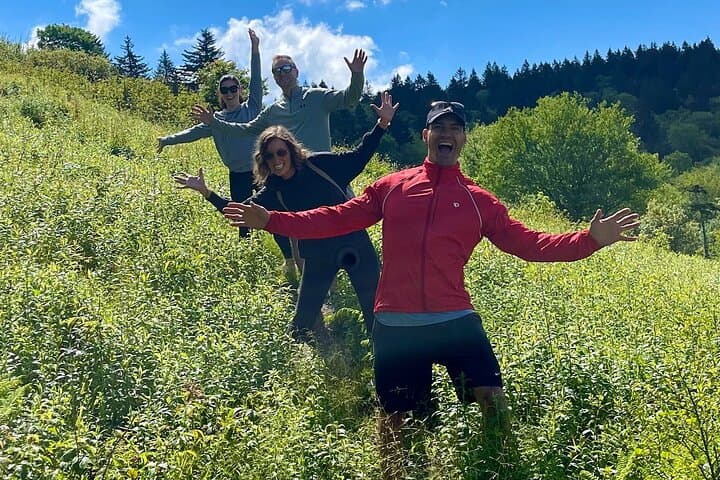
What the day feels like
The trail wakes slowly, the forest exhaling cool breath as you step beneath the canopy. Leaves whisper underfoot and a nearby stream murmurs its steady invitation, promising a waterfall ahead that will drown out thought and tighten your grin. A local guide moves easily through the pines, reading the terrain the way you might read headlines—quickly, confidently, with context. Moss glows on the rocks. A raven throws its voice down the ridge. You feel the Blue Ridge Mountains stretching around you like a long-held secret finally told aloud.
This guided hike—3 to 5 miles, tailored to the day’s group—lands you in the sweet spot between adventure and access. Within an hour of Asheville, the route threads into one of Western North Carolina’s signature landscapes: a network of paths through DuPont State Recreational Forest and the surrounding Blue Ridge, where waterfalls punch through granite and small lakes hold the sky like mirrors. Some days the loop leans waterfall-heavy, stepping to the base of roaring cascades where spray chills your cheeks. Other days it arcs by a quiet lake rimmed with white pines—eyes peeled for the bald eagles that occasionally take a patient post on shoreline snags.
On the way, your guide unpacks the mountains. The Blue Ridge is ancient, its metamorphic bedrock forged more than a billion years ago, a reminder that these soft, green curves were once Himalayan in ambition. The forest you walk through is younger but vigorous, a quilt of oak, hemlock, and rhododendron stitched together by creeks that never seem to tire. Spring unfurls trillium and foamflower; summer leans into lush; fall sets the ridges on fire with color; winter pares everything back to the elemental—stone, water, wind.
Culture, here, clings to the contours. A century of logging left scars, and a wave of conservation followed. DuPont itself carries an industrial echo; the forest is named for the company that once owned the land and operated a factory nearby. When the land became public, the state linked a series of trails, opening up a waterfall corridor that’s now a favorite of locals and travelers. The region tells more modern stories, too—iconic scenes in The Hunger Games were filmed at Triple Falls, and Asheville’s creative energy spills onto these backroads in the form of trailhead coffees, craft breweries, and gear shops that know how to point you toward a tucked-away overlook at sunset.
The hike itself is a study in pacing. Paths start soft and forgiving, then tilt toward the sound of water. As you approach the falls, the Little River throws its voice into the gorge, daring you to come closer. Mist fines the air. Granite steps demand attention—wet stone can be slick—while sunlight catches spray in a rainbow that refuses to stay still. The current never stops arguing its case downstream. You can keep your distance or step forward into the noise; either way, the falls own the moment.
Beyond the cascades, the trail relaxes into a gentler stretch. Pine duff under your boots, a brief climb that warms legs, then a breezy glide along the lake’s edge. If you’re lucky, an eagle drifts above the water, letting the thermals do the heavy lifting. Your guide points out a beaver lodge, a trace of bear on a leaning poplar, and the neat drill work of a pileated woodpecker. It’s not just a walk; it’s a primer on reading a landscape.
This is the Blue Ridge at its best: approachable and layered, a place where you can start your day with a pastry in Asheville and end it with trail grit on your calves. The moderate distance means most hikers with a basic fitness base find the route comfortable. The real trick is timing. In summer, afternoon storms roll in fast—start early if you want the falls to yourself. In fall, leaf-peeping crowds flood parking lots; a weekday or dawn launch pays off with solitude and crisp light. Winter can surprise you with ice on boardwalks, the kind you don’t notice until your heel slips a quarter inch—microspikes are your friend.
The practical edge of this guided experience is what makes it memorable. Your local guide knows which trail junctions stay muddy, which side paths lead to a safer viewpoint, and when to pivot plans if a trailhead is full. They also know where to grab food afterward—a brewpub whose kitchen does right by regional trout, or an unassuming barbecue joint that sells out by mid-afternoon. The day unspools efficiently. You don’t fuss with nav or second-guessing. You just hike, listen, and look.
As you close the loop, the forest dims to a late-day hush. The creek softens its voice; a breeze pushes through the white pines and keeps going. The trail returns what it borrowed from your legs. Back at the car, you’re flushed with the kind of tired that feels earned. Asheville waits with a cold beer and a plate of something indulgent. Tomorrow will take care of itself.
Planning notes: Expect 3–5 miles with 400–800 feet of elevation gain depending on the route. Surfaces range from smooth, rooty singletrack to wet rock near waterfalls. Wear grippy footwear and bring a light rain shell; conditions change quickly in the Blue Ridge. Water is essential—aim for at least one liter per person in cooler seasons and more in summer. In peak months, arrive early to secure parking; your guide will help adjust to closures or crowds. And as always in waterfall country, respect the barriers: these rivers are strong-willed and quick to correct a misstep. Stay on marked paths, keep a safe distance from edges, and let the currents thunder on without you.
Trail wisdom
Small choices, better day.
Start Early for Solitude
In summer and peak fall weekends, parking fills by mid-morning. Aim to hit the trail at sunrise for cooler temps and empty viewpoints.
Grip Matters Near Waterfalls
Wet rock can be deceptively slick—wear lugged, grippy soles and keep a conservative stance near edges and overlooks.
Storm Smart
Afternoon thunderstorms are common June–August. Check radar, carry a shell, and avoid exposed overlooks if thunder is within 10 miles.
Leave No Trace, Always
Stay on established paths to protect fragile creekside plants and minimize erosion on these heavily loved trails.
Local knowledge
Read the place, not just the route.
Watch for native species including Bald eagles, Pileated woodpeckers.
Keep an eye out for wildlife during the transition between areas and habitats. Respect distance guidelines.
These trails see heavy use—staying on marked routes protects bankside vegetation and prevents erosion into the waterways. Drones are restricted without permits.
Follow the guide's instructions on size limits, ethical handling, and leave-no-trace practices.
The covered bridge above High Falls—safe, unique angles on the Little River. Lake Dense loop—a quieter detour where wildlife sightings are common
Locally recommended viewpoints and quiet spots known best to local operators.
DuPont State Recreational Forest occupies former company-owned land transitioned to public access in the late 1990s and early 2000s, preserving a corridor of waterfalls and mixed hardwood forest.
Maritime roots and regional tradition shape the waterways and working coasts.
Seasonal guide
Four versions of the same landscape.
Spring
Best forWildflowers · Cool temps
ChallengesMud on shaded sections · Variable weather
Expect rushing water, emerging blooms, and comfortable hiking temperatures. Pack a light layer for chilly starts and muddy sections.
Summer
Best forSwimming holes nearby (where permitted) · Long daylight
ChallengesHumidity · Afternoon storms · Crowds
Go early to beat heat and parking crunches. Hydrate aggressively and watch the sky for fast-moving thunderstorms.
Fall
Best forPeak foliage · Crisp air
ChallengesBusy trailheads · Cooler mornings
Leaf season is magic but popular—weekday hikes shine. Layers help with temperature swings between sunlit ridges and shaded creeks.
Winter
Best forClear views · Low crowds
ChallengesIce on bridges and rocks · Cold wind
Expect thin crowds and bright, low-angle light. Microspikes can make icy boardwalks and waterfall approaches much safer.
Operator details
What the booking data adds.
Included
- ✓Gatorade
- ✓Bottled water
- ✓I provide snack bars, trail mix and chips and fruit
Not included
- —Private transportation
Good to know
- ✓Service animals allowed
- ✓Public transportation options are available nearby
- ✓Not recommended for travelers with poor cardiovascular health
- ✓Travelers should have at least a moderate level of physical fitness
- ✓We recommend this adventure for people over 12 years old as it is a good bit of hiking.
- ✓You do need to have your own vehicle - often we meet closet to the trails of where you might be staying
Pack with intention
What to bring.
Good to know
Common questions.
Expect 3–5 miles with 400–800 feet of elevation gain over 4–5 hours. It’s a moderate hike with uneven footing and short, steeper sections near waterfalls.
Plan the edges
The details that make the day easier.
DuPont State Recreational Forest’s Triple Falls and Bridal Veil Falls were filming locations for The Hunger Games (2012).
Back in Asheville, refuel at Buxton Hall Barbecue or White Duck Taco Shop, then raise a pint at Burial Beer Co. For a brewery-meets-beer-garden experience closer to the forest, swing by Sierra Nevada Brewing in Mills River—wood-fired plates, riverside patio, and a tap list built for the post-hike glow.
- Closest airport
- Asheville Regional (AVL). Typical trailheads are 40–60 minutes from downtown Asheville by car. Cell service fades on backroads and in hollows—plan meetups and maps in advance. No permits required for day hiking in DuPont; heed posted closures and seasonal advisories.
Waterfalls and creek banks are fragile—stay on durable surfaces, keep a safe distance from ledges, and pack out every crumb. Refill bottles at taps, not streams, to protect water quality for downstream communities and wildlife.
Explore by topic
Follow the threads.
Keep exploring
Make the story part of the trip.
In four hours you can move from shaded canyon ferns to wind-scoured coastal ridgelines, guided by someone who knows where the light—and the hidden views—live. This private half-day hike on the Monterey Peninsula or Big Sur is compact, curated, and perfect for travelers who want depth without a multiday commitment.
 Related story
Beneath a sky of shifting light, Skaftafell’s ice reads like a map of time. This three-hour guided glacier hike mixes technical instruction with geology and culture: compact, safe, and unforgettable.
 Related story
Lose the city for a few hours without leaving it: this 5-mile, 900-foot-gain Forest Park loop threads old-growth pockets, city viewpoints, and cultural landmarks for a compact taste of Portland’s wild side. Expect moss, roots, and stories.