
What the day feels like
Dawn lifts in pastel bands over the Coromandel Coast, and the Bay of Bengal breathes against the stone ribs of the promenade. On Goubert Avenue, the sea keeps its own slow cadence, urging the city awake. Motorbikes murmur, pigeons rearrange themselves on cornices, and White Town’s lemon- and peach-colored facades take on a soft glow—like the place has decided to whisper before it speaks. This is the hour when Pondicherry invites a different kind of exploration, one that doesn’t chase landmarks so much as listens for them.
A spiritual walk in Pondicherry is less a stroll between points and more a thread pulling through textures: saffron-edged temple flags lifting in the breeze, a sandalwood scent sneaking out from an old doorway, a chalk kolam curling across a step in delicate geometry. The streets, laid on a French grid, encourage an unhurried rhythm. Your feet fall into it. The city answers by slowing down time.
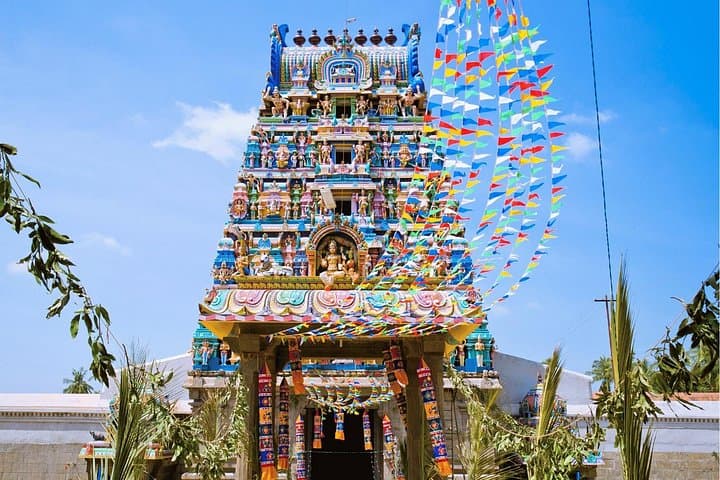
Here, faiths coexist within a few paces. A temple bell summons the morning just as a church bell answers from another street; a muezzin’s call gathers the day from a different direction. If you keep your eyes open, Pondicherry teaches by proximity: devotion isn’t neatly siloed. You might pass the Manakula Vinayagar Temple as its doorways wake to marigolds, then cross a quiet lane to the hushed, disciplined heart of the Sri Aurobindo Ashram—no phones out, no chatter, only the steady hum of collective attention. The ashram’s philosophy of Integral Yoga is less about escape and more about meeting everyday life with clarity. The city seems to have absorbed the lesson. Even traffic has moments of grace here, bowing to a pedestrian, rolling to a patient stop. The breeze off the Bay nudges you onward, as if it’s not done with your morning yet.
Pondicherry’s Franco-Tamil character isn’t a costume worn for visitors; it’s baked into the city’s bones. The French tricolor still lingers in murals and memory, a reminder that this was France’s last stronghold in India, governing here until 1954. The architecture in White Town—arched verandas, shuttered windows, bougainvillea pouring over high walls—shares space with Dravidian gopuram lines and gilded deities. The Tamil Quarter runs parallel, earthy and bustling, with courtyards and street shrines that feel tenderly used. Between them, bakeries peddle croissants next to stands steaming idlis, while café menus toggle between café au lait and filter coffee without irony. Pondicherry doesn’t choose. It blends.
Geographically, it’s a city built flat, a coastal plain pressed against a tireless sea. There are no steep climbs—nothing more challenging than an unruly curb, a narrow lane, or the slanting shade of a rain tree. That gentleness makes space for attention: to the way banyans net the sky with patient fingers; to parrots that tangle a single tree with sound; to the maritime light, which changes outfits every fifteen minutes. The Bay is the walk’s metronome. It dares you to match your pace to its push and pull.
On a guided spiritual walk, the itinerary may change with the day—season, festival, and the city’s own mood will do that. Expect roughly 2–3 kilometers of easy walking over two hours. Expect to remove your shoes at temples, cover shoulders where decorum asks, step softly around quiet zones. Photography is often restricted inside the ashram and some religious sites; street-side, the architecture rewards your lens at every turn. Look for details: carved door knockers, street shrines no bigger than a book, jasmine stalls that perfume an entire corner. The small things lead you deeper.
In a place where the sun sharpens quickly, early morning or late afternoon gift you the best air. Heat and humidity can build fast here; hydration isn’t a suggestion but a strategy. And yet the weather—like the walk—teaches a pace that respects limits. You don’t race toward insight; you let it arrive, often in ordinary scenes. A grandmother smudges sandalwood on a statue and smiles at you like she’s known you a long time. A café table catches a square of gold light and makes a plain cup of coffee look like a sacrament. A child’s chalk rangoli curls like a prayer under your step; you adjust your path without thinking. The city notices these small choices. So do you.
History spools out as you move. The ashram began in 1926, coalescing around Sri Aurobindo and Mirra Alfassa, “The Mother,” who emphasized the spiritual within the practical. The French arrival centuries before left an urban grammar that still guides—right angles, tidy vistas, an appetite for shade. In the Tamil Quarter, houses pull the day in through central courtyards, air moving like water, cooling what it touches. Everything—stone, plaster, paint—has learned to deal quietly with heat and monsoon, without drama. Maybe that’s the city’s highest lesson: steadiness as a form of devotion.
By the time the sun climbs, the promenade fills, and the Bay flexes into brighter blues. Your walk might finish near a café facing the sea, where the horizon writes a simple sentence: breathe, drink water, be here. If the tour promised a journey inward, it has delivered it by outward means—footsteps, glances, pauses. Nothing extravagant, just an accumulation of careful moments. Pondicherry, in turn, seems satisfied. The sea settles, the wind relents, and the city—always generous—hands you back to yourself a little lighter than when you began.
If you come, come ready to listen. Wear shoes you can slip on and off. Carry water. Wrap a light scarf around your shoulders where it’s kind to do so. And let the streets make their case: that attention, like faith, grows where you put it—one quiet step after another.
Trail wisdom
Small choices, better day.
Dress with respect
Carry a light scarf or shawl to cover shoulders when entering temples or quiet areas of the ashram. Modest attire ensures smooth entry and respectful interactions.
Start at first light
Begin around sunrise for cooler temperatures, softer light, and quieter streets along the promenade and White Town.
Shoes on, shoes off
Wear slip-on walking shoes; you’ll remove footwear at certain religious sites and step back into city sidewalks often.
Hydrate smart
Humidity builds fast. Bring a reusable bottle and sip regularly; cafés en route can top you up safely.
Local knowledge
Read the place, not just the route.
Watch for native species including Rose-ringed parakeets, Indian flying fox (fruit bat) at dusk.
Keep an eye out for wildlife during the transition between areas and habitats. Respect distance guidelines.
Carry a reusable bottle and avoid single-use plastics; observe quiet zones and shoe-removal protocols to help preserve the sanctity of ashram and temple spaces.
Follow the guide's instructions on size limits, ethical handling, and leave-no-trace practices.
Ananda Ranga Pillai Mansion—an 18th-century Franco-Tamil home rich with period detail. Cluny Embroidery Centre courtyard—quiet heritage space with delicate handwork
Locally recommended viewpoints and quiet spots known best to local operators.
Pondicherry was France’s final stronghold in India, administered by the French until 1954, a legacy still visible in White Town’s street plan and architecture.
Maritime roots and regional tradition shape the waterways and working coasts.
Seasonal guide
Four versions of the same landscape.
Spring
Best forMild mornings · Lower crowds
ChallengesRising humidity · Midday heat
February to March offers warm, manageable days with pleasant breezes on the seafront. Start early to avoid the sharper midday sun.
Summer
Best forEarly sunrises · Empty lanes
ChallengesHigh heat (often 32–38°C) · Heavy humidity
April to June is hot and sticky; plan dawn or dusk walks and take frequent shade breaks along tree-lined streets.
Fall
Best forFestival energy · Lush post-rain colors
ChallengesIntermittent monsoon showers · Slick pavements
October to November brings bursts of rain and cultural festivities. Carry a compact rain layer and watch your footing on wet stone.
Winter
Best forCooler temperatures · All-day comfort
ChallengesPeak-season crowds on weekends
December to January is prime: airy, comfortable, and ideal for longer rambles, especially along the promenade.
Operator details
What the booking data adds.
Included
- ✓Highly trained and friendly Storyteller/ Guide who can speak English & Hindi
- ✓Great local tips and recommendations to save money and to explore the best of the city.
Not included
- —Hotel Pickup and drop
- —Bottled water
Good to know
- ✓Suitable for all physical fitness levels
Pack with intention
What to bring.
Good to know
Common questions.
Expect about 1.5–2 hours on foot, covering roughly 2–3 kilometers on flat city streets with frequent stops.
Plan the edges
The details that make the day easier.
Puducherry remained under French administration until 1954 (de facto transfer), with de jure transfer completing in 1962—one reason French street names and architecture still endure.
Post-walk, linger over South Indian tiffin at Surguru or chase sea breezes with coffee at Le Café on the promenade. For a Franco-Tamil fix, try a croissant at Baker Street and then sample a thali nearby. Browse handmade textiles at Cluny Embroidery Centre or shop for incense and local crafts around Mission Street.
- Closest airport
- Chennai (MAA) with frequent connections; Puducherry (PNY) has limited domestic flights. Trailhead: White Town near the promenade and Sri Aurobindo Ashram. Drive time: ~3–4 hours from Chennai via ECR or NH32. Cell service: Generally good in town. Permits: None required, but observe ashram rules, silence, and no-photography zones.
Carry in/carry out principles apply even in cities: skip single-use plastics, refill water at cafés, and support heritage conservation by choosing locally run guides and shops.
Explore by topic
Follow the threads.
Keep exploring
Make the story part of the trip.
In four hours you can move from shaded canyon ferns to wind-scoured coastal ridgelines, guided by someone who knows where the light—and the hidden views—live. This private half-day hike on the Monterey Peninsula or Big Sur is compact, curated, and perfect for travelers who want depth without a multiday commitment.
 Related story
Beneath a sky of shifting light, Skaftafell’s ice reads like a map of time. This three-hour guided glacier hike mixes technical instruction with geology and culture: compact, safe, and unforgettable.
 Related story
Lose the city for a few hours without leaving it: this 5-mile, 900-foot-gain Forest Park loop threads old-growth pockets, city viewpoints, and cultural landmarks for a compact taste of Portland’s wild side. Expect moss, roots, and stories.