
What the day feels like
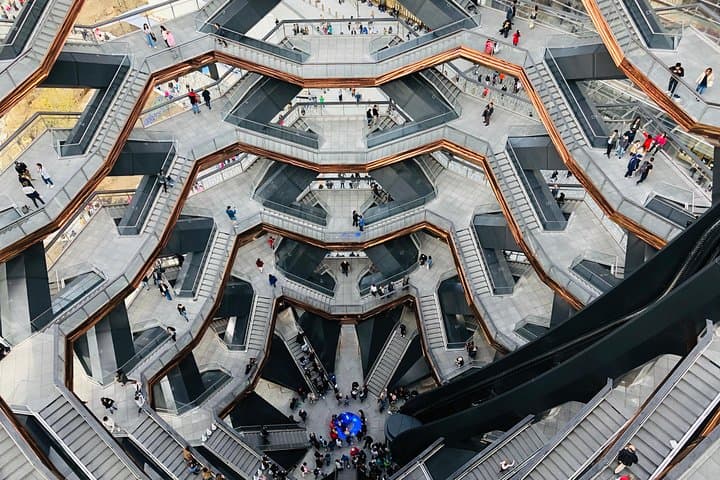
You step off the subway into late-morning light and the city rearranges itself. Concrete gives way to a narrow ribbon of green threaded above the traffic—this is the High Line, an elevated park that follows the bones of a long-retired freight rail. Beneath your feet, ornamental grasses whisper like a city-sized meadow; ahead, a honeycomb of staircases—Vessel—rises fifty stories of metal lattice. To the north, the Edge juts its glassy nose into the skyline, daring onlookers to lean past it and see the city tilt.
This guided tour draws those threads together: a walk along the High Line, a close look at the engineering and economics of Hudson Yards, a climb through Vessel’s spiraling vantage points, and optionally, an elevator up to Edge’s 1,100-foot observation deck. It’s a short walk that telescopes centuries of New York’s evolution—from river commerce to rail freight to modern glass towers—into a compact loop of design, power, and public space.
The story here is layered. The High Line began as a practical spine for Manhattan’s meatpacking and industrial districts in the 19th and early 20th centuries. As freight moved away and the tracks fell silent, the structure might have been torn down. Instead, neighborhood residents and designers reimagined it as an elevated park. The result is an urban reclamation project that married landscape architecture and public art with a vision of resilience. Hudson Yards itself sits atop a working rail yard; engineers built a platform over active tracks to cradle a new neighborhood of towers, retail, public plazas, and the Vessel—a walkable sculpture designed by Thomas Heatherwick.
Beneath the gloss of shiny retail and sleek condos there’s an older geology. Manhattan’s skyline perches on layers of schist and bedrock; where Hudson Yards stands required deep foundations and caissons sunk through fill and river sediments to bedrock below. That technical backbone allowed architects and developers to stack glass, concrete, and steel over moving trains—and to do it in a way that invites the public rather than fences it off.
On the tour, your local guide threads narrative and detail. You’ll hear why the development happened here (proximity to Midtown, rail logistics, and big bets on private investment), how the High Line’s planting palettes are chosen to mimic wild succession, and why Vessel’s geometry was meant to choreograph movement rather than offer a single picture-postcard vista. If you upgrade to Edge, you’ll stand on a wedge of sky with a glass floor and tilted windows, the Hudson River pulling at the city edge like a dark ribbon, the wind nudging you into perspective.
Why go on this particular tour? For one, it makes the city legible. Guides unpack the who’s and how’s—developers and designers, zoning incentives and public-private partnerships—so the glass façade stops being wallpaper and starts to read as policy and ambition. For photographers and architecture fans, the route strings together complementary frames: the bristly textures of High Line plantings against the crisp geometry of new towers, the human scale of Vessel’s stair treads, and the bird’s-eye sweep from Edge.
Practically, the route is accessible for most walkers. The tour runs 2–3 hours; expect flat elevated walkways, some stairs, and time spent standing at viewpoints. The guides know when to pause for photos and when to move to avoid crowds. The optional Edge ticket is worth the extra fee if you want the skyline in all directions—and a heart-rate reminder that gravity is still at work.
Timing matters. Early morning or late afternoon light softens glass and gaps crowds. Weekends bring locals and tourists; weekdays feel more neighborhood-like. Bring comfortable shoes for pavement and stairs, a light layer for wind on the deck, and a phone or small camera with space to store high-res images. Hydration is simple—there are vendors and cafés nearby, but a refillable bottle keeps you moving.
This is a city tour but it feels like a small expedition. The High Line’s plantings have a wildness that resists complete domestication; their stems and seedheads read like characters in the city’s story—persistent, stubborn, useful. The river is always a presence, at times a silver punctuation or a muted gray, reminding you that Manhattan is an island and that all of this human enterprise exists at the edge of water.
For travelers, the tour is a compact, illuminating way to experience contemporary New York: the interplay of private riches and public realm, the engineering feats underfoot, the civic debates about who the new neighborhood serves. If you want to feel how cities rework themselves—rail into park, yard into neighborhood—this is a two-hour crash course with good views and better context.
Before you go: buy the Edge upgrade in advance if you’re planning to step onto the deck—tickets sell out for sunset. Bring layers: wind and sun behave differently once you’re elevated. And treat the High Line like a living place: stick to paths, respect plantings, and support nearby businesses that keep the neighborhood vital.
In the end, the appeal isn’t just the angles or the Instagram frame. It’s watching the city remake itself in real time—a stretch of track that became a park, a rail yard that became a neighborhood, and an observation deck that offers a new scale to measure Manhattan by. The structures may be new, but the city’s forces—commerce, design, and public imagination—are unchanged. Here, they intersect on metal, stone, and glass, and you get to walk the seams.
Trail wisdom
Small choices, better day.
Buy the Edge upgrade ahead
Edge tickets often sell out at peak times—book the upgrade in advance if you want sunset or timed-entry slots.
Wear grippy shoes
Expect pavement and metal stairs; shoes with traction make Vessel’s steps and the High Line ramps more comfortable.
Plan for wind on Edge
The exposed deck can be much windier and cooler than street level—bring a light windbreaker.
Mind the plantings on the High Line
Stay on designated paths and avoid trampling planting beds—this park is an engineered ecosystem.
Local knowledge
Read the place, not just the route.
Watch for native species including Peregrine falcon (seen nesting on tall buildings), Red-tailed hawk (often seen perching on rooftops).
Keep an eye out for wildlife during the transition between areas and habitats. Respect distance guidelines.
The High Line Foundation manages plantings and programming—stay on paths to protect engineered habitats, and favor public transit to minimize carbon impact.
Follow the guide's instructions on size limits, ethical handling, and leave-no-trace practices.
The Chelsea Market passageways and food vendors one block south for post-tour eats. The elevated viewpoints on the south end of the High Line near 10th Avenue for quieter sunrise shots
Locally recommended viewpoints and quiet spots known best to local operators.
The High Line was an elevated freight rail built in the 1930s; after decades of abandonment it was transformed into a park starting in the early 2000s, catalyzing Hudson Yards’ redevelopment.
Maritime roots and regional tradition shape the waterways and working coasts.
Seasonal guide
Four versions of the same landscape.
Spring
Best forWildflower displays · Milder walking weather · Fewer summer crowds
ChallengesEarly spring rain · Variable temperatures
Spring brings the High Line’s earliest plant growth and pleasant walking temperatures—bring waterproof layers for sudden showers.
Summer
Best forLush plantings · Extended daylight · Street-level dining nearby
ChallengesHeat and humidity · Larger crowds and lines for Edge
Summer fills the park with foliage and activity; go early or late to avoid peak heat and visitor traffic.
Fall
Best forCrisp skies for photos · Autumn foliage tones · Comfortable walking
ChallengesShorter daylight · Cooler evenings
Fall offers clear light and warm plant colors on the High Line, with comfortable temperatures for walking and skyline viewing.
Winter
Best forQuiet streets · Architectural silhouettes · Crisp air on Edge
ChallengesCold winds on Edge · Possible ice on stairs or paths
Winter is quieter and starkly beautiful, but dress warmly for the exposed Edge deck and wear traction-friendly footwear.
Operator details
What the booking data adds.
Included
- ✓The Vessel
- ✓Guided visit to Hudson Yards & The High Line
- ✓Professional, entertaining, local guide
- ✓Optional upgrade to The Edge Immersive Observation Deck
Not included
- —Gratuities
Good to know
- ✓Wheelchair accessible
- ✓Infants and small children can ride in a pram or stroller
- ✓Service animals allowed
- ✓Public transportation options are available nearby
- ✓Transportation options are wheelchair accessible
- ✓All areas and surfaces are wheelchair accessible
- ✓Suitable for all physical fitness levels
- ✓We coordinate to get timed entry tickets for you to enter Vessel and the Edge observatory right after the tour. Typically, you’ll go inside Vessel first at 4 p.m. and then Edge at 5 p.m. However, times may vary slightly due to availability.
- ✓Yes, this tour is wheelchair accessible. If you’re traveling with a stroller or wheelchair, the High Line also has elevator access instead of stairs, but we can’t guarantee the elevator will be working. Both upgrades are wheelchair accessible as well. Vessel provides elevators for those who need it and priority access for visitors with disabilities. Edge is accessible with elevators and ramps.
Pack with intention
What to bring.
Good to know
Common questions.
The guided experience lasts 2–3 hours depending on group pace and whether you add the Edge upgrade.
Plan the edges
The details that make the day easier.
Edge at Hudson Yards is the highest outdoor sky deck in the Western Hemisphere at 1,100 feet, offering a glass-floor view straight down. (Edge, Related Companies)
After the tour, head to Mercado Little Spain or Chelsea Market for Spanish flavors and local vendors; try tapas or a coffee, then walk over to a rooftop bar in Hell’s Kitchen for a beer and skyline view to compare with Edge.
- Closest airports
- JFK, LGA, EWR; nearest subway: 7 train to 34th St–Hudson Yards; driving distance: central Midtown hotels are 5–15 minutes by cab; cell service: reliable in this neighborhood; permits: none required for tourists but Edge requires a paid ticket.
The High Line is a planted urban ecosystem—stay on designated paths, avoid litter, and use public transit to reach Hudson Yards to reduce your carbon footprint.
Explore by topic
Follow the threads.
Keep exploring
Make the story part of the trip.
In four hours you can move from shaded canyon ferns to wind-scoured coastal ridgelines, guided by someone who knows where the light—and the hidden views—live. This private half-day hike on the Monterey Peninsula or Big Sur is compact, curated, and perfect for travelers who want depth without a multiday commitment.
 Related story
Beneath a sky of shifting light, Skaftafell’s ice reads like a map of time. This three-hour guided glacier hike mixes technical instruction with geology and culture: compact, safe, and unforgettable.
 Related story
Lose the city for a few hours without leaving it: this 5-mile, 900-foot-gain Forest Park loop threads old-growth pockets, city viewpoints, and cultural landmarks for a compact taste of Portland’s wild side. Expect moss, roots, and stories.