
What the day feels like
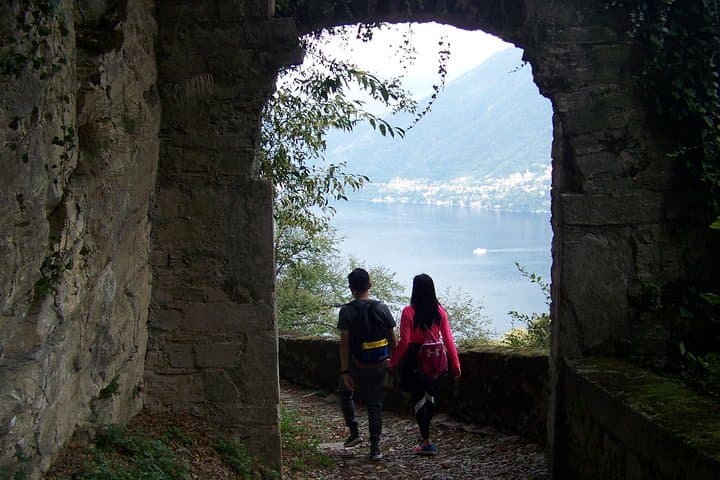
Mist sifts off Lake Como like a curtain as the ferry noses into Torno’s small dock. Cobblestones rise straight from the water’s edge, slipping into a tangle of mule paths that climb the hillside. The woods pull you in and the lake recedes, a silver sheet between trees. It’s quiet up here—quiet enough to hear the forest breathe, to notice how the breeze threads the beech leaves and how the ground, ribbed with old roots, remembers the weight of centuries. On this private outing with naturalist guide Cristina Rovelli, you follow the old Strada Regia—the royal road that once stitched Como to Bellagio—toward a trio of marvels carved by ice and time: the Avelli tombs, the hanging boulder called Pietra Pendula, and a constellation of glacial erratics the size of buses scattered like dice across the slope.
The path starts as a mulattiera, a mule track paved in time-smoothed stones that demand attention with every step. They glint in morning light, slick after rain, and the hill never quite relents; it coaxes rather than punishes, tilting you steadily into the chestnut and beech. Cristina points out the forest’s fingerprints: boar tracks stitched into the mud, a jay scolding from the canopy, lichens dappling boulders like miniature continents. The mountain seems to move with you. The trunks creak, the ravines breathe cool, and the trail—patient and persistent—keeps tugging you forward.
Above Torno, the first truth of this landscape reveals itself in stone. Erratics—boulders dragged south by Pleistocene ice—rest in improbable places, perched on ledges and shouldered into gullies. The lake’s basin was scooped by glaciers; the shore towns cling to the grooves those glaciers left behind. The boulders are pages from that story. They command the forest with the poise of elders, and Cristina reads them like a geologist reads a core: grain, striation, mineral scatter, a trail of clues linking alpine valleys to this quiet ridge.
Then the Avelli: ancient rock tombs chiseled into erratic boulders, rectangular basins with precise lips and drainage holes, carved likely in the early Middle Ages. They sit in small clearings, mysterious and deliberate. Were they Lombard burials? Cult markers? Scholars debate, but here the questions feel as important as answers. You run a palm along the edge of an Avello and the stone is cool, indifferent yet somehow listening. The forest hushes, and time folds—past stacked upon present like layers of sediment.
A little farther, the trail threads through the hamlet of Monte Piatto, where stone houses huddle close against winter and a small church taps out the hours. From here a spur cuts into a deeper green. The world narrows into a ribbon of dirt, then suddenly opens to the star of the walk: Pietra Pendula. The hanging stone balances on a point, a massive boulder stopped in motion, as if the glacier set it down mid-thought. The stone seems to breathe, too—tilting slightly when the light shifts, daring you to imagine the moment it might swing. It won’t. It has been poised like this for ages, stubborn as a proverb. You stand at its base and feel how gravity negotiates with granite. Cristina lets the silence do the talking; the boulder does the rest.
It’s not a long hike in mileage, but the terrain and curiosity pull you into a slower cadence. You stop often: to watch red squirrels slingshot across branches, to peer into a spring-fed trough in Monte Piatto, to step off the path for a framed view of Como cupped by mountains. The lake flashes between trunks like a companion keeping pace. When a breeze rises, it combs the canopy and the whole hillside answers, a green sea moving in unison.
History lingers everywhere. The Strada Regia once ferried traders and tales; today it delivers hikers, locals, and the occasional goat. The villages along its spine are built from the same stone you’re walking on—quarried, stacked, and mortared by hands that understood this landscape’s stubbornness. In the Avelli, you catch a glimpse of earlier faiths and fears, a human urge to arrange permanence in a place already shaped by permanence itself.
Practicalities here are simple and satisfying. This is a moderate outing—5 to 7 hours depending on pace, with roughly 400 to 600 meters of elevation gain and 8 to 12 kilometers of walking. The mule tracks can be slick after rain; sturdy footwear matters. Shade dominates, especially above Torno, but summer humidity can fill the woods; carry at least 1.5 liters of water and refill at the fountain near Monte Piatto. Wayfinding is straightforward with trail markers and Cristina’s guidance. Ferries and buses connect Como to Torno, and the descent to the lake at day’s end is as gentle as a bow, the water waiting like a reward.
If you come for the stone, you stay for the way the place makes you pay attention. Nature here has opinions—the forest nudges, the erratics insist, the lake insists on stealing every glance. It’s an accessible kind of wonder, close to a major city yet far in feeling, a reminder that you don’t have to summit a peak to meet the mountain. You finish where you started: on the water, with the hills now mapped in your legs and the Pendula Stone still hanging in the mind, a quiet challenge suspended in green.
Trail wisdom
Small choices, better day.
Grip matters on cobbles
The Strada Regia’s stone steps can be slick when damp—wear lugged hiking shoes with solid traction.
Hydrate and refill smart
Carry at least 1.5 liters of water; top up at the fountain in Monte Piatto before continuing to Pietra Pendula.
Mind the monuments
Do not climb on the Avelli tombs or the Pendula Stone—their edges and supports are fragile cultural and geological features.
Time your transport
Check Como–Torno ferry and C30 bus schedules in advance; late-afternoon services can be limited outside peak season.
Local knowledge
Read the place, not just the route.
Watch for native species including Red squirrel, Roe deer.
Keep an eye out for wildlife during the transition between areas and habitats. Respect distance guidelines.
These erratics and carved tombs are protected heritage—avoid touching or climbing on them and stay on signed paths to limit erosion around their bases.
Follow the guide's instructions on size limits, ethical handling, and leave-no-trace practices.
The quiet piazza at Monte Piatto near the small church—an ideal snack stop. A side spur from Strada Regia to a lake viewpoint above Torno with framed vistas of Como
Locally recommended viewpoints and quiet spots known best to local operators.
The Strada Regia is an ancient mule route linking Como to Bellagio; nearby 'massi avelli' (rock tombs) are likely early medieval, carved into glacial erratics.
Maritime roots and regional tradition shape the waterways and working coasts.
Seasonal guide
Four versions of the same landscape.
Spring
Best forWildflowers and fresh green canopy · Cooler hiking temps
ChallengesMud on shaded cobbles · Unpredictable showers
Arguably the best season: cool air, lively forests, and clear lake views. Carry a light shell for passing rain.
Summer
Best forLong daylight hours · Dense shade in the forest
ChallengesHumidity and heat · More crowds on weekends
Start early to beat heat and traffic. The woods stay shaded, but hydration and pace become key.
Fall
Best forLuminous foliage · Stable weather windows
ChallengesShorter days · Leaf-litter hiding slick stones
Golden forests and crisp air make for relaxed miles. Watch footing on leaf-covered steps after rain.
Winter
Best forQuiet trails · Clear, dry vistas after cold fronts
ChallengesIcy cobbles and cold winds · Limited transport schedules
Feasible in fair spells with proper layers and traction. Always check ferry/bus times and trail conditions.
Operator details
What the booking data adds.
Included
- ✓Guided tour with detailed naturalistic historical explanations by an expert and qualified guide
- ✓All local taxes
Not included
- —Packed lunch at the expense of the participants
- —Tickets for the funicular and Torno-Como ferry are not included ( about 7 € )
Good to know
- ✓Public transportation options are available nearby
- ✓Not recommended for pregnant travelers
- ✓Not recommended for travelers with poor cardiovascular health
- ✓Travelers should have at least a moderate level of physical fitness
- ✓It is required trekking shoes and clothing suitable for the season
Pack with intention
What to bring.
Good to know
Common questions.
Plan for 5–7 hours on trail, covering roughly 8–12 km with 400–600 m of elevation gain, depending on the exact route and pace.
Plan the edges
The details that make the day easier.
The Pietra Pendula is a classic glacial erratic above Torno, and the nearby 'massi avelli' are early medieval rock tombs carved into erratics—features unique to the Lake Como region’s geology and history.
Reward the walk with a lakeside espresso or gelato in Torno’s tiny harbor, then head to Como for polenta uncia or missoltini (sun-dried lake shad) with a crisp local white. Piazza Volta’s cafés are perfect for an aperitivo while ferries crease the water at dusk.
- Closest airports
- Milan Malpensa (MXP) ~55 km, Milan Linate (LIN) ~70 km. Trailheads: Torno ferry dock or paths above Piazza Caronti; alternative access from Brunate via the funicular. Driving: ~15–20 minutes from Como to Torno. Cell service: Intermittent in the forest, good in villages. Permits: None required for day hiking; respect local heritage protections.
These forest trails and heritage stones are vulnerable to erosion and vandalism—stick to marked paths, never climb the boulders or tombs, and pack out all trash. Refill at public fountains to minimize single-use plastics.
Explore by topic
Follow the threads.
Keep exploring
Make the story part of the trip.
Set out from Bass Harbor for a private, customizable day on Blue Hill Bay — lighthouses, puffins, seals, and the chance to feel Acadia from the water. Small groups, local captains, unforgettable views.
In four hours you can move from shaded canyon ferns to wind-scoured coastal ridgelines, guided by someone who knows where the light—and the hidden views—live. This private half-day hike on the Monterey Peninsula or Big Sur is compact, curated, and perfect for travelers who want depth without a multiday commitment.
 Related story
Beneath a sky of shifting light, Skaftafell’s ice reads like a map of time. This three-hour guided glacier hike mixes technical instruction with geology and culture: compact, safe, and unforgettable.