
What the day feels like
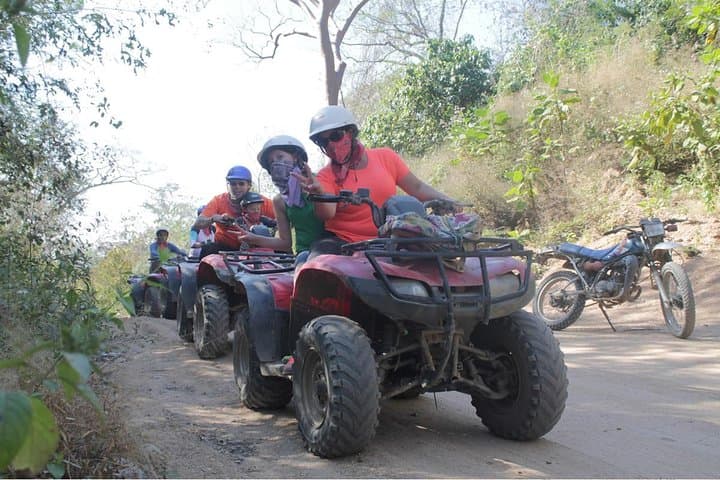
The morning air arriving from the Pacific feels like a handshake: warm, saline, and expectant. You accelerate onto a dry ribbon of dirt that snakes from the coastal plain up into the lower flanks of the Sierra Madre del Sur. The ATV beneath you vibrates with intention—tires throwing fistfuls of dust, suspension answering every rock and rill. Below, the Copalita River moves like a silver thread, unseen at first, then louder, daring you to meet it. By midafternoon you'll trade throttle for paddle, the machine's hum replaced by the river's chatter and the occasional, approving cry of a kingfisher.
This is a nine-hour loop that stitches together two of Oaxaca's most kinetic landscapes: the scrubby, sunburnt slopes where locals grow coffee and tend goats, and the shaded, fern-lined corridor of a river that remembers older weather patterns. The payoff is immediate and layered. From the ATV you read the land—erosion lines, cattle trails, a sudden stand of ceiba trees that throws long shade. From the raft you read water—eddies that want to keep you, riffles that push you forward, and calm pools where crocodiles are rumored but rarely seen.
Geologically, the Sierra Madre del Sur is a cathedral of folded rock and thin soils. Rain here is episodic; when it comes it scours gullies and rearranges trails. The Copalita River cuts toward the Pacific through those folds, carrying the story of inland hills to sea. Culturally, this stretch of Oaxaca is a palimpsest. Zapotec and Mixtec peoples left archaeological traces not far from the river's mouth; colonial-era haciendas later shifted the land economy toward sugar and cattle. Today, small coastal towns like Puerto Escondido blend surf culture with fishing and a steady trickle of adventure travelers.
The tour is delivered by a local operator based in Puerto Escondido and designed as a single-day adrenaline-meets-wildlife experience. Expect a two- to three-hour off-road ATV section—approximately 25–35 kilometers of mixed dirt track and narrow singletrack with roughly 300–500 meters of cumulative elevation gain—followed by a 1.5–2 hour guided rafting stretch on the Copalita with predominantly Class II–III rapids, punctuated by calm pools for wildlife watching and a riverside lunch. The rhythm of the day is deliberate: two-wheels up, two-paddles down.
Why go? Because it compresses a sense of Oaxaca's contrasts into a single day. Riders and paddlers get a practical read on landscape and hydrology, and a direct human connection: your guides are local, their stories anchored in the land—where coffee is harvested, which estuaries breed fish, and which trails double as donkey routes. The tour’s scale also makes it accessible for people who want outdoor intensity without camping or multi-day logistics.
Practical realities: pack for dust and sun on the trail and for damp, cooler conditions on the river. Hydration is non-negotiable; you will work your core and shoulders on the ATV and your arms on the raft. Footwear that secures on pedals and in wet conditions matters. Expect basic safety briefings, helmets, life jackets, and a guide ratio that keeps the ride and the raft moving smoothly.
Local insights matter here. Early dry-season months mean dusty trails and exposed rock; late-summer rains can turn tracks slick and amplify river flow. Wildlife is shy but present—opossums, iguanas, and numerous birds—so move quietly on foot near riverbanks. Take the time at lunch to taste local flavors: a plate of grilled fish or carne asada, lime-heavy salsas, and fresh coconut water will feel like earned rewards.
For people who love sensory contrast—hot, exposed ridgelines followed by shaded river corridors—this is a clean contract between risk and reward. It’s also a cultural exchange: the guides often point out medicinal plants, explain seasonal agricultural cycles, and share stories that ground the day in local knowledge. In short, you leave with more than mud on your boots; you leave with a rounded impression of place.
If you’re planning it, arrive in Puerto Escondido the night before. Bring sun protection for the ATV, quick-drying layers for the river, and a small waterproof dry bag for essentials during the raft section. Be ready for a long day: the tour spans roughly nine hours, and while it’s not technical in the mountaineering sense, it does ask for endurance, attention, and a willingness to get dusty and wet.
This is not a trip for people who prefer desk chairs and predictable surfaces. But for travelers who like to alternate throttle and paddle, who want to feel the land and the water in the same day, and who appreciate local storytelling folded into safety-conscious adventure, this tour delivers. The Copalita dares you to read its current; the Sierra sends you the dust test. Both answer differently depending on the season, and both are better understood up close.
Trail wisdom
Small choices, better day.
Hydrate Early and Often
Start the day with at least 1 liter of water and bring a 2–3 liter hydration system to sip on the ATV and refill at river breaks.
Secure Footwear
Wear closed-toe shoes with good grip that can handle mud and pedal contact; avoid loose sandals that can come off in the raft.
Protect From Sun and Dust
Long-sleeve sun shirts, a neck gaiter, and high-SPF sunscreen will keep dust and sunburn at bay on exposed trails.
Listen During Briefings
Safety briefings cover ATV handling, river commands, and emergency protocols — they matter for your comfort and safety.
Local knowledge
Read the place, not just the route.
Watch for native species including Iguana, Kingfisher.
Keep an eye out for wildlife during the transition between areas and habitats. Respect distance guidelines.
The riverine corridor supports sensitive riparian habitat; operators emphasize leave-no-trace principles and limit river-side impacts during lunch and stops.
Follow the guide's instructions on size limits, ethical handling, and leave-no-trace practices.
A short detour to a shaded spring-fed pool near the Copalita for a post-raft dip. A hillside lookout used by locals to spot migrating birds and coastal whales in season
Locally recommended viewpoints and quiet spots known best to local operators.
The Copalita corridor hosts archaeological traces of pre-Hispanic settlements and later colonial agro-economies; the landscape bears stories of Zapotec cultivation and colonial haciendas.
Maritime roots and regional tradition shape the waterways and working coasts.
Seasonal guide
Four versions of the same landscape.
Spring
Best forDry trails for ATVs · Birdwatching on riverbanks · Stable river flows
ChallengesDusty conditions · Higher daytime heat
Spring’s dry warmth makes for predictable ATV trails and calmer, scenic river runs, though dust and sun exposure increase.
Summer
Best forLush riverside flora · Higher wildlife activity · Warmer water swims
ChallengesAfternoon storms · Potentially stronger river currents
Summer brings green corridors and more wildlife, but afternoon rains can make trails slick and rivers swifter; plan morning departures.
Fall
Best forClear mornings and cooler rides · Post-rain vegetation · Good visibility for photography
ChallengesVariable trail conditions early fall · Occasional rain-swollen flows
Fall balances cooler air with recharged rivers; early season storms can still affect trail traction and river difficulty.
Winter
Best forCooler ATV comfort · Calm, lower river levels · Long-distance vistas
ChallengesChilly mornings · Shorter daylight hours
Winter’s cool mornings make for brisk ATV sections and lower river volumes, giving clearer rapids and broad coastal views.
Operator details
What the booking data adds.
Included
- ✓Hotel pickup and drop-off
- ✓Bottled water
- ✓Driver/guide
- ✓Lunch
- ✓Air-conditioned vehicle
- ✓All activities
Not included
- —Alcoholic drinks (available to purchase)
- —Gratuities
- —Souvenir photos (available to purchase)
Good to know
- ✓Not recommended for travelers with poor cardiovascular health
- ✓Not recommended for travelers with spinal injuries
- ✓Not recommended for pregnant travelers
- ✓Public transportation options are available nearby
- ✓Travelers should have at least a moderate level of physical fitness
- ✓Children must be accompanied by an adult
- ✓Dress code is formal
- ✓May be operated by a multi-lingual guide
Pack with intention
What to bring.
Good to know
Common questions.
The experience is a roughly nine-hour day including round-trip transfers from Puerto Escondido, ATV gear and helmets, guided raft with life jackets, lunch, and bottled water.
Plan the edges
The details that make the day easier.
Puerto Escondido sits on Oaxaca's Pacific coast and the Copalita river corridor contains archaeological remains tied to pre-Hispanic communities, offering a deep historical context to the landscape.
After the trip, head back to Puerto Escondido for fresh ceviche and a cold michelada at a beachfront palapa, or try tlayudas—a local Oaxacan specialty—at a family-run market stall to connect the day’s terrain to regional flavor.
- trailhead
- Puerto Escondido Airport (PXM)
- operator pickup in town; Driving distance from nearest town
- pick-up typically within 15–45 minutes depending on lodging; Cell service expectations: intermittent on the ridgelines, fair near the coast and during river stops; Permits or passes: none typically required for day tours, but operator handles local access.
Operators are encouraged to follow leave-no-trace and to avoid single-use plastics; respect riverbanks and avoid disturbing nesting areas and riparian plants.
Explore by topic
Follow the threads.
Keep exploring
Make the story part of the trip.
Set out from Bass Harbor for a private, customizable day on Blue Hill Bay — lighthouses, puffins, seals, and the chance to feel Acadia from the water. Small groups, local captains, unforgettable views.
In four hours you can move from shaded canyon ferns to wind-scoured coastal ridgelines, guided by someone who knows where the light—and the hidden views—live. This private half-day hike on the Monterey Peninsula or Big Sur is compact, curated, and perfect for travelers who want depth without a multiday commitment.
 Related story
Beneath a sky of shifting light, Skaftafell’s ice reads like a map of time. This three-hour guided glacier hike mixes technical instruction with geology and culture: compact, safe, and unforgettable.