
What the day feels like
Morning glows copper in Sedona. The red rock walls wake slowly, sipping the light until the buttes burn bright and the shadows retreat like a low tide. You climb into the tour vehicle and the door thunks shut; it’s the start of a five-and-a-half-hour lap around a place that doesn’t just sit—it seems to rise, gesture, and point, urging you deeper into its layered story.
Your guide steers along the Red Rock Scenic Byway, the road sneaking between Bell Rock and Courthouse Butte like a guest passing through a giant’s foyer. Sandstone towers keep watch. Juniper leans in with its resinous breath. The rocks take on roles: Bell Rock beckons, Cathedral Rock commands, and the mesas pull the horizon taut. Sedona doesn’t whisper. It greets you with an open palm.
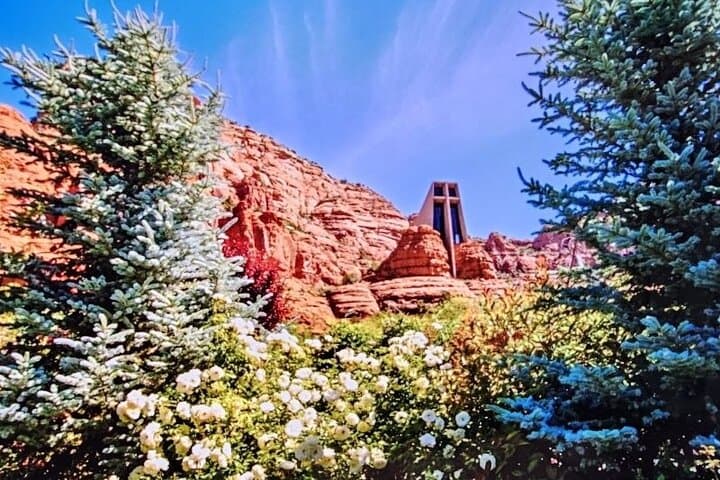
At the Chapel of the Holy Cross, a sliver of modernism set into the cliff, the edges of faith and geology touch. The view spreads in every direction—Munds Mountain, the slickrock fins of Little Horse Trail, neighborhoods stitched into the green where manzanita and prickly pear mingle under piñon. Your guide maps it all with an easy cadence: Triassic to Jurassic layers; cross-bedded sandstone deposited in ancient deserts; iron oxide painting the buttes that impossible red. The names become anchors—Coconino, Schnebly Hill, Supai Group—and suddenly the landscape is legible.
Sedona’s human story runs just as deep. Long before artist colonies and spiritual seekers, the Sinagua people farmed the floodplains of Oak Creek, growing corn and beans and leaving behind cliff dwellings and petroglyphs in shaded alcoves. The Yavapai and Apache called these canyons home, and their descendants remain a vital presence today. Your guide ties these threads without tightening them too much, leaving space for a thoughtful pause after a stop at a vista where a hawk scrawls loops across the blue. This is still living country.
By the time you circle toward Airport Mesa, the town is a map beneath your feet. The air shifts—warm currents rising from the valley. Photographers love this perch at golden hour, but in mid-morning the light draws clean lines where sandstone meets sky. The wind has a voice, pushing forward, nudging you toward the next overlook. Each stop includes short, simple walks to get under the landscape’s skin—just enough steps to smell damp mineral after a monsoon, to hear Oak Creek flick at its banks.
Sedona asks you to be present. On this tour, that’s built in. You’re not charging up long switchbacks or bushwhacking toward a remote summit. Instead, you’re collecting context. Why Cathedral Rock looks like the rib cage of the earth. How the Mogollon Rim frames the northern horizon like a cliff-side curtain call. Where water carves and hides—at Red Rock Crossing, where Cathedral’s reflection drifts on the creek; in the shaded hems of Oak Creek Canyon, where ponderosa lift straight as spires.
Culture breathes through the day, too. You might pass the Amitabha Stupa and Peace Park, a quiet pocket where prayer flags flutter in the breeze and red dirt trails meander beneath juniper. You’ll hear about Sedona’s role as a modern-day artist refuge and the area’s storied reputation for “vortex” energy sites. Whether you buy into the mysticism or not, there’s no denying how the air tilts here—light moves fast, colors turn saturated out of nowhere, and the rocks stand like actors aware of their best angles.
Logistics are friendly. This is a half-day experience designed to orient you to Red Rock Country. It’s ideal early in a trip, the kind of outing that gives shape to the days ahead—what to hike, where to linger for sunset, how to dodge the midday heat. Your guide’s playbook is packed: where to park if you go back on your own, which pullouts are worth a stop, and why staying on signed trails keeps cryptobiotic soils and fragile plant communities intact. In a place this loved, care is part of the adventure.
By afternoon, you’ve traced a full loop through Sedona’s geography and past. The land feels familiar now—a set of rooms you’ve walked through, each with its own light. The final stop has you squinting into a view where red meets blue in a line so clean it looks drawn. The rocks hold steady. The river dares you to seek shade along its cottonwoods later. Your tour ends, but the map in your head is just getting started.
Why do this tour? Because Sedona is best understood with a guide who can translate its geology, honor its cultures, and point out how to make the most of your time without falling into the crowds. Because this is a landscape that rewards attention and patience as much as athleticism. And because sometimes the smartest way to travel is to begin with the story, then go write your own chapters.
Practical Edge - Duration: Approximately 5.5 hours, with multiple viewpoint stops and short walks - Terrain: Paved roads, level to gently sloped viewpoints, occasional steps - Who it’s for: Curious travelers, photographers, families, and anyone who wants a comprehensive, low-impact survey of Sedona before diving deeper - Bring: Closed-toe shoes, sun protection, water, layers in cooler months
After the circuit, you’ll know where to chase the sunset, which trails to save for sunrise, and how to explore respectfully. Sedona will keep speaking long after the van door closes.
Trail wisdom
Small choices, better day.
Start Early for Softer Light
Morning departures mean cooler temps and richer color on the sandstone—photography and comfort both benefit.
Wear Closed-Toe Shoes
Viewpoints can involve uneven rock and a few steps; sturdy shoes improve grip on dusty slickrock.
Hydrate Aggressively
Sedona’s high-desert air is dry year-round—sip water regularly, even on a vehicle-based tour.
Plan Your Post-Tour Stops
Use your guide’s suggestions to return for sunset at Airport Mesa or a creekside stroll at Red Rock Crossing.
Local knowledge
Read the place, not just the route.
Watch for native species including Javelina, Mule deer.
Keep an eye out for wildlife during the transition between areas and habitats. Respect distance guidelines.
Stay on designated paths to protect fragile desert soils and vegetation, and never disturb archaeological sites or collect artifacts.
Follow the guide's instructions on size limits, ethical handling, and leave-no-trace practices.
Amitabha Stupa & Peace Park for a quiet red-dirt stroll and contemplative views. Yavapai Vista viewpoint for an easy-access panorama of Cathedral Rock and the Courthouse Butte area
Locally recommended viewpoints and quiet spots known best to local operators.
The Sinagua people farmed the Oak Creek corridor for centuries before European settlement; today, the Yavapai-Apache Nation maintains cultural ties to this landscape.
Maritime roots and regional tradition shape the waterways and working coasts.
Seasonal guide
Four versions of the same landscape.
Spring
Best forWildflowers and fresh greens · Mild hiking temps
ChallengesPopular viewpoints get busy · Windy afternoons
March–May brings comfortable days, crisp nights, and blooming desert plants. It’s prime time for clear views and relaxed walking.
Summer
Best forEarly-morning glow · Creekside shade
ChallengesHigh heat midday · Monsoon storms late July–August
Expect hot afternoons; schedule early tours and watch for fast-building monsoon clouds that can bring lightning and brief downpours.
Fall
Best forOak Creek foliage · Stable weather
ChallengesBusy weekends · Cooler evenings
September–November offers golden cottonwoods along the creek and steady conditions. Layers help as temperatures drop after sunset.
Winter
Best forQuiet overlooks · Occasional snow-on-red-rock drama
ChallengesCold mornings · Icy patches on shaded paths
Winter days are crisp and clear with fewer crowds. Dress warm; rare snowfalls create stunning photo opportunities.
Operator details
What the booking data adds.
Included
- ✓Parking Fees
Not included
- —Lunch
Good to know
- ✓Service animals allowed
- ✓Public transportation options are available nearby
- ✓Suitable for all physical fitness levels
Pack with intention
What to bring.
Good to know
Common questions.
Expect several short walks from the vehicle to viewpoints, often on level or gently sloped surfaces with occasional steps.
Plan the edges
The details that make the day easier.
Sedona is an International Dark Sky Community, designated by the International Dark-Sky Association in 2014, making it one of the best places in Arizona for stargazing.
Post-tour, head to Creekside American Bistro for views of Snoopy Rock over lunch, then sample local pints at Sedona Beer Co. If you want a quiet cultural detour, visit the Sedona Heritage Museum to see how homesteaders and early filmmakers shaped this town.
- Closest airports
- Flagstaff Pulliam (FLG, ~28 miles) or Phoenix Sky Harbor (PHX, ~120 miles). Most tours depart from central Sedona; many viewpoints are 10–25 minutes by vehicle. Cell service is generally good in town but can drop in canyons. No permits needed for the tour; a Red Rock Pass may be required if you return to park at certain trailheads on your own.
Red Rock Country sees heavy visitation—pack out all trash, keep dogs leashed, and stay on signed paths to protect fragile desert soils and cultural sites. Respect quiet spaces like the stupa and chapel by minimizing noise.
Explore by topic
Follow the threads.
Keep exploring
Make the story part of the trip.
 Related story
Less than two hours from Nairobi, Kereita Forest pairs hands-on canopy adventure with quiet montane trails and a sobering colonial history—perfect for families, teams, and curious travelers seeking a full-day pulse of nature.
Set out from Bass Harbor for a private, customizable day on Blue Hill Bay — lighthouses, puffins, seals, and the chance to feel Acadia from the water. Small groups, local captains, unforgettable views.
In four hours you can move from shaded canyon ferns to wind-scoured coastal ridgelines, guided by someone who knows where the light—and the hidden views—live. This private half-day hike on the Monterey Peninsula or Big Sur is compact, curated, and perfect for travelers who want depth without a multiday commitment.