
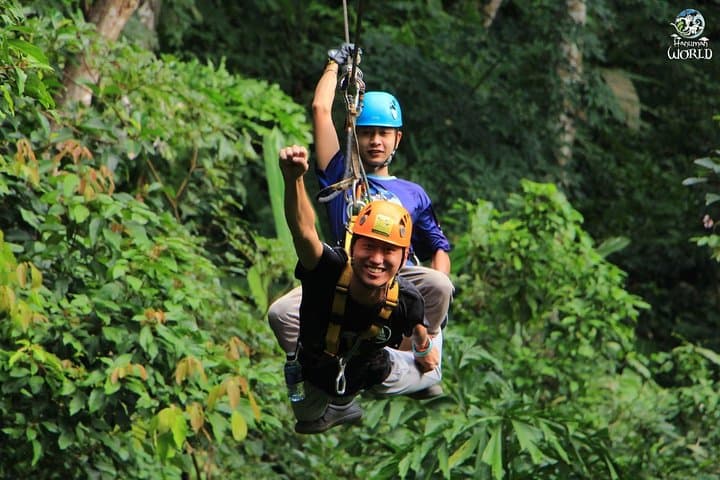
What the day feels like
You step off the platform and the forest does something almost tactile — it inhales. The first cable is long and low, a warm-up that lets the jungle reveal itself: a chorus of green, the distant thrum of a waterfall, a kingfisher slicing bright across a river gorge. Then the line pitches, you lean into the harness, and the world becomes motion. The zipline at Flying Hanuman doesn’t ask you to be heroic. It asks you to move through the rainforest the way wind does — fast, effortless, present.
Set in the wooded foothills near Kathu, just inland from Phuket’s beaches, Flying Hanuman offers a half-day immersion into a landscape often overlooked by sun-seekers: Thailand’s tropical rainforest canopy. The operation runs two core itineraries — a 28-platform course and a longer 42-platform course — that combine ziplines, suspension bridges, spiral stairways and abseils, bookended by a 20-minute wilderness walk. Along the way, dual ziplines let you race a friend, and higher cables give a bird’s-eye view of granite outcrops and river corridors that have shaped the island’s history.
Phuket’s geology is part of the story. The island is a granite outcrop, a remnant of ancient seabed uplifted and sculpted by monsoon rains. That granite underpins the rolling ridges and narrow valleys where pockets of primary and secondary rainforest still cling. The canopy here is a working landscape; historically, the region’s economy centered on tin mining and rubber, and forests were gradually cleared and replanted. Today, pockets like the Flying Hanuman site are managed as adventure tourism zones that also protect the watershed and habitat for area wildlife.
Culturally, a visit to the zipline is a reminder that Phuket has layers beyond its beaches. In nearby Phuket Town, Sino-Portuguese shophouses and street-food stalls reflect waves of trade and migration. Many guides and staff at local adventure companies are from the surrounding communities, blending outdoor skills with local knowledge — and their economic benefit is part of why canopy tourism can be a sustainable alternative to other development pressures.
The mood of the course is deliberate: practical safety briefings, professionally rigged lines, and guides who time your runs to avoid crowding at platforms. Still, the aesthetic is wild. The forest is not a manicured park. Vines lean like sentries across bridges, the undergrowth pockets orchids and ferns, and you’ll likely hear macaques or the squeak of gibbons commuting overhead. On clear days the sun punctuates the green with gold; when the monsoon drums the canopy hard, the leaves glisten and the smell of wet earth becomes the landscape’s dominant note.
Why go? For the obvious adrenaline of speed and height, yes. But equally for the perspective shift: ziplines compress time, turning hours of jungle into a series of clean, kinetic glimpses. It is an efficient way to access a terrain that would otherwise require a full day of hiking. It’s also family-friendly enough that active kids can join the fun, and rewarding for seasoned travelers who appreciate a solid half-day adventure tacked onto a beach itinerary.
Practicalities you should know: courses run on scheduled playtimes (8 a.m., 10 a.m., 1 p.m., 3 p.m.), and the tour is about four hours from pick-up to drop-off if transfers are included. Fitness needs are moderate — you’ll climb stairs and walk short stretches, but the harness does the heavy lifting. Expect mixed terrain: steel platforms, wooden bridges, and a short jungle walk that includes uneven roots and mud when it rains. Bring a light daypack, secure your camera with a strap or use the operator’s photo packages, and schedule your run for the morning if you prefer cooler temperatures and softer light for photography.
Safety standards here are high — guides run pre-flight checks and use redundant ropes and harness points. Still, personal responsibility matters: follow briefings, keep limbs inside bridges and platforms when instructed, and communicate any concerns (if you’re uncomfortable with heights, say so). In terms of ecology, stick to designated paths and avoid feeding wildlife; the goal is an adventure that leaves the forest as it was.
For travelers who want to pair adrenaline with culture, plan a morning zipline and an afternoon in Phuket Town’s old quarter. Sample Hokkien noodles at a family-run stall, and finish with a sunset beer on a beachfront promenade. Flying Hanuman is as much a half-day passport into the island’s interior as it is a thrill ride — and for many visitors, it reframes Phuket from sand-and-sun to landscape-and-life.
If you’re packing: light, quick-dry layers, good closed-toe shoes with grip, a sun hat for arrival and departure, and a phone-sized waterproof case for sudden showers. Book early in high season; the dry months (November–April) are busiest. And if you’re aiming for the clearest runs, choose the first playtime of the day — there’s a crispness to the light and the air is cooler before the midday humidity rises.
Ultimately, Flying Hanuman is about momentum and perspective. You’ll come for the zipline, but you’ll remember the small, quiet things: a hornbill call below a bridge, the scent of damp leaves after the monsoon, the brief, ridiculous grin that comes when you realize you’re flying through the heart of Phuket’s green. It’s an accessible, well-run half-day that knits a splash of adventure into a broader Southeast Asia trip, and it’s the kind of experience that sticks — not just for the speed, but for the way it makes you slow down afterward to notice everything the canopy protects.
Trail wisdom
Small choices, better day.
Book the first playtime
Morning sessions are cooler, less humid, and offer crisper light for photos; lines are also less crowded.
Secure loose items
Use a tethered pouch or the operator’s gear hooks — phones and sunglasses can’t be trusted at speed.
Wear closed-toe shoes with grip
Platforms and jungle walks are uneven and can be slippery when wet; good soles reduce slips.
Bring a small waterproof layer
Tropical showers roll through quickly — a packable shell keeps you comfortable without bulk.
Local knowledge
Read the place, not just the route.
Watch for native species including Long-tailed macaque, Common kingfisher.
Keep an eye out for wildlife during the transition between areas and habitats. Respect distance guidelines.
Many canopy-tour operators work with local communities to protect watersheds and provide sustainable livelihoods; stick to paths and avoid feeding wildlife to reduce human-wildlife conflict.
Follow the guide's instructions on size limits, ethical handling, and leave-no-trace practices.
Explore Phuket Town’s Sunday Walking Street market after your zipline for local snacks and crafts. Visit the small waterfalls and granite outcrops near Kathu for a quiet post-ride stroll
Locally recommended viewpoints and quiet spots known best to local operators.
Phuket was historically a center for tin mining and trade; the island’s mixed cultural architecture reflects Sino-Portuguese and Malay influences.
Maritime roots and regional tradition shape the waterways and working coasts.
Seasonal guide
Four versions of the same landscape.
Spring
Best forWarmer dry-air mornings · Birdwatching in leafed canopy
ChallengesIncreasing heat (Mar–May) · Midday humidity spikes
Spring moves from the cool end of dry season into hotter pre-monsoon months — mornings are best for comfort and visibility.
Summer
Best forLower visitor numbers · Lush green canopy
ChallengesMonsoon showers and slippery platforms · Possible schedule changes
Summer overlaps with the rainy season; expect sudden downpours, but the forest is vivid and less crowded mid-week.
Fall
Best forGood value travel deals · Post-monsoon greenery
ChallengesIntermittent rain early in season · higher humidity
Fall is a transitional period — late fall into November clears into the dry season and offers dramatic light after rains.
Winter
Best forDry, comfortable weather · Peak visibility for views
ChallengesHigher tourist numbers · Advance bookings required
Thailand’s ‘winter’ is the best time for stable weather — clear skies, cooler mornings, and predictable operating schedules.
Pack with intention
What to bring.
Good to know
Common questions.
The total experience lasts about four hours, including safety briefings, harnessing, multiple zipline runs (28 or 42 platforms depending on your choice), suspension bridges, an abseil point, and a short wilderness walk; transfers are often included in bookings.
Plan the edges
The details that make the day easier.
Phuket is Thailand’s largest island and was historically a major tin-mining center; some inland trails and ridges owe their shape to past mining and replanting efforts.
After the course, head to Phuket Town for Hokkien noodles at a local stall or sample fresh seafood at the local markets; a cold Leo beer or a bowl of tom yum at an open-air restaurant is the low-key, satisfying way to round out an active day.
- Closest airport
- Phuket International Airport (HKT); Driving distance: ~25–40 minutes from Patong
- Phuket Town depending on traffic; Cell service
- generally reliable but patchy in dense canopy; Permits: none required for day visitors (operator handles safety certifications).
Support operators that employ local guides and follow leave-no-trace practices; avoid single-use plastics, stay on marked trails, and never feed wildlife to reduce human-habituated animals.
Explore by topic
Follow the threads.
Keep exploring
Make the story part of the trip.
Set out from Bass Harbor for a private, customizable day on Blue Hill Bay — lighthouses, puffins, seals, and the chance to feel Acadia from the water. Small groups, local captains, unforgettable views.
In four hours you can move from shaded canyon ferns to wind-scoured coastal ridgelines, guided by someone who knows where the light—and the hidden views—live. This private half-day hike on the Monterey Peninsula or Big Sur is compact, curated, and perfect for travelers who want depth without a multiday commitment.
 Related story
Beneath a sky of shifting light, Skaftafell’s ice reads like a map of time. This three-hour guided glacier hike mixes technical instruction with geology and culture: compact, safe, and unforgettable.