
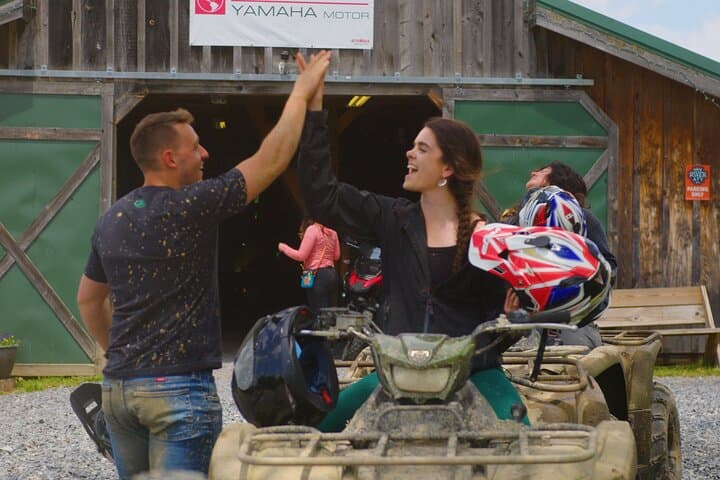
What the day feels like
You start with the engine’s low rumble beneath you and a ribbon of dust unspooling into the valley. The forest here does most of the talking—oak and hickory shoulders crowd the trail, leaves flick a green pattern across helmets, and the gorge opens and closes like a hand offering and withdrawing views. In a matter of minutes the New River is in sight: a dark ribbon threaded through sandstone cliffs, a current that has been carving this place since before the Appalachians themselves rose up.
This is a half-day ATV tour across a network of more than 100 miles of trails carved into the slopes above the New River Gorge. It’s equal parts terrain and tempo: short technical pitches that demand attention, long rolling benches that let you tuck your elbows and enjoy speed, and lookout ridges where the machines fall quiet and the geology does the talking. The ride is designed for a broad range of abilities—guides tune the route to match competence and appetite—so you could be a rider on your first machine or someone chasing a technical loop on a sport-ready quad. The constant is the place itself: steep-cut valleys, coal-era scars softened by regrowth, and the distinctive hush that lives under mature eastern hardwood forest.
Geologically, the New River is a paradox. It’s one of the oldest rivers in North America—its course predates the Appalachian uplift—and it stubbornly slices north to south through rock layers, producing the dramatic drop-offs and rock faces that define the Gorge. Culturally, the corridor bears the imprint of centuries of human work: indigenous pathways, the coal and timber boom of the 19th and early 20th centuries, and a recent pivot toward outdoor recreation that has turned towns like Fayetteville into staging grounds for rafting, climbing, and off-road trips.
Local guides bring more than a spare helmet. They add context: where miners once hoisted coal on narrow-gauge tracks below, where a cellar hole indicates a homestead that fed a family through winters of backbreaking work, and where pockets of rare plant communities cling to cooler north-facing slopes. The ride is part history lesson, part mechanical poetry—throttle control becomes a language for reading terrain as much as an input to acceleration.
Practical details are refreshingly straightforward. The tour runs about 3.5 hours on the trail (210 minutes total), starts and finishes near Fayetteville, West Virginia, and the operator provides top-of-the-line ATVs, helmets, and instruction. Riders must be at least 18 and carry a valid U.S. driver’s license. Groups move at a guided pace with frequent stops—photo outlooks, technique coaching, and safety checks. Expect to spend roughly half the tour on intermediate terrain, with optional loops for more technical sections if your group is up for it.
What makes this session especially appealing is its accessibility without diminishing the sense of remoteness. You’re never far from help or a cellular signal in the worst spots, but the trails weave you through landscapes that feel rugged and remote—especially early or late in the season when the light strikes the ridgelines low and long.
For planning: book early for weekends and prime fall foliage dates; the from-price is about $195 per rider. Wear sturdy, closed-toe boots, bring a hydration pack, and pack layers—the gorge can be ten degrees cooler at the bottom than at the trailhead. Guides emphasize trail etiquette: stay on mapped routes, avoid wet trails that can erode quickly, and respect wildlife and private lands that border many trail corridors.
If you go, take a camera with a fast shutter, but be mindful of mounts—loose equipment on rough trails is a recipe for lost lenses. Choose a lower center of gravity on your machine by keeping knees tucked and weight balanced, and use your throttle like a conversation: small inputs, steady responses. For newcomers, the biggest learning curve is body positioning and anticipating changes in traction—your guide will school you quickly.
Beyond the ride itself, the New River Gorge is a hub for layered outdoor experiences: whitewater rafting in summer, world-class rock climbing on sandstone cliffs, and miles of hiking that reveal coal-era ruins and scenic overlooks. Even a short visit can be a full day: morning on the trail, a late lunch at a local cafe in Fayetteville, and an evening at a community brewery watching the sun tilt behind the gorge.
An ATV tour here is more than a thrill; it’s an embodied way to read the landscape—how rivers predate ranges, how industry shaped communities, and how the same slopes that once fed coal and timber economies now support a resilient outdoor-recreation culture. It’s efficient, tactile, and immediate: the throttle introduces you to the pace of the place, the trails teach you to move through it with curiosity and care, and the views remind you why wild spaces deserve both use and protection.
For travelers deciding whether to sign up: this tour delivers a compact, high-value sample of New River country. It’s well-suited to people who want motion without the logistical overhead of a multi-day trip—who want landscape, history, and speed, all in the span of a morning or afternoon. Follow the guides’ safety instructions, come prepared for dust and temperature swings, and leave with a sense that you’ve traveled through a very old river’s most dramatic chapters.
At the end of the day, when the engines cool and conversations turn to the one section that made everyone laugh or swear, it’s easy to see why this stretch of West Virginia is a magnet. You leave with a collection of small memories—the smell of pine and oil, a cliffside panorama, the feeling of a machine under you that responds to intent—and a clearer sense of a place where natural history and human stories are braided along a river that keeps carving its stubborn path.
Trail wisdom
Small choices, better day.
Hydrate Early
Start with water and continue sipping—ATV riding is deceptively dehydrating, especially on sunny ridge runs.
Eye Protection Matters
Use a sealed goggle or visor; dust and flying debris are common on dirt trails.
Ride the Terrain
Shift your weight forward on climbs and back on descents to maintain traction and control.
Leave No Trace
Stick to designated trails, pack out what you pack in, and avoid muddy detours that damage soil.
Local knowledge
Read the place, not just the route.
Watch for native species including White-tailed deer, Red-tailed hawk.
Keep an eye out for wildlife during the transition between areas and habitats. Respect distance guidelines.
Trails cross sensitive habitats and private lands—operators emphasize staying on mapped routes, minimizing erosion by avoiding muddy detours, and packing out all trash to protect the gorge's ecosystems.
Follow the guide's instructions on size limits, ethical handling, and leave-no-trace practices.
Ridge overlooks that frame the New River Bridge (best at sunrise or late afternoon). Small backcountry hollows where remnant coal-era ruins peek out among regrowth
Locally recommended viewpoints and quiet spots known best to local operators.
The New River corridor has a deep human history: early indigenous travel routes, then a boom in coal and timber through the 1800s and 1900s, which shaped many of the logging roads now used as ATV trails.
Maritime roots and regional tradition shape the waterways and working coasts.
Seasonal guide
Four versions of the same landscape.
Spring
Best forWildflowers and new foliage · Cooler riding temperatures
ChallengesMud on low-elevation trails · Variable weather with late snow or cold snaps
Spring offers fresh green scenery and smoother temperatures, but expect muddy sections—guides may reroute to avoid sensitive wet tracks.
Summer
Best forLong daylight for extended rides · Complementary water activities on the New River
ChallengesHeat and insect activity · Dustier trails and potential afternoon storms
Summer is peak season—plan for heat management, early start times, and busy weekends in Fayetteville.
Fall
Best forPeak foliage colors · Crisp, stable riding weather
ChallengesHigh demand and advanced bookings needed · Cooler morning temps require layers
Fall is optimal for scenery—expect spectacular ridge views and busy tour schedules; book well in advance.
Winter
Best forClear visibility and quiet trails · Less crowded touring
ChallengesCold temperatures and possible icy sections · Shorter daylight hours
Winter rides are quieter and starkly beautiful but demand warm layers and flexible routing to avoid ice.
Operator details
What the booking data adds.
Included
- ✓Bottled water
- ✓After The Tour
- ✓After The Tour
Good to know
- ✓Wheelchair accessible
- ✓Infants and small children can ride in a pram or stroller
- ✓Transportation options are wheelchair accessible
- ✓Suitable for all physical fitness levels
Pack with intention
What to bring.
Good to know
Common questions.
No—guides provide instruction and will match routes to your comfort level, though basic comfort with throttle and braking helps.
Plan the edges
The details that make the day easier.
The New River is considered one of the oldest rivers in North America, predating the Appalachian Mountains it now slices through.
After the ride, head into Fayetteville for locally sourced comfort food and a cold local beer—look for community-run cafes and a brewpub scene that has grown alongside the outdoor economy; conversation quickly turns to trails, river lines, and where to watch sunset over the gorge.
- Closest airports
- Raleigh County Memorial (BKW) ~30–40 min, Charleston Yeager (CRW) ~50–60 min; Driving from Fayetteville: 10–30 minutes depending on trailhead; Cell service: generally good near towns, patchy in hollows; Permits
- Passes
- no special public permits for the tour but operator waiver and ID required.
This area includes sensitive riparian and forest habitats—stay on designated trails, avoid riding when trails are saturated to reduce erosion, and pack out waste to protect the New River Gorge ecosystem.
Explore by topic
Follow the threads.
Keep exploring
Make the story part of the trip.
Set out from Bass Harbor for a private, customizable day on Blue Hill Bay — lighthouses, puffins, seals, and the chance to feel Acadia from the water. Small groups, local captains, unforgettable views.
In four hours you can move from shaded canyon ferns to wind-scoured coastal ridgelines, guided by someone who knows where the light—and the hidden views—live. This private half-day hike on the Monterey Peninsula or Big Sur is compact, curated, and perfect for travelers who want depth without a multiday commitment.
 Related story
Beneath a sky of shifting light, Skaftafell’s ice reads like a map of time. This three-hour guided glacier hike mixes technical instruction with geology and culture: compact, safe, and unforgettable.