
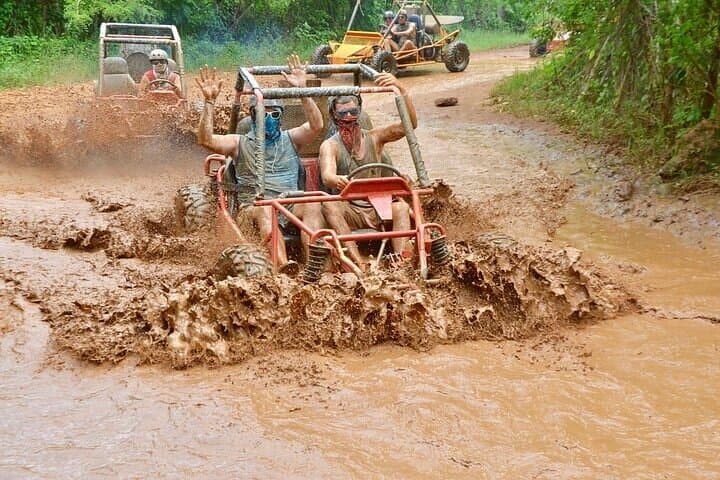
What the day feels like
You kick the starter and the buggy answers with a short, eager bark—your little machine impatient to meet the landscape. Within minutes the manicured resorts of Bávaro recede, replaced by scrubby karst, palms leaning into the trade wind, and a ribbon of road that seems to have been doodled by a local cartographer. The terrain alternates between hard-packed dirt, sand-swept tracks and the occasional wash of coral rubble; each turn rearranges the view: a lone fisherman mending net, a clump of almond trees, the surf flashing beyond a dune.
This is the Buggies Ecological Adventure Tour in Macao, a half‑day ride that packages the theatrical contrasts of the east Dominican Republic into four active hours. It’s not a manic motorsport—more a human-scale expedition where the buggy is your translator, translating the country’s wild coastal pulse into the language of speed and control. Along the way the guide threads in local knowledge: how the soil remembers centuries of reef, where sugarcane plantations once dominated, and why Macao Beach remains one of the few stretches near Punta Cana that has kept a raw, public character.
Geologically, you’re traveling over the island’s younger limestone platform—karst features etched by rain and time, with fragments of ancient reef embedded in the dirt. The result is a landscape that favors low scrub, scattered palms, and sand pockets that test your line through corners. Historically, the Macao corridor sits between two worlds: the tourist infrastructure that boomed here in the late 20th century, and older coastal communities that fished and farmed long before mass resorts arrived. Guides often point out small palapas where families sell fried fish and coconut water—simple reminders that tourism and local life still negotiate daily.
Macao Beach is the tour’s payoff. Unlike the long, screened-off hotel beaches east of Bávaro, Macao has a living shoreline. Waves arrive with real energy, and local surfers read them with a practiced eye—this stretch is one of the best surf breaks on the Dominican east coast. The sand is broad and coarse in places, soft in others; you’ll likely have ten minutes to stretch your legs, to step into the surf, and to sample a fresh pescado frito from a roadside shack while the buggies idle in the shade.
Culturally, the ride is a reminder that the Dominican Republic isn’t a single story. You’ll sense influences from Taino place names to Spanish colonial traces and African-rooted culinary traditions. The guides—often local—are storytellers, too: they point out how the land was used for sugar and how recent conservation efforts try to protect the coastal dunes and surf breaks from overdevelopment.
Practical notes: the tour runs about four hours (roughly 240 minutes). Expect a mix of slow technical sections and faster, open runs. Driving skill is part of the fun—these are not paved highways—and the buggies require constant engagement: throttle modulation on sand, smooth steering on uneven rock. Bring closed-toe shoes and a spirit for modest bumps; the pace encourages you to look up from the dash.
Why travelers book this rather than a bused beach day? It’s active and immediate—the physicality of steering through landscape creates a more intimate relationship with place than watching from a resort balcony. For families or groups of mixed ability it’s adaptable: guides adjust speed, and there are plenty of stops to regroup, photograph, or taste local snacks.
If you go: plan for midday heat if you’re there in high season—sun protection is nonnegotiable. The dry months (December–April) offer more predictable dust and less rain, while the summer brings greener surroundings and the occasional dramatic downpour that turns tracks into slick challenge runs. Safety is managed by the operator: helmets, basic briefings, and a local guide who knows where to cut or throttle back. Still, the activity is motorized and requires attention—this is adventure, not a chauffeured tour.
For photographers, the ride’s best frames come when you pause: a low-angle shot of lines in the sand, a portrait backlit by palm fronds, or surf arcs at Macao with spray frozen against blue. Keep a lightweight, weather-sealed camera or a phone in a dry pouch; dust is the persistent nemesis.
In short: the Macao buggy tour is kinetic, scenic, and culturally textured. It’s ideal for travelers who want a short but physical immersion into the Dominican coast beyond the resort strip. You leave with sand in your shoes, a better sense of the island’s edges, and a memory of a horizon that feels a little wilder for having been driven.
Length & Practical Summary - Duration: approximately 4 hours. - Skill: comfortable with basic vehicle handling; no special license typically required for tourist buggies, but follow the operator’s briefing. - Terrain: sandy tracks, hard-packed dirt, occasional rocky patches; short on elevation gain but high on sensory variety.
The tour is a meeting of contrasts—machine and sea, local economy and global tourism. It doesn’t sugarcoat the region, and that’s the point: it gives you an honest half day of motion, salt, and story.
Trail wisdom
Small choices, better day.
Wear closed‑toe shoes
The tracks can be rocky and bumpy—sturdy shoes protect your feet and provide better control while entering/exiting the buggy.
Bring a dry pouch
Dust and spray are both likely; protect phones and cameras with a waterproof, dustproof pouch.
Hydrate and sun‑protect
Carry water and apply SPF—four hours in the trade wind can still leave you sunburned and dehydrated.
Listen to the guide
Guides know local tracks and surf conditions—follow their instructions for speed and line choices.
Local knowledge
Read the place, not just the route.
Watch for native species including Brown pelicans hunting surf, Iguanas and small lizards on the dunes.
Keep an eye out for wildlife during the transition between areas and habitats. Respect distance guidelines.
Local groups and guides emphasize protecting dunes and surf access—avoid driving on vegetated dunes and pack out all trash to reduce erosion and habitat loss.
Follow the guide's instructions on size limits, ethical handling, and leave-no-trace practices.
Small palapa fish shacks near Macao beach—fresh fried catch and coconut water. A short inland detour to a local artisan stand selling woven hats and palm crafts
Locally recommended viewpoints and quiet spots known best to local operators.
The Macao corridor sits on limestone plain once dotted by small farms and coastal fishing communities; recent decades saw development pressure from tourism expansion.
Maritime roots and regional tradition shape the waterways and working coasts.
Seasonal guide
Four versions of the same landscape.
Spring
Best forDry weather drives · Sharper coastal views
ChallengesIncreased visitors on Easter week · Dusty tracks in dry spells
Late winter into spring is generally dry and stable—good visibility and predictable track conditions, but expect slightly higher visitor numbers around holidays.
Summer
Best forLush coastal scenery · Lower travel prices
ChallengesAfternoon rain showers · Softer, muddier tracks after storms
Summer brings greener scenery and fewer crowds; short, heavy storms can briefly make some trails slippery or sandy.
Fall
Best forQuieter beaches · Warm water for a post‑ride swim
ChallengesHurricane season window (keep an eye on forecasts) · Occasional rain
Fall can be quieter but more weather‑variable—check forecasts and be prepared for sudden rain.
Winter
Best forPeak dry season · Stable seaside conditions
ChallengesPeak tourist season and higher prices · Sun intensity despite cooler air
Winter is the most predictable season for clear skies and firm tracks—book early to secure preferred times.
Operator details
What the booking data adds.
Included
- ✓Air-conditioned vehicle
Not included
- —Gratuities
- —Alcoholic Beverages
Good to know
- ✓Not recommended for travelers with spinal injuries
- ✓Not recommended for travelers with poor cardiovascular health
- ✓Not recommended for pregnant travelers
- ✓Travelers should have at least a moderate level of physical fitness
Pack with intention
What to bring.
Good to know
Common questions.
Most operators provide instruction and you can drive on tour without a local license; confirm requirements when booking and follow the safety briefing.
Plan the edges
The details that make the day easier.
Macao Beach is renowned locally for its surf—one of the better breaks on the east coast of the Dominican Republic and a favorite among Dominican surfers.
After your ride, head to a beachfront palapa at Macao for fried fish with tostones and a cold Presidente beer, or return to Bávaro for more restaurant variety—try a local sancocho or a seafood plate at a family‑run comedor to sample Dominican flavors.
- Closest airport
- Punta Cana International Airport (PUJ); Driving distance: ~30–45 minutes from Bávaro
- Punta Cana; Cell service
- generally good along main roads, patchy on some coastal tracks; Permits: none typically required for tourist buggies—operator handles logistics.
Respect dune vegetation and marked paths—driving on vegetated dunes accelerates erosion; support operators who practice 'leave no trace' and minimize waste at beach stops.
Explore by topic
Follow the threads.
Keep exploring
Make the story part of the trip.
Set out from Bass Harbor for a private, customizable day on Blue Hill Bay — lighthouses, puffins, seals, and the chance to feel Acadia from the water. Small groups, local captains, unforgettable views.
In four hours you can move from shaded canyon ferns to wind-scoured coastal ridgelines, guided by someone who knows where the light—and the hidden views—live. This private half-day hike on the Monterey Peninsula or Big Sur is compact, curated, and perfect for travelers who want depth without a multiday commitment.
 Related story
Beneath a sky of shifting light, Skaftafell’s ice reads like a map of time. This three-hour guided glacier hike mixes technical instruction with geology and culture: compact, safe, and unforgettable.