
What the day feels like
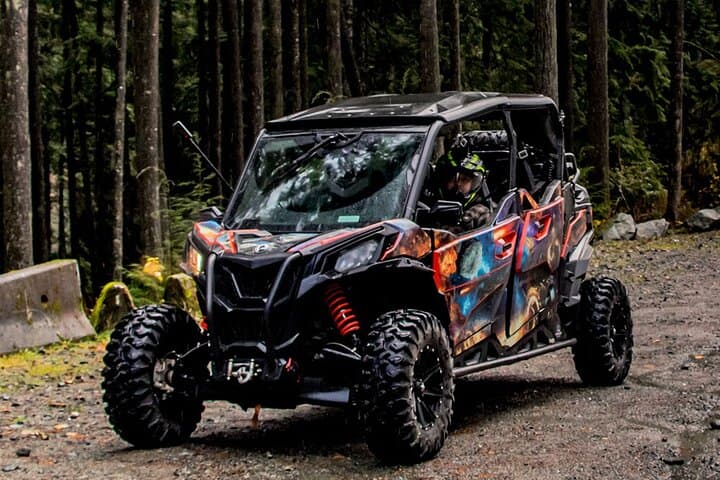
The engine breathes like a caged animal and the forest answers. You push the throttle and the UTV surges forward, tires chewing through loam and moss while cedars lean in to watch. For a day—ten hours of single-track, ridge runs, and river crossings—you’re not on a pavement timetable; you’re moving with the country: the Coast Mountains to the north, the glassy inlet to the west, the steady scent of cedar and wet stone. This is a full-day ATV (UTV) adventure staged out of Vancouver that puts you in the driver’s seat of a powerful off-road vehicle, threading through terrain that is at once rugged and carefully stewarded.
Start times are early and the day feels designed so that the light moves with you. Morning mists hang low in the valley, keeping the air cool, and by late afternoon the coastal sun fires the ridgelines into gold. The route changes with the seasons—rutted, slippy trails in the shoulder months, dusty and jumpy in the dry late summer—and the operator’s local knowledge keeps the experience authentic and safe. Expect to cover dozens of kilometers across logging roads, technical single-track, and open meadows; breaks on viewpoints and rivers give you time to taste the place rather than simply pass through it.
The landscape you move through is part of the Pacific Northwest’s geologic story: uplifted Coast Mountains carved by repeated glaciations, spliced by river valleys and sheer granite outcrops. On many runs you’ll see evidence of that history in exfoliating granite faces, glacial erratics, and sedimentary fans. Culturally, this is the traditional territory of the Musqueam, Sḵwx̱wú7mesh (Squamish) and Tsleil-Waututh peoples—lands whose management and stewardship long predate motorized trails. Local operators increasingly partner with Indigenous guides and landholders to reduce impacts and share cultural context, so ask about that when you book.
This particular tour is designed as a private, full-day experience—ten hours of guided UTV time with instruction, safety gear, and route planning included. The fee reflects that level of service: private vehicles, experienced guides, and logistical support are built into the price. A typical day mixes open, fast sections (where you can let the UTV stretch its legs) with tighter technical stretches that reward concentration and finesse rather than speed. You’ll learn to read trail surfaces—slick clay after rain, loose shale on descents—and how to use engine braking, throttle control, and weight distribution to make the machine feel like an extension of your body.
Why book something like this? For starters, it’s immediacy: you cover ground you couldn’t see on foot in a day and get into viewpoints that are otherwise inaccessible without long hikes or multi-day logistics. It’s also communal—the vehicles are social, so the day feels like a rolling conversation, punctuated by the kind of shared laughter that comes after a muddy splash or a technical climb that required everyone’s coaching. For photographers, the vantage points change by the hour; for families or groups with mixed fitness levels, the UTV lets you share a rugged outdoor day without leaving anyone behind.
Practicalities matter. This is a full-day commitment—expect to be out for roughly 10 hours, with most of that on-trail. Guides supply helmets, safety briefings, and basic instruction; no advanced off-road experience is required, though a steady head and willingness to learn help. Dress in layers—coastal weather can flip from fog to sun in an hour—and bring closed-toe shoes with decent tread. Hydration is essential; even with mid-day breaks, the act of driving and the concentration demanded by rough terrain is surprisingly tiring.
There’s an environmental balance to strike: well-managed UTV operations stick to designated trails, limit group sizes, and practice leave-no-trace principles. Ask your operator about trail stewardship and how they minimize impacts—good outfits will know the names of the access points and the broader restoration projects in play. If you respect that framework, the payoff is huge: sweeping vistas, close-up encounters with old-growth cedars and coastal alder, and the kind of wild openness you rarely find within an easy drive of a major city.
After the ride, route back to Vancouver’s waterfront and you’ll find a city that pairs well with the day’s grit—seafood, craft beer, and a rooftop view. It’s a satisfying loop: the rawness of backcountry transmission and the civility of city dining in the same twenty-four hours.
If you’re booking: confirm what’s included (vehicle per two people vs. per person, fuel policy, waiver forms, any minimum age or license requirements), check cancellation terms, and ask about options for customizing routes if you want more technical sections or a gentler, scenic loop. For photographers, plan for a chest harness and a lens cloth—trail dust is part of the deal. And finally, go willing to slow down: the machine is fast, but the best moments are small—a river crossing that surprises you, a horned raven that follows the party, a sudden clearing with a view that makes the whole day snap into focus.
Trail wisdom
Small choices, better day.
Layer for coastal changeability
Mornings can be foggy and cool while afternoons warm up—pack a lightweight waterproof shell and breathable mid-layer.
Bring closed-toe, grippy shoes
Appropriate footwear stabilizes you in the UTV and during on-trail stops; avoid sandals.
Hydrate and snack often
A day of focused driving and trail vibrations increases sweat and fatigue—carry at least 2 liters and high-protein snacks.
Listen to your guide
Guides know where to push and where to conserve trails—follow instructions for safety and reduced impact.
Local knowledge
Read the place, not just the route.
Watch for native species including Black-tailed deer, Bald eagle.
Keep an eye out for wildlife during the transition between areas and habitats. Respect distance guidelines.
Responsible operators stick to designated trails to limit erosion and often participate in trail maintenance; visitors should avoid widening tracks and pack out all waste.
Follow the guide's instructions on size limits, ethical handling, and leave-no-trace practices.
A ridge-side meadow that opens to a rarely visited inlet viewpoint. A small backcountry river ford with natural pools for a lunchtime stop
Locally recommended viewpoints and quiet spots known best to local operators.
The Coast Mountains were shaped by repeated glaciations and have long been inhabited and stewarded by Musqueam, Sḵwx̱wú7mesh and Tsleil-Waututh peoples—ask your guide about local place names.
Maritime roots and regional tradition shape the waterways and working coasts.
Seasonal guide
Four versions of the same landscape.
Spring
Best forgreen forest photography · rushing rivers · cooler temps for driving
Challengesmuddy trails · increased runoffs · variable weather
Spring brings saturated soils and fast rivers—expect muddy sections and best-in-show waterfalls, but pack for wet conditions.
Summer
Best fordry, faster trails · longer daylight · clear ridgeline views
Challengesdusty conditions · higher temperatures · more weekend crowds
Late summer is the driest and most stable time for UTVs—fast runs and wide viewpoints, but protect gear from dust.
Fall
Best forautumn colors · cool, crisp air · quieter trails
Challengesearly nightfall · wet leaves slicking trails · cooler mornings
Fall offers dramatic colors and fewer people; be prepared for rapidly cooling temperatures and shortening days.
Winter
Best forsnow-dusted scenery · muted light for photos · fewer visitors
Challengessnow/ice on trails · cold conditions · limited route access
Winter can be beautiful but more technical: expect snow, ice, and possible route closures—confirm vehicle suitability before booking.
Operator details
What the booking data adds.
Included
- ✓Helmets
- ✓1 UTV ( 1 driver + 3 passengers per UTV)
- ✓Sound system
- ✓UTV
- ✓Gas
Good to know
- ✓Public transportation options are available nearby
- ✓Not recommended for travelers with spinal injuries
- ✓Not recommended for pregnant travelers
- ✓Not recommended for travelers with poor cardiovascular health
- ✓Travelers should have at least a moderate level of physical fitness
Pack with intention
What to bring.
Good to know
Common questions.
No special off-road license is typically required; guides provide instruction and a waiver, but you should have a valid government-issued ID and be comfortable operating a manual or automatic off-road vehicle.
Plan the edges
The details that make the day easier.
Vancouver lies on the traditional territories of the Musqueam, Sḵwx̱wú7mesh (Squamish) and Tsleil-Waututh nations—these communities have managed and cared for the land for millennia.
Finish your day back in Vancouver with fresh-caught Pacific salmon at a waterfront seafood spot, or head to Gastown and try a local craft brewery—many operators will recommend a nearby pub or sushi spot ideal for rinsing off the day’s grit and sharing photos.
- Closest airport
- Vancouver International Airport (YVR); Typical driving
- pickup from downtown Vancouver
- 30–90 minutes depending on trailhead; Cell service: intermittent on trails—expect dead zones; Permits: operator handles access—waiver required, no additional public permits usually needed.
Stay on designated trails, avoid widening tracks, pack out all trash, and ask about operator trail restoration projects—responsible use keeps access open for everyone.
Explore by topic
Follow the threads.
Keep exploring
Make the story part of the trip.
Set out from Bass Harbor for a private, customizable day on Blue Hill Bay — lighthouses, puffins, seals, and the chance to feel Acadia from the water. Small groups, local captains, unforgettable views.
In four hours you can move from shaded canyon ferns to wind-scoured coastal ridgelines, guided by someone who knows where the light—and the hidden views—live. This private half-day hike on the Monterey Peninsula or Big Sur is compact, curated, and perfect for travelers who want depth without a multiday commitment.
 Related story
Beneath a sky of shifting light, Skaftafell’s ice reads like a map of time. This three-hour guided glacier hike mixes technical instruction with geology and culture: compact, safe, and unforgettable.