
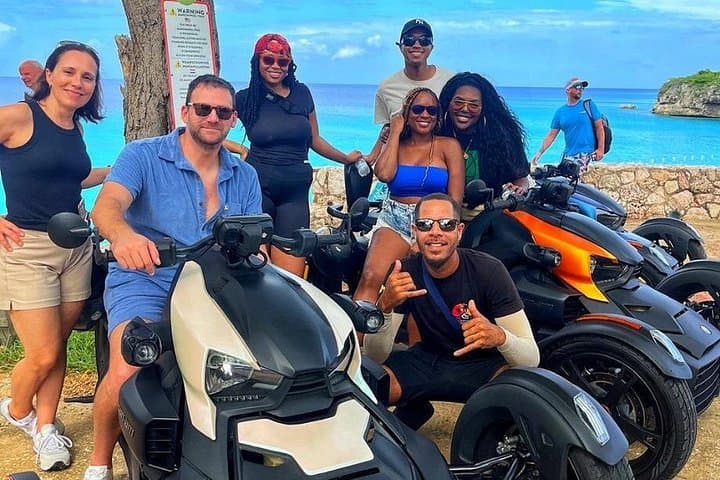
What the day feels like
You feel the engine before you see the horizon. It arrives as a low, eager vibration beneath your palms, a promise of speed and sand and salt air. The road out of Willemstad tightens into coral-strewn tracks, the citys bright Dutch facades shrinking behind you as cacti and spiny shrubs take over. Within minutes the idea of an island holiday—lounging on a single beach—splits into something kinetic: each turn reveals a new shade of Caribbean blue, a different shape of rock, a stiller pool of water hosting an improbable avifauna.
This is a three-hour Can‑Am loop across Curaçao's west side, a compact ride that stitches together the island's best shorthand: wind on your face, swimming with sea turtles, and salt flats where flamingos mime a choreographed calm. Guided, group-paced, and staged from Willemstad, the tour is short enough to leave the rest of your day open and long enough to feel like a true escape from the cruise-ship postcard.
The route is practical and cinematic at once. First stop, Daniels, a roadside patch where someone slices open a coconut and hands you the sweet, clean water that feels like permission to relax. You sip it while the guide briefs you—safety, line order, and the soft rules of Curaçao off-road etiquette. Then the Can‑Ams dip toward Grote Knip, a wide crescent of sand so white it makes the ocean look impossibly deep. Riders often pull off here for a short stretch: the sand is forgiving, the cliffs offer quick viewpoints, and the coves have a clarity that tempts a quick snorkel.
Playa Grandi is the trip’s marine highlight. It’s the kind of beach that runs on reputation: sea turtles arc in the shallows, their heads bobbing as if checking who’s come to see them. Your guide times the stops for calm water and minimal boat traffic; you enter in a controlled group, swim with purposeful respect, and watch the ancient, unhurried rhythm of marine life. After the water cools your shoulders, the ride continues to Jan Kok’s salt flats, a shallow, glittering expanse where pink flamingos pick at brine shrimp with astonishing patience. That color against the glassy flats feels staged by nature, then repeated in the memory when you talk about it later.
Underneath the easy pleasures is an island shaped by geology and history. Curaçao sits on a largely limestone base topped by wind-sculpted scrub and cliffs. The island’s western shore is where waves have met rock for millennia; coves and beaches are separated by jagged terraces of fossilized coral. Willemstad itself, your launch point, is a living archive of colonial trade and architecture; its waterfront neighborhoods are a UNESCO World Heritage Site, a reminder of how the Caribbean was stitched into global commerce and culture.
The tour is short on elevation—this is a coastal island—but it demands attention. Tracks turn from tar to sand to broken coral; traction can surprise you. That makes timing important: mornings are cooler and the sea calmer, and your best turtle encounters tend to be earlier in the day before waters warm and boats churn surf. The operator supplies helmets and pre-ride instruction; riders can add a passenger for free, which makes this one of the more social, cost-effective outing options on the island.
Practicalities matter here. The whole loop runs about three hours with several purposeful stops; expect to ride roughly 35–50 kilometers depending on specific routing. Dress for sun and salt: layered moisture-wicking clothing, closed-toe shoes for the saddle, reef-safe sunscreen for the swim stop, and a small dry bag for a phone and ID. Bring cash for a coconut or a quick snack, though most modern vendors accept cards near the larger beaches.
Safety is straightforward but non-negotiable. Vehicle handling is taught, but if you are new to off-road riding, mention it during booking—the guides will pace the group accordingly. Watch the dunes and coral patches: when the track narrows, let the guide set speed. And in the water, remember the golden rule of wildlife encounters—watch, don’t touch. Sea turtles are protected and flamingos are easily spooked by loud, sudden movement.
Why book a short, motorized loop when you could spend the day snorkeling or hiking? Because this tour compacts variety into an action-packed afternoon: it’s transportation, viewpoint, and wildlife encounter rolled into one. For travelers short on time, families wanting a single memorable outing, or couples looking to combine adrenaline with postcard beaches, it’s perfectly calibrated.
If you go, aim for morning departures, hydrate before you arrive, and leave space in your afternoon for a slow meal in Willemstad. Savor the contrast—the mechanical, immediate thrill of a Can‑Am ride and, minutes later, the soft choreography of a turtle underwater, utterly indifferent to your presence. It’s an island lesson in scale: fast engines and slow animals coexisting under the same sun.
Trail wisdom
Small choices, better day.
Ride early
Morning departures offer cooler temperatures, calmer sea conditions for snorkeling, and better chances to see turtles close to shore.
Use reef-safe sunscreen
Youll stop to swim at Playa Grandi; protect reefs by choosing reef-safe sunscreen and applying before you arrive.
Closed-toe shoes only
Wear sturdy, closed-toe shoes for better control on sandy and rocky tracks.
Respect wildlife distances
Do not chase or touch turtles or flamingos; follow your guide’s instructions for viewing and swimming.
Local knowledge
Read the place, not just the route.
Watch for native species including Green sea turtles, Caribbean flamingos.
Keep an eye out for wildlife during the transition between areas and habitats. Respect distance guidelines.
Curaçao's reefs and coastal birds are sensitive to disturbance—stay on marked paths, use reef-safe sunscreen, and follow guide instructions to minimize impact.
Follow the guide's instructions on size limits, ethical handling, and leave-no-trace practices.
Small coves north of Grote Knip that are quieter than the main beach. The viewing platform at Jan Kok for slow photography sessions of flamingos at low tide
Locally recommended viewpoints and quiet spots known best to local operators.
Willemstad’s historic center is a UNESCO World Heritage Site, reflecting the island's colonial trading history and distinctive Dutch-Caribbean architecture.
Maritime roots and regional tradition shape the waterways and working coasts.
Seasonal guide
Four versions of the same landscape.
Spring
Best forwarmer water snorkeling · fewer wind-driven waves
Challengesoccasional short showers · stronger midday sun
Spring is warm with stable sea conditions ideal for snorkeling, though quick showers can appear—pack a light shell.
Summer
Best forlonger daylight hours · lush coastal scenery
Challengeshotter temperatures · higher humidity
Summer brings heat and humidity that make early-morning rides more comfortable; stay hydrated and use sun protection.
Fall
Best forquieter beaches · good visibility underwater
Challengesoccasional tropical squalls · variable surf
Fall is shoulder season with fewer crowds and good snorkeling, but watch for the occasional squall that can roughen coastal waters.
Winter
Best fordry weather · calm seas · peak wildlife viewing
Challengeshigher visitor numbers · pricier travel
Winter is dry season—ideal for clear water and comfortable riding, though it’s also peak tourist season.
Operator details
What the booking data adds.
Included
- ✓Unlimited Free bottled water
- ✓Free Fresh Coconut
- ✓Use of Snorkelling equipment
- ✓Free Granola Bar
- ✓Quality gear ensuring a safe and worry-free adventure.
- ✓Free photos taken by the tour guide during the tour, so you can relive the memories.
Not included
- —Private transportation
- —Pick-up Fee 15 USD per person
- —Safety Deposit of $250 per bike on location
Good to know
- ✓Public transportation options are available nearby
- ✓Not recommended for travelers with spinal injuries
- ✓Not recommended for pregnant travelers
- ✓Not recommended for travelers with poor cardiovascular health
- ✓Travelers should have at least a moderate level of physical fitness
- ✓The total duration of the tour includes the travel time.
Pack with intention
What to bring.
Good to know
Common questions.
The tour lasts approximately three hours and includes Can‑Am rental, helmet, guided driving, multiple stops (Daniels, Grote Knip, Playa Grandi, Jan Kok), and time for a supervised swim with sea turtles.
Plan the edges
The details that make the day easier.
Willemstad's historic city center has been a UNESCO World Heritage Site since 1997, celebrated for its vibrant colonial architecture and role in Caribbean trade.
After the ride, head back to Willemstad’s Pietermaai or Punda districts for local flavors: try keshi yena (a savory stuffed cheese dish) at a local eatery, sip a cocktail with blue Curaçao, or find Plasa Bieu for authentic island food and a casual beer.
- Closest airport
- Curaçao International Airport (CUR) ~20 minutes to Willemstad; Typical drive to western start points: 30–45 minutes; Cell service: good in town, patchy on remote beaches; Permits: none required—guided tour covers vehicle use
This tour visits sensitive marine habitats and salt flats—use reef-safe sunscreen, keep distance from wildlife, and follow guides to reduce impact on nesting and feeding areas.
Explore by topic
Follow the threads.
Keep exploring
Make the story part of the trip.
 Related story
Less than two hours from Nairobi, Kereita Forest pairs hands-on canopy adventure with quiet montane trails and a sobering colonial history—perfect for families, teams, and curious travelers seeking a full-day pulse of nature.
Set out from Bass Harbor for a private, customizable day on Blue Hill Bay — lighthouses, puffins, seals, and the chance to feel Acadia from the water. Small groups, local captains, unforgettable views.
In four hours you can move from shaded canyon ferns to wind-scoured coastal ridgelines, guided by someone who knows where the light—and the hidden views—live. This private half-day hike on the Monterey Peninsula or Big Sur is compact, curated, and perfect for travelers who want depth without a multiday commitment.