
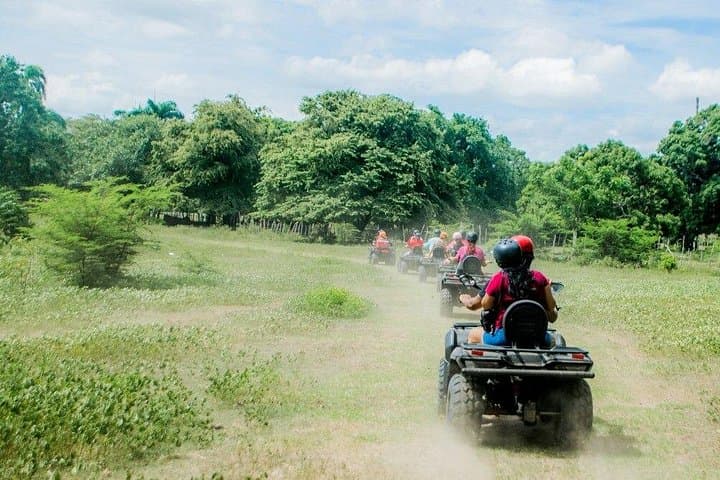
What the day feels like
The engine’s first breath punches the morning quiet. Dust rises in a gold sheet from the path ahead, and sugarcane stalks on either side lean like an audience watching you pass. For the next three-and-a-half hours you’ll alternate between lowland pace and full-throttle grins: rutted dirt roads that rattle your ribs, a narrow lane that smells of fresh coffee, a cigar factory whose humidity and cedar are as precise as an instrument, and a final, cool surrender at a near-empty beach where the Caribbean insists you walk straight into the water.
This is Puerto Plata by throttle—an easy-to-reach slice of the Dominican Republic that rewards motion. The Viator-run ATV Adventure Tour in Puerto Plata Culture and Beach is short enough to fit into a half-day itinerary but long enough to feel like you’ve gone somewhere. It’s not a hair-raising, rock-crawling expedition; it’s an accessible, motorized land-tour that stitches together landscapes, local commerce, and a moment of ocean. You’ll cover a patchwork of treated dirt lanes and coastal trails—roughly 12–18 miles of riding with minimal elevation change—rolling through agricultural lowlands, small hamlets, and the rim of beachfront where the sea tempts you to strip off your dusty layer.
Puerto Plata’s coastline and hinterland have been threaded by movement for centuries. The city was one of the early Atlantic ports of Hispaniola, a meeting point for trade winds, colonial ambition, and, later, tourism. Geologically, the region sits on the northern edge of the Hispaniola microplate: limestone and volcanic outcrops give way quickly to alluvial soils that favor sugarcane and coffee cultivation. Cultural history is present on the route—cigar-making is both craft and economy here, and small-scale producers still roll local tobacco into rich, humid sticks. The tour leans into that practical cultural exchange: short tastings of coffee, chocolate, and cigars aren’t just stop-and-go novelties; they’re a way to connect a single ride to the livelihoods that shape landscapes.
Your bilingual guide does more than call directions. Expect a running commentary on crops, on the labor rhythm of the fields, on the story behind a family-run factory where cocoa is roasted and cocoa nibs are turned into smooth chocolate. They’ll point out how mamajuana—a local rum-infused herbal concoction—started as a home remedy and became the unofficial drink of the northern coast. And when you finish on the sand, the sea acts like a patient teacher: the water doesn’t ask permission, it simply draws you in, a blue invitation after dust and engine heat.
Practically speaking, this is a user-friendly adventure. The experience spans 3–3.5 hours of guided activity (the operator lists 180–240 minutes total) and includes round-trip transport from Puerto Plata, Sosúa, Cabarete, and nearby resorts. It’s designed for families and adrenaline-seekers alike—routes are curated for safety, and a bilingual guide provides continuous support. Expect a mix of single-rider ATVs and two-seat buggies; operators usually accommodate first-timers with a quick safety and handling lesson before you leave.
Terrain notes: the tracks are coastal lowland—dirt, sand, and packed trails—with occasional ruts and short, rooty patches where drainage cuts across lanes. Elevation gain is negligible; you won’t be climbing alpine passes, but the surface can demand attention, so a steady seat and basic throttle control matter. The final beach stop is usually at a quiet stretch where you can swim; currents are friendly near shore but always respect posted warnings.
Why go? It’s compact and social: you get motion, access, and bites of culture without committing a full day to travel. It’s a particularly good option if you’re based in Cabarete or Sosúa and want to blend an active, outdoorsy impulse with laid-back coastal time. The combination of engine, culture stops, and a seawater rinse makes for a well-structured experience—there’s momentum, and then relief. You leave with a photograph of a sun-sprayed field, a memory of a warm cigar wrapper in your hand, and sand between your toes.
For planning: travel light but smart. Bring a bandana or buff to keep dust out of your teeth, sunglasses that stay put, and a small, securely strapped daypack if you want a camera and a bottle. Timing matters: mornings are cooler and the light is better for photos; after midday, the heat creaks up and the beach stop feels more like refuge than reward. Operators accept most experience levels but will require a liability release and an ID; ask in advance about passenger rules if you prefer a two-seat buggy instead of piloting an ATV yourself.
Environmentally, staying on prescribed tracks is important—these lowland soils erode if riders spill off trail. Respect local businesses at tasting stops: purchases and polite engagement directly support neighborhoods where tourism revenue can be limited but impactful.
If you leave wanting more, Puerto Plata’s northern coast supplies it: kite-surfing in Cabarete, snorkeling from Sosúa’s reefs, and a slower day of exploring the historic Victorian facades in Puerto Plata town center. But on a busy travel schedule, this half-day trail delivers a concentrated, kinetic sense of place: landscape, livelihoods, and the lure of the sea, all accessed by the most immediate travel mode the island loves—one with an engine and a grin.
Trail wisdom
Small choices, better day.
Start Early
Morning departures mean cooler temperatures, better light for photos, and firmer trail surfaces.
Bring a Buff
A neck gaiter or bandana cuts dust and wind—simple, effective protection for the drive.
Secure Your Camera
Use a chest harness or wrist strap—phones and cameras jostle on rough sections.
Listen to the Guide
Guides manage route safety and local context—follow instructions on speed and passing.
Local knowledge
Read the place, not just the route.
Watch for native species including Brown pelicans, Coastal hermit crabs and shorebirds.
Keep an eye out for wildlife during the transition between areas and habitats. Respect distance guidelines.
Stick to designated trails to prevent coastal erosion and avoid disturbing shoreline vegetation; support local producers at tasting stops.
Follow the guide's instructions on size limits, ethical handling, and leave-no-trace practices.
Small family-run cigar and chocolate shops along the route (buy direct to support locals). Quiet beach coves near Playa Cofresí for an off-peak swim after the tour
Locally recommended viewpoints and quiet spots known best to local operators.
Puerto Plata has been a maritime and trading hub since colonial times; local cigar and rum production are longstanding cultural industries.
Maritime roots and regional tradition shape the waterways and working coasts.
Seasonal guide
Four versions of the same landscape.
Spring
Best forWarmer water swims · Fewer crowds than winter · Lush coastal greenery
ChallengesPossible brief showers late in season · Variable trail softening after rains
Spring offers warm ocean temps and green fields; expect occasional short rain but generally great riding conditions.
Summer
Best forLong daylight for later pickups · Warmest ocean water · Fruit harvest glimpses
ChallengesHigh heat and humidity · Greater chance of storms late in season
Summer brings heat and vibrant coastal life—ride early to avoid mid-day humidity and check weather for tropical activity.
Fall
Best forFewer tourists · Citrus and coffee harvest windows · Good beach conditions
ChallengesHurricane season overlaps (Aug–Nov) · Occasional heavy downpours
Fall is quieter but sits inside hurricane season—monitor forecasts and tour operator updates closely.
Winter
Best forDry, stable riding conditions · Comfortable temperatures · Peak travel season amenities
ChallengesHigher tourist numbers · Prices may be higher
Winter (Dec–Apr) is the most reliable season—dry trails and comfortable temps make for ideal riding and beach stops.
Pack with intention
What to bring.
Good to know
Common questions.
No—operators provide a safety briefing and basic handling instruction; routes cater to beginners and intermediate riders.
Plan the edges
The details that make the day easier.
The northern Dominican Republic around Puerto Plata sits near significant amber deposits; Dominican amber—often found with insect inclusions—has provided important paleontological insights.
After the ride, head to a beachfront paladar in Sosúa or Cabarete for fresh ceviche and a cold Presidente beer; sample mamajuana at a small local bar and browse neighborhood cigar shops for handmade souvenirs.
- Closest airport
- Gregorio Luperón International Airport (POP); Typical pickup: Puerto Plata, Sosúa, Cabarete; Driving distance from Puerto Plata town: 10–30 minutes depending on meeting point; Cell service: Reliable near towns, spotty on some rural stretches; Permits: None required for tourists on guided tours.
Stay on marked trails to reduce erosion, avoid littering at beach stops, and support local artisans by purchasing directly from small producers.
Explore by topic
Follow the threads.
Keep exploring
Make the story part of the trip.
Set out from Bass Harbor for a private, customizable day on Blue Hill Bay — lighthouses, puffins, seals, and the chance to feel Acadia from the water. Small groups, local captains, unforgettable views.
In four hours you can move from shaded canyon ferns to wind-scoured coastal ridgelines, guided by someone who knows where the light—and the hidden views—live. This private half-day hike on the Monterey Peninsula or Big Sur is compact, curated, and perfect for travelers who want depth without a multiday commitment.
 Related story
Beneath a sky of shifting light, Skaftafell’s ice reads like a map of time. This three-hour guided glacier hike mixes technical instruction with geology and culture: compact, safe, and unforgettable.