
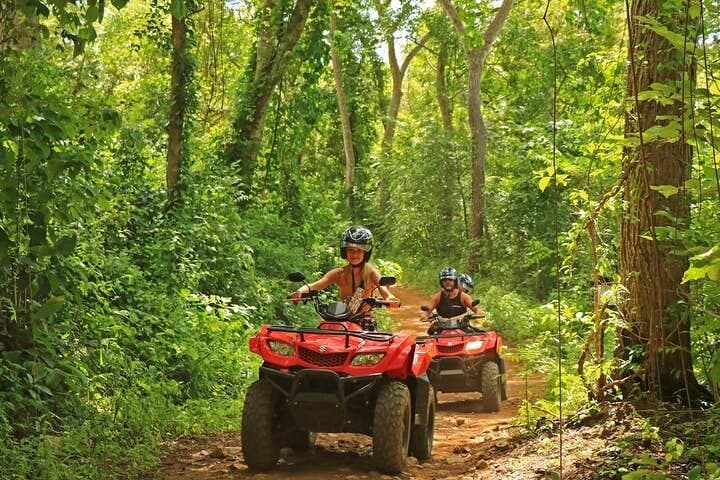
What the day feels like
When the guide fires the starter and the first bike grumbles to life, the jungle answers—leaves rustle like an audience leaning in. The trail immediately narrows, roots and ruts folding into one another, and the roar of the quad becomes the single steady sound that threads you forward. You bank around a mahogany trunk and the canopy opens; in the distance the Pacific flashes an interval of impossible blue. In three hours you’ll have navigated village tracks, rocky ridgelines and river fords, and you’ll end at Playa Panamá with a sandy boot-print to prove it.
This is Coastal Guanacaste in miniature: a place where volcanic ranges slope down into the sea, where cattle pastures sit cheek by jowl with lowland rainforest, and where road surfaces change mood without warning. The geology is at once blunt and generous—old lava flows and fractured basalt give way to beach sand that squishes against your tires. The land here has been shaped by the nearby Cordillera de Guanacaste, whose ancient eruptions left a patchwork of iron-rich soils that favor hardy tropical dry forests and the scrubby green that turns gold in the dry months.
Culturally, the route stitches together a few local realities. Small communities that line the trail still observe the rhythms of a rural Costa Rica: morning coffee at the soda (a family diner), a pause to fix a tire under a mango tree, children waving as you pass. Guanacaste’s identity is distinct—its music, its cowboy-like traditions (the guanacastecos), and its cuisine. You may smell frying plantain or see a roadside stand selling ceviche; the last stretch to Playa Panamá often carries a scent of salt and sunburned wood.
Why people come on this three-hour run is obvious: it’s tactile, immediate, and forgivingly achievable. The route maps out roughly 20 miles (30–40 kilometers) of mixed terrain—dirt track, packed sand, short technical stretches of loose volcanic gravel, and a handful of shallow river crossings that dare the wheels to bite. Elevation change is moderate; expect rolling climbs up to 300–400 meters total cumulative gain rather than alpine ascents. That keeps the ride energetic without being punishing. The payoff is cinematic: a scrubby ridge that looks west, a sudden canyon of shadowed green, and finally the ocean opening like a reward.
Practicalities matter here in ways they don’t for a parked tour. Helmets, goggles, and the right footwear turn a noisy afternoon into a comfortable memory. Timing matters too: take the tour mid-morning to avoid the hottest point of the day and to get a smoother trail surface before late-afternoon traffic from local farmers. Guides on these private ATV runs aren’t just route markers; they’re translators—of terrain, of local custom, and of temperament. A good guide knows when to suggest throttle and when to call for patience.
For travelers, the experience sits between a day trip and a micro-expedition. Expect to cover variable surfaces, to get dust on your skin and salt in your hair, and to end with wet feet in a Pacific cove. You’ll learn how the land holds water in the dry season and how rivers become personality-rich features in the wetter months, daring you to cross differently each time you visit. Birdsong and the occasional howler monkey punctuate the ride; the environment feels alive and reactive—rivers will challenge you, wind will push at you, and the sun will insist on showing you its power.
A few concrete tips: choose closed-toe hiking boots with good tread, wear long pants to protect against branches, and bring a hydration bladder clipped to your pack so you can drink without stopping. Don’t overpack; the ATVs have limited storage and you’ll want your hands free. If you plan to swim at Playa Panamá, stow a lightweight towel or pack a quick-dry shirt in a waterproof stuff sack. And be ready to relax—the last half-hour at the beach has a different tempo: slow breathing, cold water, and the kind of silence that makes everything else worth it.
Beyond the adrenaline, there’s a soft ethical line to respect. These routes traverse working land and fragile coastal environments—stay on the trail, follow your guide’s directions, and carry trash out. Local economies benefit directly when tours hire local guides, shop at community sodas, and respect private property. It’s a raw, joyful way to see Costa Rica’s Pacific coast—one that combines the mechanical thrill of off-road riding with the simple, human pleasure of sand between your toes.
How to fit it into a trip: this is a half-day commitment that can be slotted into a longer Guanacaste itinerary—morning surf lessons, an afternoon ATV run, and dinner of fresh fish and cold Imperial in a shaded palapa. For families or mixed-ability groups, private tours can tailor the pace. For the adventurer, the ride is a tidy, high-energy underscore to a longer Costa Rican stay—a reminder that this country is as much about motion as it is about vistas.
The machines hum. The jungle leans in. And when you finally coast into Playa Panamá, helmet in hand and sand in your shoes, you’ll understand why a three-hour loop of dirt and surf can feel like the day’s best kind of proof: that you moved, that you saw, and that the land pushed back just enough to make it worth the return trip.
Trail wisdom
Small choices, better day.
Bring a Hydration Pack
You’ll be moving at pace and won’t want to stop—hydration bladders let you sip continuously without fumbling for bottles.
Wear Protective Layers
Long pants and closed-toe shoes protect against branches, spray, and heat; a light wind shell helps on exposed ridgelines.
Listen to Your Guide
Guides know local crossings, fragile sections, and the best places to slow down for photos—follow their cues for safety and respect.
Pack a Waterproof Bag
Bring a dry sack for phones, documents, and a swimsuit if you plan to swim at Playa Panamá.
Local knowledge
Read the place, not just the route.
Watch for native species including Howler monkeys, White ibis.
Keep an eye out for wildlife during the transition between areas and habitats. Respect distance guidelines.
Do not stray from designated trails to protect fragile dry-forest regeneration; local tour operators often support reforestation and community-based conservation projects.
Follow the guide's instructions on size limits, ethical handling, and leave-no-trace practices.
An early-morning viewpoint ridge—ask your guide to stop for sunrise photos. A local soda near the trailhead serving fresh ceviche and gallo pinto
Locally recommended viewpoints and quiet spots known best to local operators.
Guanacaste has a strong cowboy (sabanero) culture, and many rural communities still celebrate traditional festivals tied to cattle ranching and Independence Day.
Maritime roots and regional tradition shape the waterways and working coasts.
Seasonal guide
Four versions of the same landscape.
Spring
Best forDry trails · Cleaner beach water · Longer daylight
ChallengesHigher temperatures · Busy tourist season
Spring (dry season) brings dusty, fast trails and warm afternoons—ideal for off-road traction but expect more visitors and stronger sun.
Summer
Best forLush green scenery · Fewer crowds · Cooler mornings
ChallengesAfternoon showers start forming · Some muddy sections
Summer shows the jungle in full green; intermittent showers can make sections slick—good tires and cautious riding keep it fun.
Fall
Best forQuieter trails · Bird activity · Lower hotel rates
ChallengesVariable weather · Occasional road washouts
Fall is transitional—fewer people and interesting weather. Expect some softer ground after rains and more caution at river crossings.
Winter
Best forBest visibility · Consistent dry trails · Reliable beach conditions
ChallengesPeak tourist crowds · Higher prices
Winter is prime dry-season season: crisp skies and consistent trails, but also peak demand—book ahead to secure a private tour.
Operator details
What the booking data adds.
Included
- ✓Private transportation
- ✓atv machines
- ✓Bottled water
- ✓Air-conditioned vehicle
Not included
- —Gratuities
Good to know
- ✓Not recommended for travelers with spinal injuries
- ✓Suitable for all physical fitness levels
Pack with intention
What to bring.
Good to know
Common questions.
No—most operators provide a brief orientation. Basic comfort with a throttle and brakes is helpful, and guides will tailor pace to the group.
Plan the edges
The details that make the day easier.
Costa Rica protects roughly a quarter of its land in national parks and reserves, making it one of the most protected countries in the world.
After the ride, head to a nearby soda for fresh ceviche and a cold Imperial, or try arroz con camarones at a beachfront palapa; local artisans sell woven hats and coffee—perfect souvenirs.
- Closest airport
- Liberia (LIR); Typical drive from Playas del Coco
- Playa Hermosa
- 20–45 minutes; Cell service: intermittent on ridgelines and in deep jungle; Permits: none required for private commercial tours.
Stay on marked trails to avoid eroding sensitive soils, carry out all trash, and consider booking with operators who contribute to local conservation initiatives.
Explore by topic
Follow the threads.
Keep exploring
Make the story part of the trip.
Set out from Bass Harbor for a private, customizable day on Blue Hill Bay — lighthouses, puffins, seals, and the chance to feel Acadia from the water. Small groups, local captains, unforgettable views.
In four hours you can move from shaded canyon ferns to wind-scoured coastal ridgelines, guided by someone who knows where the light—and the hidden views—live. This private half-day hike on the Monterey Peninsula or Big Sur is compact, curated, and perfect for travelers who want depth without a multiday commitment.
 Related story
Beneath a sky of shifting light, Skaftafell’s ice reads like a map of time. This three-hour guided glacier hike mixes technical instruction with geology and culture: compact, safe, and unforgettable.