
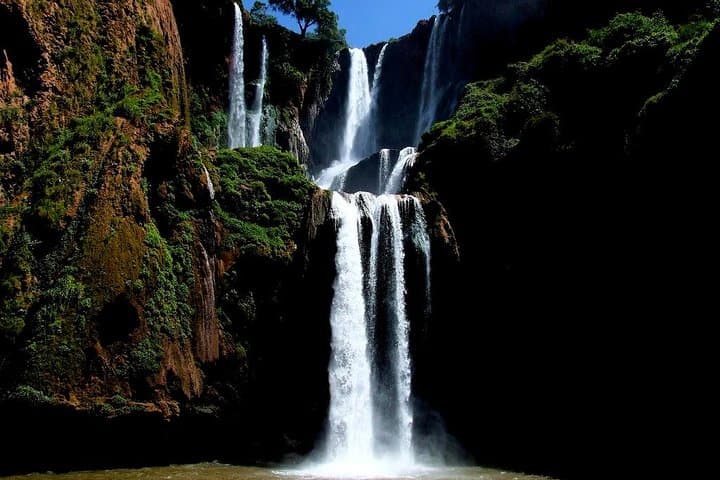
What the day feels like
The roar finds you first—low and insistent, like a drum line behind the hills—long before the path reveals the famous plunge of Ouzoud. The morning drive from Marrakech gives way to olive groves and ochre ridges, the Middle Atlas lifting the horizon into a torn edge. By the time you reach the pedestrianized village of Ouzoud, the air is cooler, damp with spray. The river has been busy at work for millennia here, carving travertine steps from limestone, polishing rock into bowls and slides, daring you to follow its pulse.
From the top lookout, the falls unravel in three clean stages, a 110-meter cascade wrecking the calm with a white, muscular sweep. The water throws its own weather—mist rising, rainbows threading the air at midday. Barbary macaques watch from olive branches like curious neighbors. It’s a scene that pulls you forward. Stone steps drop into the gorge, past tea-scented terraces and bamboo huts where tajines simmer and bread puffs on clay ovens. Every turn offers a new angle: the wide curtain of the main drop, the powdery red canyon wall streaked with mineral stains, the small pools where kids shriek and splash. Ouzoud is not a wilderness epic; it’s a living, local amphitheater where nature sets the stage and people have built comfortable seats.
This is what makes Ouzoud unique in Morocco. Many travelers come for dunes or high peaks; here, the Middle Atlas trades drama of height for the drama of water. The name itself nods to its setting—“Ouzoud” likely comes from the Berber word for “olive,” and the groves stitch the valley in bright green. The geology cooperates: soft limestone lets the river sculpt terraces that look almost designed, while iron-rich earth paints the canyon in familiar Moroccan colors. Add the hospitality of Amazigh (Berber) communities—craft stalls selling handwoven rugs and olive-wood spoons, terrace restaurants cantilevered over the gorge—and you get a rare pairing: a true cascade you can hike, swim, and dine beside in a single, leisurely loop.
The standard circuit is straightforward, and that’s part of its charm. Expect 2–4 kilometers, with roughly 200–300 meters of descent and ascent as you circle from the rim down to the plunge pool and back up the opposite side. The path is stone and packed dirt, shaded by olive and fig trees that clap their leaves in the canyon breeze. Steps are uneven and often wet, so your footing matters—Ouzoud’s spray likes to keep the rocks honest. Plan to stop often, not just to catch your breath but to let the place play out around you: macaques passing quietly over the branches; the river pressing on, stubborn and sure; robed boatmen easing their flat-bottom skiffs toward the base of the falls, where a short splashy ride will soak you and put the roar in your chest.
Practicalities are simple. Start early to beat midday bus crowds and to catch the falls in soft light. Bring cash in small bills for tea, tajines, and the optional boat ride—cards are rare here. Modest swimwear is appreciated, and sandals alone are a gamble on wet stone; lightweight hiking shoes or grippy water shoes are better. Lifeguards are not part of the scene, so if you swim, do it conservatively. Spring brings the strongest flows and the greenest hills, but summer’s long days reward a late-afternoon descent when the sun slides off the cliffs and the water cools skin that’s been walking Marrakech’s alleys the day before.
Ouzoud’s history is embedded in the terraces. For generations, local families have farmed olives and figs on these slopes, turning the river into irrigation and the waterfall into a livelihood. Crafts line the path not as trinkets but as extensions of everyday life: handwoven textiles in Amazigh patterns, clay tagines glazed in the colors of the valley, bottles of argan and olive oil with stories behind each harvest. Order a tagine at a low riverside table and watch the pot arrive still burbling; you’ll eat with the waterfall at ear-level, cumin and coriander rising in the mist. The place asks you to linger, not sprint.
There’s wildness, too—quiet, if you’re listening. The Barbary macaques here are a protected reminder of North Africa’s native primates; they’ll regard you like a tolerated guest. Resist the urge to feed them. Across the banks, kingfishers stitch blue arrows above eddies, and swifts write loops in mist. The river pushes forward regardless of the crowds, a steady, patient architect shaping the canyon’s future.
On the climb out—steps tightening, switchbacks curt—you’ll look back and realize how the path links every layer: the top lip queuing the horizon, the second drop boiling at mid-height, the plunge pool bright and loud, the cafés and reed huts perched like watchtowers. This compact loop, with its honest elevation and easy access, makes Ouzoud one of Morocco’s most approachable adventures. It’s a full-day story in a tidy package: leave Marrakech after breakfast, hike, swim, eat, watch macaques puzzle over their human visitors, and be back in the city in time for a rooftop dinner.
What to know before you go: the falls can be crowded, especially midday and on weekends, but the energy is part of the experience, and early starts solve most problems. The gorge gets slick—footwear matters. Hydrate like you would for any warm-weather hike, even in winter’s mild sun. And carry out what you bring in; erosion is already at work here, and the river doesn’t need plastic to contend with.
In the end, Ouzoud is a reminder that adventure doesn’t always mean suffering. Sometimes it’s a careful descent on cool stone, a quick dunk in a cold pool, a plate of lamb and prunes eaten with your shoes off while the waterfall speaks in its endless language. Sometimes the river dares you simply to listen—and then invites you back for tea.
Trail wisdom
Small choices, better day.
Start Before 9 a.m.
Beat tour-bus crowds and catch soft morning light on the falls for cooler hiking and quieter cafés.
Wear Real Traction
Wet rock and polished steps are slick—light hikers or grippy water shoes are safer than sandals.
Carry Small Bills
Most vendors and boatmen accept cash only; bring small dirham notes for food, rides, and tips.
Respect the Macaques
Don’t feed monkeys, keep distance, and secure food—human snacks harm wildlife and attract crowds.
Local knowledge
Read the place, not just the route.
Watch for native species including Barbary macaque, Common kingfisher.
Keep an eye out for wildlife during the transition between areas and habitats. Respect distance guidelines.
Avoid feeding macaques and pack out all trash. Stick to marked steps to minimize erosion on the soft limestone.
Follow the guide's instructions on size limits, ethical handling, and leave-no-trace practices.
The lower-left boulder field for rainbow shots at midday spray. Olive groves above the rim path for quiet views back into the gorge
Locally recommended viewpoints and quiet spots known best to local operators.
Ouzoud likely derives from the Amazigh word for ‘olive,’ reflecting centuries of groves terraced into these slopes.
Maritime roots and regional tradition shape the waterways and working coasts.
Seasonal guide
Four versions of the same landscape.
Spring
Best forStrongest water flow · Green hillsides
ChallengesMuddy, slippery steps · Occasional showers
Peak flow and mild temperatures make spring ideal. Expect lush scenery and lively cascades.
Summer
Best forSwimming · Long daylight
ChallengesHeat in midday · Heavier crowds
Warm water and late sunsets suit a dip; plan early or late hikes to avoid the hottest hours.
Fall
Best forStable weather · Fewer crowds
ChallengesLower water levels · Dusty trails
Comfortable temperatures and calm paths; the falls are smaller but still photogenic.
Winter
Best forCool hiking · Clear air
ChallengesCold water · Shaded, damp steps
Quiet trails and crisp views; bring layers and expect chilly swims or skip them altogether.
Pack with intention
What to bring.
Good to know
Common questions.
Yes, swimming is allowed near the plunge pool, but currents vary with flow. Enter cautiously and avoid getting too close to the main cascade.
Plan the edges
The details that make the day easier.
Ouzoud Falls drop about 110 meters and sit amid olive groves—‘Ouzoud’ is believed to come from the Amazigh word for ‘olive.’
Eat riverside: order a lamb-and-prune tagine and mint tea at a terrace table brushing the water’s edge. Back in Marrakech, recover at a neighborhood hammam, then try a rooftop in the medina for sunset—berenjena zaalouk, fresh bread, and a view that ties the day together.
- Closest airport
- Marrakech Menara (RAK). Trailhead: Ouzoud village parking. Drive: ~160 km, 2.5–3 hrs from Marrakech. Cell service: Good in the village, patchy in the gorge. Permits: None required; bring cash for food, crafts, and optional boat rides.
Barbary macaques are considered Endangered—keep distance, never feed them, and pack out all trash. Stay on established steps to limit erosion on soft limestone.
Explore by topic
Follow the threads.
Keep exploring
Make the story part of the trip.
In four hours you can move from shaded canyon ferns to wind-scoured coastal ridgelines, guided by someone who knows where the light—and the hidden views—live. This private half-day hike on the Monterey Peninsula or Big Sur is compact, curated, and perfect for travelers who want depth without a multiday commitment.
 Related story
Beneath a sky of shifting light, Skaftafell’s ice reads like a map of time. This three-hour guided glacier hike mixes technical instruction with geology and culture: compact, safe, and unforgettable.
 Related story
Lose the city for a few hours without leaving it: this 5-mile, 900-foot-gain Forest Park loop threads old-growth pockets, city viewpoints, and cultural landmarks for a compact taste of Portland’s wild side. Expect moss, roots, and stories.