
What the day feels like
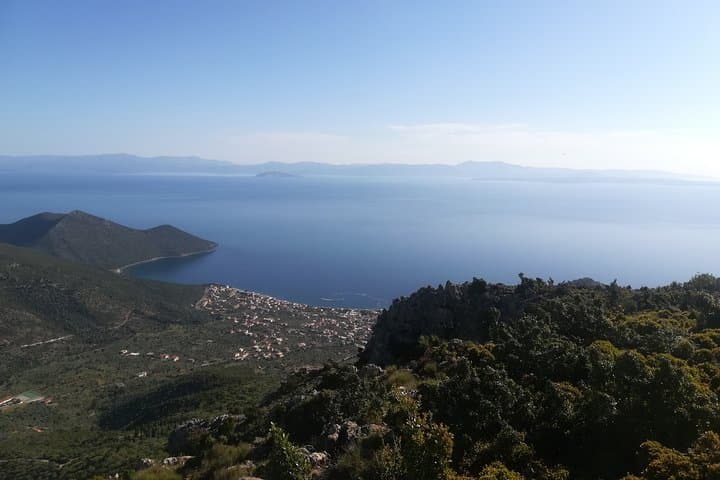
The morning begins with the sea talking in a low hush, a blue mirror flexing against the small port of Tyros. Fishing boats bob like commas between sentences as your guide points up—past the whitewashed homes and orange-tiled roofs—to the shoulder of hillside where castle ruins keep watch. The air is salted and bright. A narrow, old cobbled road—kalderimi—threads upward, and the stones feel as if they know every foot that’s passed here for centuries. You follow as the village exhales and the mountain beckons.
This is Tsakonia, a stubbornly distinct pocket of Arcadia in the southeastern Peloponnese, where the Tsakonian dialect—a descendant of ancient Doric Greek—still clings to everyday life in whispers and greetings. Tyros sits at the seam where Parnon’s limestone flanks descend to the Aegean. The hike laces these layers together: port to village lanes, lanes to kalderimi, kalderimi to the ridge where the castle’s bones still grip the slope. The sea, never far, keeps daring you to look back.
You start on stone that remembers. The kalderimi rises through olive terraces and tidy kitchen gardens, its surface set with rounded cobbles that demand attention and reward steady pacing. Lizards dart. Rosemary leans in with resin on the wind. Every switchback opens a new angle on the Gulf of Arcadia, the water a sheet of hammered metal under the sun. Your guide, steeped in Tsakonian culture, pauses by a dry-stone wall to point out the old foot route villagers once used to move goods between hamlets long before asphalt stitched the coast.
Halfway up, the path skims a ledge where goats negotiate the scree with enviable grace. Here, the mountain shows its geology in cross-section—crumbly marls and slabs of pale limestone stacked like ancient ledgers. In spring, wildflowers write a soft margin: red poppies, yellow daisies, a confetti that the wind edits on a whim. The ascent is gradual but honest. Expect roughly 5–6 kilometers round-trip with 250–300 meters of gain, enough to wake the calves and keep your breath honest.
The castle ruins arrive in fragments—walls braided with time, apertures framing sea and sky. It’s not the grand turrets of fairy tales; it is the practical, weather-bitten fortress of a coast that watched for sails with intent. Stand here and the Aegean spreads like an argument you’ve already won. The breeze pushes forward. Olive leaves applaud. The village below looks like an arrangement made for the word home.
The descent is its own reward: mountain to sea in a single, smooth paragraph. The old road feeds into narrow lanes, white walls flexing to let you pass. Your guide pours traditional Greek coffee at a quiet café, thick and strong, sweetened if you like. It tastes like a pact with the day—slow down, look closer. As cups clink, you hear Tsakonian lilt in nearby conversation, a reminder that culture isn’t just something to read about; it’s something the street itself speaks.
Tyros invites an unhurried kind of adventure. The route is manageable for most hikers with a decent base of fitness, but it teaches you to watch your feet and your horizon at once. The kalderimi is firm but uneven, a mix of cobbles and packed earth with occasional loose gravel. Good shoes matter. Water matters. Sun sense matters, especially in summer when the coastal heat presses down. Start early for shade on the uphill and the best light scraping across the sea.
Post-hike, the port’s tavernas drift into focus—tables a few steps from the tide, the clatter of plates, the quiet theatre of the grill. This is Tsakonian eggplant country, celebrated across the region. Order it baked until silky, drizzled with local olive oil, and paired with fish as fresh as new ink. If you stay the night, Tyros trades daytime shimmer for the softer pulse of evening: a village that knows exactly where it is and is in no hurry to be anywhere else.
For planners, logistics are straightforward. Tyros is about a three-hour drive from Athens International Airport, skirting the Saronic Gulf before cutting into the ribbed folds of Arcadia. Cell coverage is generally reliable in the village and along open slopes, less so in tucked ravines. No permits are required to walk the kalderimi or visit the castle remains, but basic trail etiquette is the currency here: tread lightly, greet locals, and leave the stones as you found them.
It’s a short hike by mileage, yet big on context. History, language, rock, sea—each takes a turn at the lead, then hands the rope to the next. The mountain doesn’t perform; it simply is. The Aegean doesn’t pose; it insists. And you, moving between them on a road that predates your maps, become part of a line that keeps going, one step at a time, toward a view that refuses to stay still.
Trail wisdom
Small choices, better day.
Start Early for Shade
Begin before 9 a.m. to catch cooler air and softer light on the ascent; the kalderimi offers intermittent shade only.
Wear Real Footwear
The old cobbles are uneven and can be slick with dust—grippy hiking shoes with good tread make a big difference.
Carry Enough Water
Bring at least 1–1.5 liters per person; village fountains may not always be running or potable.
Mind the Descent
Loose gravel appears on steeper switchbacks—shorten your stride and keep your weight over your feet.
Local knowledge
Read the place, not just the route.
Watch for native species including Kestrels riding thermals over the ridge, Goats and small lizards along sun-warmed walls.
Keep an eye out for wildlife during the transition between areas and habitats. Respect distance guidelines.
Stick to established cobbled paths to protect fragile terrace walls and native plants; pack out all trash and avoid climbing on the castle’s unstable masonry.
Follow the guide's instructions on size limits, ethical handling, and leave-no-trace practices.
The upper terrace below the ruins for a quieter, wind-sheltered view of the gulf. A short detour along olive terraces where old stone cisterns hide among carob trees
Locally recommended viewpoints and quiet spots known best to local operators.
Tyros lies in the heart of Tsakonia, where the Tsakonian dialect traces links to ancient Doric Greek; the old kalderimi reflects centuries of foot travel between villages and fields.
Maritime roots and regional tradition shape the waterways and working coasts.
Seasonal guide
Four versions of the same landscape.
Spring
Best forWildflowers · Mild temperatures
ChallengesChangeable winds · Occasional showers
Green hillsides and blooming slopes make for prime hiking; layers help with breezy ridgelines.
Summer
Best forClear views · Sea swimming post-hike
ChallengesMidday heat · High UV exposure
Start early and plan a swim at the port after; heat intensifies by late morning on exposed sections.
Fall
Best forStable weather · Warm seas
ChallengesShortening daylight · Variable wind
Comfortable temps and quieter paths; carry a light layer for cooler evenings and gusty afternoons.
Winter
Best forCrowd-free trails · Crisp air
ChallengesRain-slick stones · Cool winds
Expect cooler, wet conditions; check forecasts and bring a waterproof layer for squalls.
Operator details
What the booking data adds.
Included
- ✓At the end of our hiking we offer coffee, tea or juice at cafe in front the sea
- ✓Bottled water
- ✓All Fees and Taxes
Good to know
- ✓Not recommended for travelers with spinal injuries
- ✓Not recommended for travelers with poor cardiovascular health
- ✓Not recommended for pregnant travelers
- ✓Service animals allowed
- ✓Public transportation options are available nearby
- ✓Infants and small children can ride in a pram or stroller
- ✓Suitable for all physical fitness levels
- ✓hiking shoes
- ✓sun protection
Pack with intention
What to bring.
Good to know
Common questions.
Plan for 2.5–3 hours on an old cobbled path with roughly 250–300 m of elevation gain. It’s moderate, with uneven stone underfoot and short, steeper sections.
Plan the edges
The details that make the day easier.
The Tsakonian dialect, still heard in Tyros and neighboring villages, descends from ancient Doric Greek and is considered one of Europe’s most linguistically distinct modern dialects.
Refuel at a harborfront taverna with Tsakonian eggplant baked in olive oil, grilled local fish, and a crisp village salad. Pair dinner with Peloponnesian white wine, then stroll the quay for gelato as the boats settle and the village lights flicker on.
- Closest airport
- Athens (ATH). Trailhead: near Tyros port. Drive time: ~3 hours from Athens, ~45 minutes from Leonidio. Cell service: generally good in the village, variable on exposed ridges. Permits: none required. Parking: along the seafront (arrive early in summer).
The kalderimi is a heritage path—stay on the stones, don’t dislodge rocks from terrace walls, and avoid climbing on the castle masonry. Carry a reusable bottle and pack out all trash.
Explore by topic
Follow the threads.
Keep exploring
Make the story part of the trip.
Set out from Bass Harbor for a private, customizable day on Blue Hill Bay — lighthouses, puffins, seals, and the chance to feel Acadia from the water. Small groups, local captains, unforgettable views.
In four hours you can move from shaded canyon ferns to wind-scoured coastal ridgelines, guided by someone who knows where the light—and the hidden views—live. This private half-day hike on the Monterey Peninsula or Big Sur is compact, curated, and perfect for travelers who want depth without a multiday commitment.
 Related story
Beneath a sky of shifting light, Skaftafell’s ice reads like a map of time. This three-hour guided glacier hike mixes technical instruction with geology and culture: compact, safe, and unforgettable.