
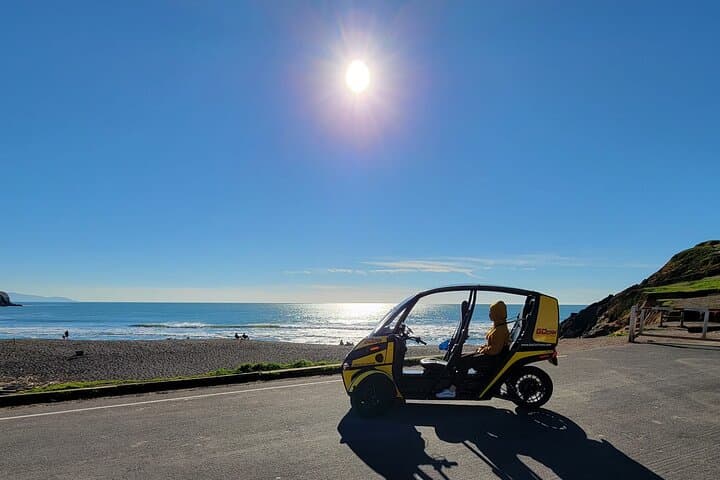
What the day feels like
The EV hums like a polite guest as you slip through the Presidio, the bay bright and hard as a coin to your right while the bridge looms, abruptly monumental. Salt wind tugs at your jacket and the Pacific dares you to look away from the span — orange against blue, cables like the strings of a giant instrument. In a city built on angles and ascent, this is a different kind of movement: slow, deliberate, and close enough to feel the spray on your face when you lean over the railing at Crissy Field.
GoCAR’s GPS-guided electric vehicle tour turns San Francisco into a short, precise set of scenes. It’s a curated drive — Presidio, Crissy Field, the Golden Gate Bridge itself — then over the world’s most famous suspension span into Sausalito, with an optional loop into the Marin Headlands where cliffs drop into surf and concrete remnants of Cold War radar stations sit like sculptures. The advertised tour runs four hours, a private experience priced from $339 per group, and it’s as much about the landscape as it is about seeing the city from a human scale: no rush, no traffic anxiety, just a mapped route that lets the bridge, the bay, and the headlands take the lead.
There’s history at every turn. The Golden Gate Bridge, completed in 1937, was conceived as an audacious link between a city and its open edge; the Presidio, once a Spanish and then U.S. Army post, now parks and museums; Sausalito grew from a fishing and tidal mill town to a WWII shipbuilding hub at Marinship, and later to an artists’ enclave punctuated by floating houseboats with names and stories. Geologically, the Headlands tell a deeper story — uplifted crust, marine terraces, and sedimentary layers folded and torn by the San Andreas fault just inland — which is why cliffs here fall into the water at angles that feel both sudden and inevitable.
Culturally, the drive is a cross-section of Bay Area hybridity: military forts sit beside tech commuters, local fishermen and artists bump shoulders with tourists, and the cafés of Sausalito pour espresso beneath galleries that still smell faintly of varnish. The bridge itself is part monument, part machine, a living piece of infrastructure that needs constant care; the very color, International Orange, was chosen to complement the fog and to make the span visible in low light. That fog has personality here, too — sometimes it slides in like a cat, muffling sound and softening light; other times it holds back and leaves the vistas sharp.
Practicalities are straightforward. The tour length is about four hours with flexibility for a Marin Headlands loop or a stop in Sausalito for lunch and waterfront photos. Expect brief walks at overlooks and a few photo stops — comfortable shoes matter, but the tour’s not a hike. The EVs are GPS-guided and easy to drive, so no special license beyond the normal is required, and the private format means itineraries can stretch or tighten if you ask. Bring layered clothing (the wind from the Golden Gate will find any gap), a charged camera, and a plan for parking if you choose to explore on foot in Sausalito; ferries back to San Francisco run regularly and are an excellent way to end the day.
For photographers the bridge at golden hour is the obvious draw, but don’t miss the headlands’ north-facing overlooks where the light slices across sea stacks and the horizon becomes a graphic line. Wildlife shows up on its own schedule: pelicans often fish low over the water, harbor seals bob in the bay near the ferry terminals, and migrating raptors are sometimes visible above the ridgelines.
Beyond the checklist, there’s a kind of restorative ease to moving by electric vehicle in this landscape. Without engine roar, the city’s edges come forward — children calling on Baker Beach, the clanging of a distant construction site, the small thunder of surf — and the separation between human and nature thins to a manageable, welcoming distance. The tour works for a variety of travelers: families who want a fuss-free introduction to the bridge and the bay, couples chasing picture-perfect views, or visitors who prefer curated experiences to figuring out public transit and parking.
If you plan to book, consider timing. Weekends fill with locals and tourists; weekday mornings after the commute often have clearer skies and fewer cars. Fall is famously kind to the Bay — less fog, stable weather — but every season has a different mood. The electronic nature of the tour and the private setup mean you’ll have flexibility, but the most valuable currency here is time: linger at the headlands; let the bridge sit with you for a minute. The city yields its best angles when you slow it down.
This is not an extreme adventure; there are no knife-edge climbs or technical skills required. Instead, it’s a compact lesson in coastal geography, civic ambition, and how to read a shoreline. It’s for people who like their landscapes with context, who want to be told the backstory as much as they want to see the view, and who appreciate the practical benefits of an electric tour — low emissions, silent approach, and a route that puts the Golden Gate at the center of the story.
In the end, the bridge still steals the show: a human line thrown across a wild place, a color chosen to argue with fog, a structure that will outlast many of the cars that cross it. The EV’s whisper fades, the salt air lingers, and you’ll leave with a clearer sense of why San Francisco looks the way it does: a city that begins and ends at the water, stitched together by steel and by the people who crossed it.
Trail wisdom
Small choices, better day.
Layer Up for Wind
Wind from the Golden Gate can be cold and persistent — bring a windproof layer even on warm days.
Book Golden Hour
Schedule the Marin Headlands loop for an hour before sunset for dramatic light and fewer crowds.
Pack Charge for Cameras
Phones and cameras will get heavy use at overlooks — carry a spare battery or power bank.
Consider the Ferry Home
If you stop in Sausalito, the ferry to SF offers a scenic return and bypasses bridge traffic.
Local knowledge
Read the place, not just the route.
Watch for native species including Harbor seals, Brown pelicans.
Keep an eye out for wildlife during the transition between areas and habitats. Respect distance guidelines.
The headlands are managed by the Golden Gate National Recreation Area — stay on trails, pack out trash, and respect seasonal nesting closures for seabirds.
Follow the guide's instructions on size limits, ethical handling, and leave-no-trace practices.
Point Bonita Lighthouse (seasonal access). Fort Cronkhite battery ruins and Rodeo Beach vistas
Locally recommended viewpoints and quiet spots known best to local operators.
The Presidio’s military history stretches from Spanish colonial times through its 20th-century role as an Army base; Marinship in Sausalito was a key WWII shipbuilding yard.
Maritime roots and regional tradition shape the waterways and working coasts.
Seasonal guide
Four versions of the same landscape.
Spring
Best forWildflowers in the Headlands · Clear morning light
ChallengesUnpredictable wind · Morning fog
Spring brings blooming coastal scrub and brisk temperatures; mornings can be foggy but afternoons often clear.
Summer
Best forLong daylight · Calmer mornings
ChallengesAfternoon fog · Higher weekend crowds
Summer can be foggy along the coast, especially in the afternoon; mornings are usually clearer and cooler.
Fall
Best forStable skies · Golden-hour photography
ChallengesShorter days later in the season · Popular time for visitors
Fall is typically the clearest season with extended blue-sky days—ideal for wide, unobstructed views.
Winter
Best forDramatic stormlight · Fewer tourists
ChallengesRain and slick surfaces · Windy days
Winters are cooler and wetter; clear, cold days produce sharp visibility but bring wind and colder temps.
Operator details
What the booking data adds.
Included
- ✓Map
- ✓Tank of Gas
- ✓Helmets
- ✓GPS Touring Car
- ✓Golden Gate Bridge Toll
- ✓8.75% environmental fee for carbon offset, gas and tire recycling
Not included
- —Hotel Pick-up Drop-off
- —Optional: Collision Damage Waiver (CDW) $19
Good to know
- ✓Not recommended for travelers with spinal injuries
- ✓Service animals allowed
- ✓Public transportation options are available nearby
- ✓Suitable for all physical fitness levels
- ✓Wheelchair accessible
Pack with intention
What to bring.
Good to know
Common questions.
The standard tour runs four hours, with time for photo stops, a Sausalito visit, and an optional Marin Headlands loop.
Plan the edges
The details that make the day easier.
Marinship in Sausalito built Liberty and Victory ships during WWII, transforming the town into a major wartime industrial center.
After the tour, head to Sausalito’s waterfront for fresh seafood at Scoma’s or a craft beer at a local pub; explore galleries and the houseboat community for a tight dose of local culture.
- Closest airport
- SFO (20–30 minutes by car); trailhead
- meeting point
- Presidio
- Crissy Field area; Driving distance from downtown SF
- ~10–15 minutes; Cell service: Good in city, spotty at some headlands overlooks; Permits: None for tour, parking fees may apply in Sausalito.
This is an electric vehicle tour; favor low-impact behavior: stay on designated viewpoints, do not feed wildlife, and pack out any trash to protect shoreline habitats.
Explore by topic
Follow the threads.
Keep exploring
Make the story part of the trip.
Set out from Bass Harbor for a private, customizable day on Blue Hill Bay — lighthouses, puffins, seals, and the chance to feel Acadia from the water. Small groups, local captains, unforgettable views.
In four hours you can move from shaded canyon ferns to wind-scoured coastal ridgelines, guided by someone who knows where the light—and the hidden views—live. This private half-day hike on the Monterey Peninsula or Big Sur is compact, curated, and perfect for travelers who want depth without a multiday commitment.
 Related story
Beneath a sky of shifting light, Skaftafell’s ice reads like a map of time. This three-hour guided glacier hike mixes technical instruction with geology and culture: compact, safe, and unforgettable.