
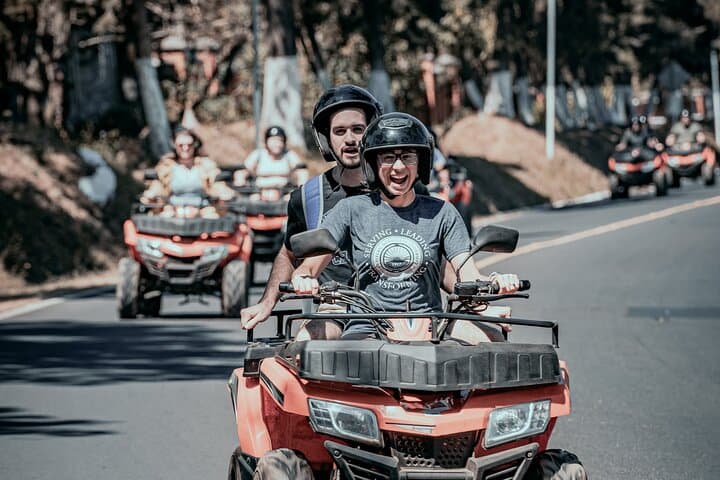
What the day feels like
The engine bucks beneath you like a restless animal, and for a moment the world narrows to throttle, dust, and the silhouette of Volcán de Agua perfect against a blue Guatemalan sky. You push forward and the trail opens—mauve adobe roofs, a break in the trees revealing a field of macadamia trees, the bright turquoise apron of a jade shop doorway where an artisan files the edges of a necklace. This is not just an off-road ride; it’s a passage through layers of history and daily life, four hours stitched with culture, small-farm stops, and the steady hum of a machine under your hands.
Antigua Guatemala sits in a bowl of highland valleys rimmed by volcanoes—geology that shaped both the land and the region’s colonial fortunes. Your route threads past Ciudad Vieja, one of the earliest Spanish settlements in Guatemala and home to the ruins of the first cathedral in Central America (1534). The villages you visit—San Pedro Las Huertas, San Juan del Obispo—are living snapshots of craft economies: jade workshops where local families turn a centuries-old stone into modern baubles, a chocolate factory that leans into cacao’s deep Mayan roots, and the Nispero Museum with its compact but informative take on local botanicals and heritage.
The cultural focus is deliberate. This tour balances the thrust of an ATV with low-impact, curated stops—Valhalla Macadamia Farm, where you’ll learn how nuts are grown, processed, and sold; a jade workshop where artisans explain the mineral’s symbolic weight; a chocolate demo that traces a bean’s arc into a sample you can taste. Guides are often local and bilingual; they translate not just words but context—why a particular festa matters, or why a ridge line collapsed in an earthquake and rearranged a town’s streets.
There’s a practical cadence to the day: morning departures make the most of firm trails and softer light, stops are short but substantive, and the route alternates open tracks with tight village lanes. Terrain shifts quickly—gravel and packed dirt, short ruts, and occasional muddy patches after rain—so a steady hand matters more than bravado. Drivers can choose their vehicle type (ATV, buggy, bike, tour truck, or car) according to skill and appetite; for first-timers an ATV guided behind a lead vehicle is the most accessible, letting you sample the thrill without taking on the full responsibility of navigation.
Beyond the engine and the itinerary, there’s a human geography to the day. Markets pulse with produce and handmade jewelry; elders chat in café doorways and kids chase each other past stone fountains. The effect is connective: you feel the country at a human scale, not as a backdrop. The tour’s four-hour length is a compact, efficient way to experience rural life without the fatigue of a longer expedition. If you want to linger, guides can often help arrange additional time at a specific stop—buy a piece of jade, sit down for a slow cup of coffee, or wander a small museum.
Practical realities: book for morning slots in the dry season (November–April) to avoid mud and collapsing visibility; bring closed-toe shoes, sun protection, and a small amount of cash for market purchases. Safety briefings are standard; helmets are provided. If you plan to drive your own ATV, be honest about experience: on loose sections it’s steadier to follow a guide’s line than to try carving a shortcut.
Why go? Because it’s kinetic and local. The ride gives you a physical connection to geography; the stops provide cultural context that’s often absent from more sterile adventure tours. It’s a short, high-yield window into Antigua’s hinterlands—perfect for travelers who want to combine a little adrenaline with tangible encounters and meaningful purchases that support local makers.
If you go: pick a vehicle that fits your skill level; plan the visit early in your Antigua stay so you can follow up on anything you loved (a particular craftsman, a chocolate maker); and treat the day as a conversation, not just a checklist. When the engine quiets and you stand with a cup of locally roasted coffee, the valley feels different—worn not just by time and tectonics, but also by the people who have tended it for generations.
Trail wisdom
Small choices, better day.
Choose the right vehicle
Match your option (ATV, buggy, bike, truck) to experience and comfort—ATVs are fun but require a steady hand on loose terrain.
Go early
Morning departures minimize dust and heat and take advantage of firmer trails before afternoon showers.
Carry small bills
Vendors and craft shops often accept cash only—bring small denominations for purchases and tips.
Respect photo etiquette
Ask permission before photographing artisans or people in villages; a quick phrase in Spanish goes a long way.
Local knowledge
Read the place, not just the route.
Watch for native species including Hummingbirds, Agoutis (forest rodents).
Keep an eye out for wildlife during the transition between areas and habitats. Respect distance guidelines.
Support small farms and artisans directly, avoid single-use plastics during visits, and follow guide directions to minimize trampling and disturbance on rural paths.
Follow the guide's instructions on size limits, ethical handling, and leave-no-trace practices.
Valhalla Macadamia Farm for a quick tour and tastings. Nispero Museum in San Juan del Obispo—compact local history and botanical displays
Locally recommended viewpoints and quiet spots known best to local operators.
The route passes Ciudad Vieja, once an early Spanish settlement and site of the region’s first formal cathedral (1534); Antigua itself is a UNESCO World Heritage city with layers of colonial history.
Maritime roots and regional tradition shape the waterways and working coasts.
Seasonal guide
Four versions of the same landscape.
Spring
Best forFirmer trails · Blooming gardens
ChallengesVariable rains late in season · Dust on dry days
Spring overlaps the dry-to-wet shoulder—early spring brings good riding; late spring can see sporadic showers, so check forecasts.
Summer
Best forLush green scenery · Fewer tourists
ChallengesAfternoon thunderstorms · Some muddy, slippery sections
Summer is green and dramatic, but expect more rain—choose morning departures and waterproof gear.
Fall
Best forClear skies · Harvest-time produce
ChallengesVariable temperatures in highlands · Occasional road repairs
Fall often delivers crisp mornings and stable trails—ideal for combining riding with market visits.
Winter
Best forCrisp air and visibility · Lower humidity
ChallengesCool mornings, need for layers · Shorter daylight hours
Guatemala’s ‘winter’ is dry and pleasant—dress in layers for cool starts and warmer afternoons.
Operator details
What the booking data adds.
Included
- ✓Entrance fee to the macadamia farm and to the chocolate and nispero experience
- ✓Safety equipment
- ✓Guided visit to all the locations described in the itinerary
- ✓Choose between ATV, Buggie, or Private Car
- ✓Hotel pick-up and drop-off in Antigua
- ✓Certified tour guide
Not included
- —Food and beverages
- —Gratuities
Good to know
- ✓Public transportation options are available nearby
- ✓Suitable for all physical fitness levels
Pack with intention
What to bring.
Good to know
Common questions.
No—options exist for beginners and experienced riders; guides provide a safety briefing and lead for less-experienced drivers. Be honest about your comfort level when booking.
Plan the edges
The details that make the day easier.
Antigua Guatemala was designated a UNESCO World Heritage Site in 1979 for its well-preserved Spanish Baroque-influenced architecture and tracts of colonial-era ruins.
After the ride, try a plate of pepián at a local comedor, pick up Guatemala-roasted coffee at a neighborhood roaster, and visit a jade workshop in San Pedro Las Huertas to watch artisans at work—finish with a small chocolate tasting to tie the day together.
- Closest airport
- La Aurora International Airport (GUA) in Guatemala City (~40 km). Driving from Antigua center: 15–30 minutes to meeting points depending on village route. Cell service: Good in towns, patchy on some rural stretches. Permits
- passes
- None required for this private tour; bring ID for booking confirmation.
The tour supports local artisans and farmers; please avoid single-use plastics, pack out any trash, respect private farmland boundaries, and purchase directly from local vendors to keep benefits in the community.
Explore by topic
Follow the threads.
Keep exploring
Make the story part of the trip.
Set out from Bass Harbor for a private, customizable day on Blue Hill Bay — lighthouses, puffins, seals, and the chance to feel Acadia from the water. Small groups, local captains, unforgettable views.
In four hours you can move from shaded canyon ferns to wind-scoured coastal ridgelines, guided by someone who knows where the light—and the hidden views—live. This private half-day hike on the Monterey Peninsula or Big Sur is compact, curated, and perfect for travelers who want depth without a multiday commitment.
 Related story
Beneath a sky of shifting light, Skaftafell’s ice reads like a map of time. This three-hour guided glacier hike mixes technical instruction with geology and culture: compact, safe, and unforgettable.