
What the day feels like
The helicopter lifts off with a tidy shiver, blades beating a steady cadence as Turnagain Arm unspools below like a silver ribbon daring you seaward. Anchorage slips behind, and the Chugach Mountains rise with a quiet confidence, their ridgelines stitching the horizon. In minutes, green turns to white. The glacier appears—a living snowfield with blue-veined creases and wind-carved drifts—and the pilot settles onto an alpine shelf where a team of Alaskan huskies is already singing. The dogs don’t wait for introductions; they pull at their lines with grins you can feel. The snowfield winks in the sun, and the air is 20 degrees cooler, clean enough to taste.
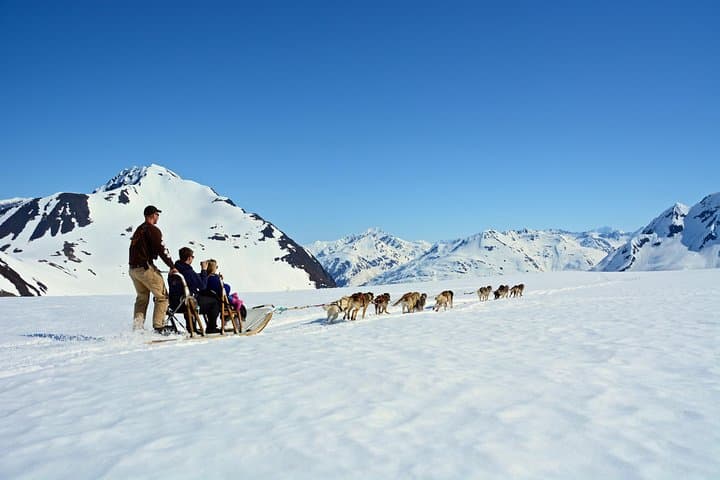
This is summer dogsledding above Girdwood, a quick helicopter hop from sea-level forest to high-country snow—an Alaskan sleight of hand that keeps winter alive when the valleys glow green. A guide clips you into a sled—sitting, standing, or swapping positions to try both—and the team lunges forward with a joyous jolt. The runners whir, the glacier hums underfoot, and the wind shoulders into you like a friendly sparring partner. A loop unfolds across the snowfield, with mountains keeping watch from every angle. One moment you’re eye level with serrated peaks; the next, the trail swings close to the camp where kettles hiss and anchors bite deep into blue ice. You can feel the dogs calibrate to each other’s rhythm—shoulders dancing, tails flagging—while the musher calls subtle cues that ripple down the line.
Here, snow tells stories. The surface shifts as the sun arcs; hard-packed ribbons give way to softer patches that whisper under the sled. The glacier breathes—creaking now and then, sending a reminder that it is moving, shaping, memorizing the seasons in layers. Look closely and you’ll spot the nuance: compressed ice glowing an electric sapphire near small melt channels; wind-sculpted sastrugi caught in the light; tiny crystals banking the trail like powdered sugar with an attitude.
Mushing belongs to this place. Long before it was a thrill for travelers, dogs and sleds were work—lifelines threading remote communities, hauling mail, medicine, and supplies. The historic Iditarod Trail begins on the Kenai Peninsula, slipping north through the mountains beyond Girdwood toward the Interior. Summer glacier camps keep that lineage alive when valley snow is long gone. Many dogs here are active or retired race athletes, and it shows—lean, focused, and eager to run even as they nuzzle your gloves between laps. This is the state sport for a reason; Alaska moves to the tempo of a dog team when snow calls the tune.
Lift your eyes and the geology starts talking too. The Chugach Range is a wrinkled collision zone where ancient seafloor met North America and didn’t back down. Pressure turned snow to firn and firn to ice, building these rivers that flow slow enough to pretend they’re still. On clear days you can see far, out to peaks serrated like handsaws and back across the tide silts of Turnagain Arm. On cloudy ones, the mood swings, and the glacier draws its own boundaries with fog and shifting light. Both are worthy. In Alaska, weather has agency; it sets terms, and you learn to adapt.
A practical note: this is an efficient, two-hour escape with big payoff. Most trips meet at the heliport in Girdwood, 35 miles south of Anchorage on the scenic Seward Highway. Check in, weigh in (weight and balance matter in helicopters), pull on glacier overboots and a parka if needed, and review a short safety brief. The flight itself is a show—forest giving way to granite and ice—and then it’s boots-on-snow. Expect a friendly camp with guides who know their dogs as individuals. The run around the snowfield is smooth and surprisingly quiet; the only constant is the dogs’ eager chatter and the hiss of runners. There’s time for photos and dog cuddles, and usually a chance to swap roles between sitting in the sled and bracing on the back with the musher.
Pack for mountain weather even in July. Sunglasses are essential in snow glare. Sunscreen earns its keep, as does a warm, windproof layer and gloves. The glacier can feel 10–30°F cooler than town, and a breeze will remind you who’s boss. Helicopter flights are weather-dependent; give yourself a buffer if you’re planning other activities the same day. Families are welcome, but age and mobility restrictions vary by operator—confirm when booking. If you’re nervous about helicopters, know that the ride is short and scenic, with pilots who do this daily. You’ll spend the majority of your time on the glacier with the dogs.
When the sled arcs back to camp and you kneel to scratch a dog behind the ears, you understand the hook. Alaska invites you to participate, not just observe. The glacier pushes forward in its slow way, the mountains hold their line, the wind tests your layers, and the huskies lobby for one more lap. Back in the helicopter, camp grows small, the tracks fade to thread, and the valley greens surge back into view. It’s a neat lesson in scale and time: the giant world you just raced across is still here, storing winter for anyone curious enough to visit.
After you land, linger in Girdwood if you can. This is a mountain town with a generous streak—trails slipping into spruce, waterfalls tucked just off the road, and a food scene crafted by people who choose to live where mountains speak with authority. The day’s story has an exclamation point already, but the valley adds a satisfying coda: steam rising from a bowl of soup, a local beer catching the light, and the knowledge that, high above the treeline, pawprints are already softening into the next chapter.
Planning essentials at a glance: this experience typically runs late spring to early fall when the alpine snowfields are stable. Book early, as seats are limited and weather can shuffle schedules. Dress smart, hydrate, and bring curiosity. The glacier is waiting, the dogs are ready, and the mountains—well, they’ve been ready all along.
Trail wisdom
Small choices, better day.
Buffer for Weather
Helicopter flights are weather-dependent—build a flexible window before or after your tour in case conditions shift.
Dress for Glacier Wind
Even in July, expect 10–30°F cooler temps on the glacier. Wear windproof layers, gloves, and sunglasses for glare.
Know the Weight Policy
Helicopters require precise weight and balance; expect to step on a scale at check-in and pack accordingly.
Protect Your Camera
Bring a strap and spare battery—cold drains power fast. Avoid touching helicopter windows with lenses to prevent smudges.
Local knowledge
Read the place, not just the route.
Watch for native species including Mountain goats on nearby cliffs, Bald eagles riding Turnagain Arm thermals.
Keep an eye out for wildlife during the transition between areas and habitats. Respect distance guidelines.
Glaciers here are sensitive to warming trends; stay within marked areas, follow guide instructions, and pack out all waste to minimize your footprint.
Follow the guide's instructions on size limits, ethical handling, and leave-no-trace practices.
Virgin Creek Falls—an easy, mossy walk to a photogenic cascade minutes from town. Winner Creek Gorge—short hikes to thundering water and slickrock channels
Locally recommended viewpoints and quiet spots known best to local operators.
Girdwood grew from mining roots into a ski town, and the historic Iditarod supply route crossed nearby Crow Pass—mushing remains Alaska’s official state sport.
Maritime roots and regional tradition shape the waterways and working coasts.
Seasonal guide
Four versions of the same landscape.
Spring
Best forBright snow contrast for photos · Lower-angle light and cooler temps
ChallengesChangeable weather · Softening snow by afternoon
Late spring brings longer days and firmer morning snow with moody, dramatic skies over the Chugach.
Summer
Best forPeak accessibility · Stable glacier operations
ChallengesHigh sun glare · Variable cloud cover and wind
Prime season for summer mushing—expect efficient operations, plenty of daylight, and crisp air on the snowfield.
Fall
Best forQuieter bookings · Cooler temperatures
ChallengesMore frequent storms · Potential for schedule adjustments
Shoulder season can be serene, but be ready for weather delays and rapidly changing conditions.
Winter
Best forValley mushing elsewhere · Aurora viewing (off-glacier)
ChallengesThis glacier tour typically does not operate · Limited daylight
Glacier-based dogsledding pauses in deep winter; consider valley sled tours or ski days at Alyeska instead.
Operator details
What the booking data adds.
Included
- ✓90-minute Helicopter Dogsledding Tour
- ✓Helicopter flight to glacier
- ✓All taxes and fees
- ✓Guided dogsled experience
Not included
- —Gratuities
- —Comfort surcharge applied to guests over 250lbs
- —Transportation from Anchorage to Girdwood available. Please call our office for more information
Good to know
- ✓Infants are required to sit on an adult’s lap
- ✓Travelers should have at least a moderate level of physical fitness
- ✓Children must be accompanied by an adult
- ✓Small infants (prior to walking) may ride on an adult’s lap free
- ✓Operates on a snow-covered glacier, possible cool temperatures and occasional rain, please dress appropriately
- ✓Please arrive 30 minutes before your tour time.
- ✓Weight limit is 290 pounds per guest. Additional fee for
- ✓Must be able to walk unassisted on uneven snow, and hold on to the sled
Pack with intention
What to bring.
Good to know
Common questions.
Flights are typically short—often around 10–15 minutes—offering sweeping views of the Chugach before landing on the snowfield.
Plan the edges
The details that make the day easier.
Dog mushing has been Alaska’s official state sport since 1972, and the historic Iditarod Trail passes the mountains above Girdwood via Crow Pass.
Refuel at Jack Sprat for locally sourced comfort food or grab a post-flight pint at Girdwood Brewing Company with views of spruce and peaks. The Bake Shop near Alyeska serves legendary soup-and-bread combos perfect after glacier wind. If time allows, ride the Alyeska Aerial Tram for dinner with an alpine panorama.
- Closest airport
- Anchorage (ANC). Meet point: Girdwood heliport, ~35 miles
- 45–60 minutes south via the Seward Highway. Cell service
- good in town; none on the glacier. Permits: no special permits required; follow operator check-in, weight
Glaciers are fragile systems—follow flagged paths, never litter, and keep a respectful distance from melt features. Helicopter emissions are real; many operators consolidate flights—consider bundling activities in one trip to minimize your footprint.
Explore by topic
Follow the threads.
Keep exploring
Make the story part of the trip.
Set out from Bass Harbor for a private, customizable day on Blue Hill Bay — lighthouses, puffins, seals, and the chance to feel Acadia from the water. Small groups, local captains, unforgettable views.
In four hours you can move from shaded canyon ferns to wind-scoured coastal ridgelines, guided by someone who knows where the light—and the hidden views—live. This private half-day hike on the Monterey Peninsula or Big Sur is compact, curated, and perfect for travelers who want depth without a multiday commitment.
 Related story
Beneath a sky of shifting light, Skaftafell’s ice reads like a map of time. This three-hour guided glacier hike mixes technical instruction with geology and culture: compact, safe, and unforgettable.