
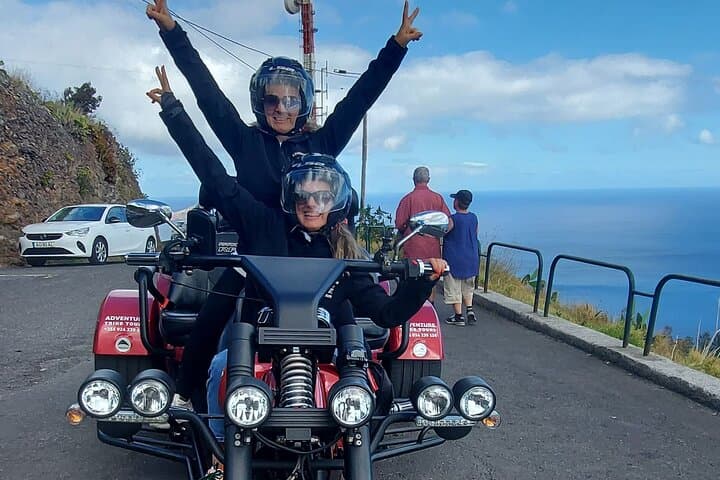
What the day feels like
You pull on the helmet and the Atlantic wind pushes a final strand of hair across your face like an impatient hand. The engine of the custom-built trike thrums beneath you—less machine than confident travel companion—and the waterfront of Funchal shrinks into a mosaic of red tile and bobbing boats. In front, a ribbon of asphalt climbs, coiling up the island’s spine toward jagged summits and sheer sea cliffs. For the next three hours you are negotiating microclimates: sunlit terraces, eucalyptus-scented switchbacks, cloud-scooped ridges. Madeira is moving around you—green, vertical, alive—and the trike makes it intimate in a way a coach never could.
This private Adventure Trikes tour is a compact, kinetic primer on what makes Madeira feel like an island condensed into mountain. In roughly 180 minutes you’ll pass a traditional fishing village, stop at a glass skywalk that puts the ocean under your toes, peer into the dramatic bowl called Nuns Valley (Curral das Freiras), and crest toward Pico do Arieiro, one of the island’s highest viewing points. It’s curated to maximize views and variety: coastal cliffs, cultivated terraces, and alpine-like ridgelines all in one sweep. For travelers with limited time who still want to escape the city, it’s a persuasive way to taste Madeira’s scale and geology.
Geologically, Madeira is young and severe—formed by volcanic eruptions that left a backbone of peaks and deep, glacial-feel valleys. Pico do Arieiro, at 1,818 meters, sits within that backbone and offers a raw perspective on the island’s vertical memory: ridges carved by erosion, layers of basalt, and ocean that looks like a clipped, endless sheet. Curral das Freiras, the so-called Nuns Valley, is a bowl of pines and terraced settlements that once sheltered nuns fleeing pirate raids; today it’s a quiet vantage that rewards slower breaths. The glass skywalk—on a coastal sea cliff—accentuates Madeira’s dramatic meeting of stone and sea; the platform’s transparency gives a dizzying sense of suspension over water and waves.
Culturally, this tour threads through living traditions. Fishing villages still set espetos—skewered sardines—over open coals, and markets sell the island’s famous black scabbardfish and passionfruit liqueurs. Guides on the trikes usually point out agricultural terraces and the historic role of sugar and wine in Madeira’s economy, connecting the land’s form to human work. Because this is a private tour, your guide will pace stops for photos, short walks, or to explain the island’s local stories—how the laurisilva forest once covered more of the archipelago, or why postcard images of Madeira nearly always show terraces holding onto improbable slopes.
Practical nuts and bolts: the tour runs about three hours and is private, priced from roughly USD 171.52 (subject to change). Most of the route is on paved roads, with short, optional walks at viewpoints; you’ll reach high elevations—Pico do Arieiro sits near 1,818 meters—so temperatures and wind can shift quickly. The motorcycle-style trikes are stable and comfortable for those who’ve never ridden a bike; however, the experience is best for travelers who want an active, sensory journey rather than a passive bus ride.
How to get the most from it: plan for morning light if you want softer shadows and often clearer skies in the mountains. Bring layers; Madeira’s microclimates can change within minutes—sunlight on the coast, fog at altitude, gusts on the ridgeline. Keep your camera at the ready, but also set it down sometimes and simply watch: the way the ocean refracts late light, the terraces stacked like steps into the valley. Finally, if you have mobility concerns, ask the operator beforehand about accessibility—the trikes involve a low step and short walks at overlooks.
Why travelers love it: it compresses the island’s contrasts into a single, efficient window—sea, sky, cliff, and summit—without the organizational friction of renting a car and finding parking at view points. For photographers it’s a practical moving platform; for curious travelers, it’s a guide-led primer on Madeira’s geology and culture. And because the tour is private and guide-driven, you get context: names, history, and the kind of local tips that turn a good view into an understood one.
If you want a fast, scenic way to connect Funchal with Madeira’s wilder edges, this trike tour is a bracing, approachable option. It invites you to lean into the landscape’s movement—the cliffs dare you, the ridges encourage you forward—and rewards that attention with vistas that linger long after the engine goes still.
Trail wisdom
Small choices, better day.
Layer for microclimates
Temperatures can drop dramatically above 1,000 m—pack a windproof layer even if it’s warm in Funchal.
Bring a compact camera or phone gimbal
The trike stops frequently for photos; a small stabilizer helps capture smooth shots from a moving platform.
Secure small loose items
Wind at cliffside viewpoints can be strong—use zippers or bungee cords for hats and light gear.
Hydrate and snack
Three hours of elevated roads and views is pleasantly demanding—carry water and a small snack for quick energy.
Local knowledge
Read the place, not just the route.
Watch for native species including Madeira Laurel Pigeon (Trocaz Pigeon), Bottlenose dolphins off the south coast.
Keep an eye out for wildlife during the transition between areas and habitats. Respect distance guidelines.
Large tracts of Madeira’s higher elevations include laurisilva forest, a UNESCO World Heritage site—stay on roads and viewpoints, avoid disturbing endemic flora, and pack out all waste.
Follow the guide's instructions on size limits, ethical handling, and leave-no-trace practices.
Eira do Serrado viewpoint above Curral das Freiras for quieter, panoramic valley views. Early-morning access to the glass skywalk to beat the crowds and catch clearer coastal light
Locally recommended viewpoints and quiet spots known best to local operators.
Curral das Freiras (Nuns Valley) was historically a place of refuge for nuns fleeing pirate raids—its steep walls shaped both isolation and self-sufficiency.
Maritime roots and regional tradition shape the waterways and working coasts.
Seasonal guide
Four versions of the same landscape.
Spring
Best forClear mountain views · Wildflower displays · Milder temperatures
ChallengesUnpredictable showers · Cool mornings at altitude
Spring offers crisp air and blooming hedgerows; mornings can be cool but often clear—great for photography.
Summer
Best forLonger daylight · Warm coastal stops · More stable weather
ChallengesStronger sun exposure · Possible haze in the afternoon
Summer is warm on the coast and good for extended stops—bring sun protection and plan earlier departures.
Fall
Best forCrisp light for photos · Fewer crowds · Comfortable driving temperatures
ChallengesOccasional storms · Variable mountain fog
Autumn brings vivid late‑day color and often calmer roads; microclimates still mean layers are necessary.
Winter
Best forDramatic cloud inversions · A quieter island experience
ChallengesWind and low clouds at high points · Cooler temps
Winter can produce striking cloud seascapes around ridges though visibility can be limited—dress warmly.
Operator details
What the booking data adds.
Included
- ✓Helmets and Jackets will be offered while on tour
Not included
- —Coffee and/or Tea
Good to know
- ✓Infants and small children can ride in a pram or stroller
- ✓Public transportation options are available nearby
- ✓Suitable for all physical fitness levels
- ✓The 3 hour tour is very dependent on how long clients want to remain at each site, we flexible according to the clients needs on tour, each group of clients are different some like to stay at a view point have coffee and spend 45min. So it's very flexible. We have a route that takes but the clients decides how long they want to spend at each stop. We have time within the 3 hour tour we stop at other view points.
Pack with intention
What to bring.
Good to know
Common questions.
The private tour lasts about three hours and is priced from approximately USD 171.52, though rates can vary by provider and season.
Plan the edges
The details that make the day easier.
Madeira’s laurisilva forest is a UNESCO World Heritage Site—these subtropical, ancient laurel forests once covered much of southern Europe and now persist here, harboring many endemic species.
After the tour, head back to Funchal’s Mercado dos Lavradores for fresh fruit and local pastries, try espetada or black scabbardfish at a nearby restaurant, and sample a glass of poncha at a traditional bar to round out the island experience.
- Closest airport
- Cristiano Ronaldo Madeira International Airport (FNC)
- Typical start
- Funchal town center
- Driving to Pico do Arieiro
- ~30–45 minutes from Funchal depending on stops
- Cell service
- generally good near towns, intermittent at the highest viewpoints
- Permits
- none required for this private tour
Madeira’s ecosystems are fragile—stay on paved viewpoints, avoid removing plants or stones, carry reusable bottles, and pack out trash to keep high ridgelines and laurisilva stands healthy.
Explore by topic
Follow the threads.
Keep exploring
Make the story part of the trip.
Set out from Bass Harbor for a private, customizable day on Blue Hill Bay — lighthouses, puffins, seals, and the chance to feel Acadia from the water. Small groups, local captains, unforgettable views.
In four hours you can move from shaded canyon ferns to wind-scoured coastal ridgelines, guided by someone who knows where the light—and the hidden views—live. This private half-day hike on the Monterey Peninsula or Big Sur is compact, curated, and perfect for travelers who want depth without a multiday commitment.
 Related story
Beneath a sky of shifting light, Skaftafell’s ice reads like a map of time. This three-hour guided glacier hike mixes technical instruction with geology and culture: compact, safe, and unforgettable.