
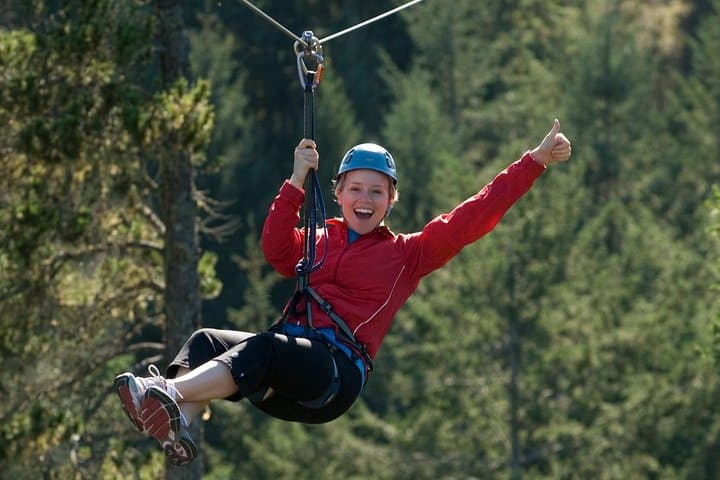
What the day feels like
The truck noses uphill into the forest, a boxy, safari-style beast with the purr of purpose. Ferns part. Sword ferns flash their sawtooth smiles. Cedars lean in, old guardians whispering as tires climb toward the ridge. The air shifts—cooler, resin-sweet, carrying a hint of salt from the nearby straits. Somewhere above the canopy, cables thread the trees like silver trails, a promise stretched between platforms. You feel it before you see it: the rainforest daring you to leave the ground.
On the Zipline Adventure Tour just west of Victoria, British Columbia, flight comes wrapped in moss and mist. This is coastal temperate rainforest—lush, layered, and alive. Guides clip you into a harness with practiced ease, walking you through braking and body position until the forest’s hum lowers a notch. The first step off the platform is a conversation. Gravity nudges. The cable sings. Below, the canopy ripples—Douglas firs and red cedars shouldering one another for light—while eagles trace lazy circles over the valley, owning the thermals. The line carries you forward as if the forest itself is pushing, urging you across eight ziplines, past a swaying 100-foot suspension bridge, and along wooden platforms anchored into the hillside.
This is adventure with a view. Between runs, openings in the trees reveal blue water rimming the coast—the Strait of Juan de Fuca stretching toward the Olympic Mountains. On clear days, the peaks look close enough to touch, pulling the horizon tight. On misty ones, the forest closes ranks and turns the experience into a dream of greens and grays, each drop of condensation tapping your helmet with soft percussion. Either way, the course is built for flow. Lines stack in a progression: shorter, confidence-building first, then longer and faster, with a final flight that feels like a grin stretched between two trees. It’s two hours of movement threaded by small stillnesses—clips, checks, laughter; the brief hush before the leap.
The rainforest here is more than scenery. Vancouver Island’s coastal temperate rainforest ranks among the largest remaining in the world, a green engine that exudes oxygen and drinks down rain. Western red cedars can live for a millennium; Sitka spruces corner the wind with thick, salt-tolerant bark. Understory and overstory negotiate constantly—salal pressing low, bigleaf maples trading shade for moss. It’s a living system that rewards a slower gaze, and the guides know it. Between zips, they point out nurse logs and salmonberry, tell stories of the island’s natural history, and share a quiet reverence for the Coast Salish territories on which the adventure unfolds. This is T’Sou-ke and Lekwungen land, shaped long before timber and tourism by people who read the tides and forest with practiced fluency.
There’s history in the hardware here too. Ziplining as recreation owes its roots to both ecology and necessity—scientists once rigged traverses to study wildlife high in the canopy, while farmers in mountainous regions strung lines to move goods across ravines. On Vancouver Island, it’s become a way to feel the folds of the land without stomping through them. Platforms perch off the forest floor. Trails are purposeful, minimal. Even the approach ride is part of the story: ten minutes up an old logging grade in that rumbling truck, gaining elevation so gravity can do its work.
Practicalities are refreshingly simple. The course is guided from start to finish. You don’t need technical experience—just the willingness to step off solid ground and trust your gear. Closed-toe shoes are required. Layers are wise. A light drizzle won’t cancel the day; this forest knows rain like a friend. Wind swirls in the upper reaches and cools the lines; in summer, the canopy throws good shade. Spring brings a riot of new growth and clearer views as the forest leafs in. Fall is gold and green stitched together, with crisp air that sharpens the senses.
For many, the moment that sticks isn’t the longest line or the fastest run—it’s the bridge. The 100-foot suspension span hums with the energy of movement, every step sending a gentle sway through cable and wood. The forest watches you cross—fir needles pointing the way, maples shrugging a leaf or two to the trail below. The bridge gives you time to look into the understory, to note the dark seam of a seasonal creek or the soft shoulder of a mossed stump. Then the zipline calls again, a taut line across a deep breath.
This is a choose-your-pace kind of adventure. If you’re new to heights, the guides are skilled at giving you room while keeping you safe. Nervous laughter is common on the first platform; that laughter tends to change by the third line, shaped into something steadier. Experienced thrill-seekers will appreciate the course design—varied perspectives, smooth transitions, just enough span to feel speed without losing the nuance of the setting. The rainforest does its part, stealing the show when the sun shafts through and stitching the air with birdsong when it doesn’t.
When the truck shuttles you down at the end, the forest doesn’t release you so much as nod farewell. The cable chatter fades. The ocean smell returns. You’re back on the ground, but some part of you still hangs in the green, listening for the zip and the rush and the quick thump of landing.
If you’re building a Victoria itinerary, this tour slots in easily between coastal hikes and harbor meals. Combine morning flight time with an afternoon at nearby Sooke Potholes Provincial Park, where the Sooke River carves swimming holes into polished rock. Or walk a section of the Coast Trail in East Sooke Park, where the rainforest meets the Salish Sea and tidepools hold worlds of their own. In town, the Inner Harbour pulls you in with seaplanes and salt air; by evening, you’re swapping stories over local salmon and a pint from Sooke Brewing. The island has a way of keeping the day in motion, slow or fast, your call.
The takeaway is uncomplicated: this is adventure that feels good in the body and stays in the mind. The rainforest has presence. The lines have rhythm. And for two hours, gravity becomes your friendly guide, ushering you through a landscape that asks you to pay attention—to height, to speed, to the quiet power of trees doing their work.
Trail wisdom
Small choices, better day.
Dress for the canopy
Wear breathable layers and a light rain shell—conditions can shift quickly under the trees, even on sunny days.
Secure your valuables
Use a wrist strap or chest mount for phones/action cameras; loose items can’t be used on the lines.
Closed-toe shoes only
Trail shoes or sturdy sneakers improve footing on platforms and short forest walks between lines.
Arrive early and hydrate
Check in 20 minutes ahead to gear up without rush and drink water before you ride—the excitement can mask thirst.
Local knowledge
Read the place, not just the route.
Watch for native species including Bald eagles, Black-tailed deer.
Keep an eye out for wildlife during the transition between areas and habitats. Respect distance guidelines.
Stay on designated paths and platforms to protect fragile understory and moss. Pack out all trash and respect wildlife viewing distances.
Follow the guide's instructions on size limits, ethical handling, and leave-no-trace practices.
Sooke Potholes Provincial Park swimming holes along the Sooke River. Coast Trail in East Sooke Park for tidepools and rugged shoreline views
Locally recommended viewpoints and quiet spots known best to local operators.
This area lies within the traditional territories of the T’Sou-ke and Lekwungen peoples, whose deep ties to forest and sea shape the region’s cultural fabric.
Maritime roots and regional tradition shape the waterways and working coasts.
Seasonal guide
Four versions of the same landscape.
Spring
Best forCooler temps · Fresh foliage
ChallengesVariable rain · Slick platforms
Shoulder-season freshness with bursts of sun between showers. Expect vibrant greens and fewer crowds.
Summer
Best forLong daylight · Clear views
ChallengesWarmer afternoons · Busy weekends
Prime visibility and comfortable temps under the canopy; book ahead for peak dates.
Fall
Best forCrisp air · Autumn color
ChallengesEarly dusk · Occasional storms
Golden maples and stable, cool air make for great riding—pack a warmer layer and headlamp for travel.
Winter
Best forMystic fog · Quiet trails
ChallengesCold rain · Potential weather delays
A moody rainforest experience with fewer guests; bring waterproof layers and check for weather advisories.
Operator details
What the booking data adds.
Included
- ✓All necessary equipment is provided
- ✓2-hour zipline tour
Not included
- —Hotel pickup and drop-off
- —Food and drinks
- —Gratuities
Good to know
- ✓Not recommended for pregnant travelers
- ✓Not recommended for travelers with poor cardiovascular health
- ✓Public transportation options are available nearby
- ✓Suitable for all physical fitness levels
- ✓Participants must weigh a minimum of 60lbs (28kg) and a maximum of 275lbs (125kg)
- ✓Minimum passenger age is 5
- ✓Absolutely no alcohol, cannabis, or illicit drug use permitted prior to or during a tour.
- ✓All guests are required to sign a waiver. Participants under 19 must have a parent or guardian’s signature. The waiver must be completed at the time of check-in and witnessed by staff.
- ✓Operates in all weather conditions, please dress appropriately
- ✓Wear closed-toe, closed-heel footwear
- ✓If canceled due to poor weather, you will be given the option of an alternative date or full refund
- ✓Must arrive 20 minutes before the scheduled tour time: check-in 20 minutes before the tour
Pack with intention
What to bring.
Good to know
Common questions.
No. The tour is fully guided and includes a thorough safety briefing and practice before the first line.
Plan the edges
The details that make the day easier.
Vancouver Island’s coastal temperate rainforest is among the largest remaining temperate rainforests on Earth, home to ancient western red cedar and Sitka spruce ecosystems.
Post-flight, refuel at Sooke Brewing Company with a West Coast IPA and a rotating food truck lineup, or head to Wild Mountain for farm-to-table fare focused on local seafood and produce. Coffee and pastries at Shirley Delicious make a solid pre- or post-adventure stop if you’re exploring the coast.
- Closest airport
- Victoria International (YYJ). Course location: west of Victoria near Sooke (45–60 minutes’ drive). Cell service: spotty in the forest; download directions ahead. Permits: none required; advance booking and check-in are mandatory.
Platforms and lines are designed to minimize forest-floor impact—help by staying on constructed paths, avoiding mossy edges, and packing out all waste. This is Indigenous land; travel with respect.
Explore by topic
Follow the threads.
Keep exploring
Make the story part of the trip.
 Related story
Less than two hours from Nairobi, Kereita Forest pairs hands-on canopy adventure with quiet montane trails and a sobering colonial history—perfect for families, teams, and curious travelers seeking a full-day pulse of nature.
Set out from Bass Harbor for a private, customizable day on Blue Hill Bay — lighthouses, puffins, seals, and the chance to feel Acadia from the water. Small groups, local captains, unforgettable views.
In four hours you can move from shaded canyon ferns to wind-scoured coastal ridgelines, guided by someone who knows where the light—and the hidden views—live. This private half-day hike on the Monterey Peninsula or Big Sur is compact, curated, and perfect for travelers who want depth without a multiday commitment.