
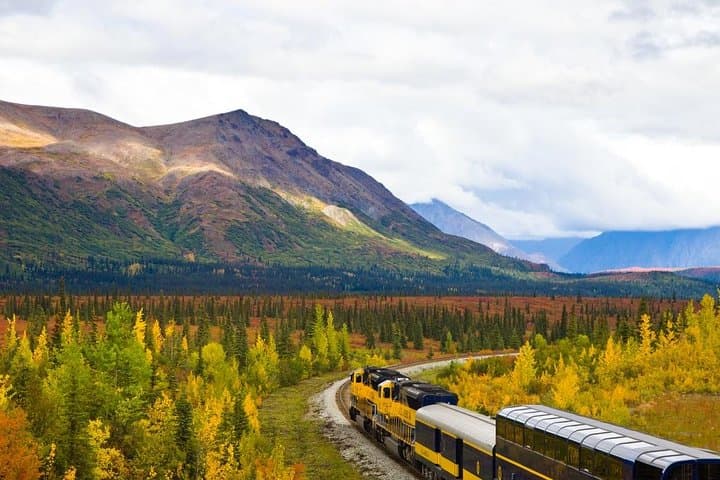
What the day feels like
The rails hum first, a steady, low purr that tells you it’s time. You find your seat, a big glass frame on the world, and the boreal forest glides by like a green tide. Spruce lean in to listen. The Nenana River braids and re-braids, shouldering its way south, and the Alaska Range keeps pace in the window, the stern chaperone you hoped would appear. If the sky is clear, Denali steps out from its weather, showing its improbable mass—a mountain that makes the rest of the range look like foothills. On a train, the landscape sets the rhythm; you just learn the beat.
This is the Denali Star, the Alaska Railroad’s spine of summer travel, carrying you one way from Denali National Park to Anchorage in about eight unhurried hours. It’s a corridor of geology and story: takes on gold, coal, and the hard lessons of frontier engineering. The route slips through Broad Pass, the lowest notch through the Alaska Range at roughly 2,363 feet, then drops along the Susitna River toward Talkeetna, that knot of climbers and bush pilots where summit dreams are measured in weather windows. Past Wasilla, the Chugach Mountains gather, blue and serrated, and Anchorage spreads against Cook Inlet like a ledger of streets and stories at the end of the line.
History rides shotgun here. The Alaska Railroad was hammered and trestled into existence between 1914 and 1923, stitched south from Fairbanks and north from tidewater. In 1923, President Warren G. Harding tapped the golden spike at Nenana, linking a territory too large for the lower 48 to imagine. The railroad made Talkeetna a launchpad for expeditions, fed homesteads and camps, and threaded together communities that still rely on it. Sit long enough in the dome car and you’ll hear pieces of this—conductors narrating, place names unfolding like a map you can read with your eyes shut: Hurricane Gulch, Curry, the Susitna, Montana Creek.
Geology speaks in broad strokes. The Denali Fault, a major strike-slip feature, wrenches the Earth’s crust beneath your path. The Alaska Range is young and hungry, shouldering skyward as ice gnaws at its flanks. You cross the Hurricane Gulch Bridge, a steel spine 296 feet over a yawning gorge, and the wind reaches up as if to test your nerve. The train doesn’t blink. Rivers pull you along—Nenana into Tanana into Yukon, Susitna down to the sea—each current pushing forward, daring the banks to hold.
Culture rolls with the wheels. In summer, car hosts share their hometown stories and the names of mountains you’ll forget and then remember when they arrive on your camera roll. On the platform in Talkeetna, climbers in work-worn boots trade weather reports in quick, efficient sentences; here, the mountain makes the rules. In Denali National Park, Athabascan history threads through guides’ interpretation—subsistence traditions, language, a long belonging to the boreal and the river valleys the train traces today.
The Denali Star is not a rush. That’s the point. You sit high in the dome car if you’ve booked GoldStar Service, a glass bubble wrapped around the sky. Adventure Class seats keep the views crisp and the ride smooth, with easy access to the Vista Dome. A dining car rolls out reindeer sausage and salmon chowder. Between bites, you will spot moose shouldering through willow, bald eagles riding thermals over sandbars, trumpeter swans folded like origami into backwater ponds. On clear days, Denali is the headline; on socked-in days, texture steals the show—lichen, kettle ponds, the black sheen of a muskeg pool.
Practicality holds the trip together. Expect a full day: roughly eight hours to chisel the miles from Denali Depot to Anchorage’s downtown station. Denali typically rises on the right-hand side when traveling south; book accordingly if you care about mountain views, but remember the route curves and the show is wide. Luggage can be checked at the station; keep cameras, layers, and medications with you. There’s food on board, but snacks never hurt. The train is smooth enough that motion sickness is rare, though the big windows tempt long stares and longer conversations.
If your goal is to see the Great One, timing can help. Summer is peak, but late August and early September often deliver crisp air and stable visibility, when the mountain is less shy. Spring brings a palette of thaw and moving water, with tracks shouldered by snowbanks that still remember winter. In midseason light, the landscape paces itself—no rush, just steady in its shift from one biome to the next.
Most travelers pair this one-way ride with time in Denali National Park—hikes along the Savage River, a bus ride down the Park Road as far as conditions allow, and quiet evenings in Healy or the Denali Park area. The train becomes the release valve, a way to exhale after backcountry ambition. Sit back. Let the steel do the work. You’ll cross country you’d never see from the highway, glide over canyons that would take days to reach on foot, and arrive with a day’s worth of stories that smell faintly of spruce and diesel.
There’s a humility to rail travel in Alaska. Mountains set the scale. Rivers keep time. The boreal knows you’re passing through and whispers anyway. It’s an adventure without bravado and a practical way to connect two very different Alaskan chapters. By the time Anchorage grows in the window, you’ll have followed a range, bridged a gorge, shadowed a river, and let the north set your pace. That’s the reward: you moved far without hurrying, and the land moved you back.
Trail wisdom
Small choices, better day.
Pick the right side
Heading south, Denali often shows best on the right side of the train. If mountain views matter, request those seats when booking.
Layer up for microclimates
Temperatures swing between high-elevation passes and coastal lowlands; pack a light puffy and a breathable shell even in summer.
Bring optics
Small binoculars make a big difference for spotting moose, eagles, and distant glaciers while the train is moving.
Eat early, shoot late
Dine before the marquee vistas—Hurricane Gulch and Talkeetna approaches—so you’re free to photograph when the scenery spikes.
Local knowledge
Read the place, not just the route.
Watch for native species including Moose, Bald eagles.
Keep an eye out for wildlife during the transition between areas and habitats. Respect distance guidelines.
Wildlife along the corridor is sensitive to disturbance—observe from the train and avoid approaching animals at station stops. Support rail travel’s lower-impact model by packing light and minimizing single-use plastics onboard.
Follow the guide's instructions on size limits, ethical handling, and leave-no-trace practices.
Hurricane Gulch Bridge—watch the gorge appear suddenly as the train glides onto the high trestle. Broad Pass—on clear days, a sweeping window into the Alaska Range’s geometry
Locally recommended viewpoints and quiet spots known best to local operators.
In 1923, President Harding drove the golden spike at Nenana, completing the Alaska Railroad and linking interior Alaska to the coast.
Maritime roots and regional tradition shape the waterways and working coasts.
Seasonal guide
Four versions of the same landscape.
Spring
Best forMelting river scenes · Fewer crowds
ChallengesVariable snow near Broad Pass · Cool, windy conditions
Expect lingering snowbanks and rushing rivers; clear, cold mornings can deliver big mountain views before clouds build.
Summer
Best forPeak service frequency · Wildlife sightings
ChallengesHigher prices and fuller trains · Afternoon cloud cover on Denali
Long daylight, lush boreal forest, and the best chance for caribou and moose along the corridor.
Fall
Best forCrisp visibility · Tundra color
ChallengesShorter days · Cool temps and early frost
Late August into September brings gold birch, ruby tundra, and sharper views—great for photography from the dome cars.
Winter
Best forAurora possibilities (off-peak routes) · Quiet travel
ChallengesLimited or no Denali Star service · Extreme cold
The Denali Star is seasonal; winter rail experiences shift south. If you’re here off-season, plan alternate legs or fly.
Operator details
What the booking data adds.
Included
- ✓Optional dining and snack bar
- ✓One-way rail transportation from Denali to Anchorage
- ✓Comfortable reserved seating
- ✓Alaskan tour guide providing narration throughout journey
Not included
- —Lodging in Anchorage
- —Tours and activities in Anchorage
- —Transportation after arriving in Anchorage
- —These options can be booked independently or through Alaska Railroad directly after booking.
Good to know
- ✓Wheelchair accessible
- ✓Infants and small children can ride in a pram or stroller
- ✓Service animals allowed
- ✓Public transportation options are available nearby
- ✓Infants are required to sit on an adult’s lap
- ✓Transportation options are wheelchair accessible
- ✓Suitable for all physical fitness levels
- ✓Children must be accompanied by an adult
- ✓Infants (0-1) may be added to a reservation as lap children (not requiring a paid, reserved seat) but they must be registered in the booking. To register an infant as a lap child, please indicate so in the “Special Requests” option in the final checkout and include the infant’s name, age and gender.
Pack with intention
What to bring.
Good to know
Common questions.
Plan on roughly 8 hours, depending on operating conditions and scheduled stops like Talkeetna and Wasilla.
Plan the edges
The details that make the day easier.
The Alaska Railroad was completed in 1923 when President Warren G. Harding drove the golden spike at Nenana, linking Alaska’s interior to its southern coast.
Bookend your ride with Denali Brewing beers and wood-fired pizza in Talkeetna if you’re stopping over, or 49th State Brewing in Healy for burgers and a local pint. In Anchorage, celebrate the arrival with fresh halibut at Glacier Brewhouse or reindeer sausage at a downtown cart. If time allows, pop into the Talkeetna Historical Society Museum for a tight, engaging look at mountaineering lore and railroad history.
- Closest airport
- Ted Stevens Anchorage International (ANC) at the terminus; Fairbanks International (FAI) if traveling onward north. Departure: Denali Park Depot. Drive time to Denali Depot from Healy: ~20 minutes. Cell service: Intermittent to spotty between Denali and Wasilla. Permits: None required; train ticket and photo ID needed.
Rail is a low-impact way to cover Alaska’s vast distances—stay off the tracks at stops, pack out all waste, and use a reusable bottle. Keep voices low when wildlife is visible to reduce disturbance and keep curtains open to reduce cabin lighting glare on night wildlife.
Explore by topic
Follow the threads.
Keep exploring
Make the story part of the trip.
In four hours you can move from shaded canyon ferns to wind-scoured coastal ridgelines, guided by someone who knows where the light—and the hidden views—live. This private half-day hike on the Monterey Peninsula or Big Sur is compact, curated, and perfect for travelers who want depth without a multiday commitment.
 Related story
Beneath a sky of shifting light, Skaftafell’s ice reads like a map of time. This three-hour guided glacier hike mixes technical instruction with geology and culture: compact, safe, and unforgettable.
 Related story
Lose the city for a few hours without leaving it: this 5-mile, 900-foot-gain Forest Park loop threads old-growth pockets, city viewpoints, and cultural landmarks for a compact taste of Portland’s wild side. Expect moss, roots, and stories.