
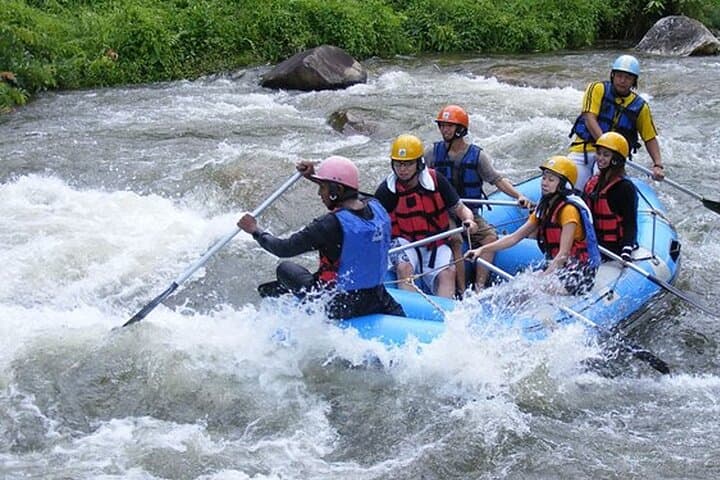
What the day feels like
The morning starts with a van turning off the highway and into a narrow ribbon of road where palms and rubber trees press close. Steam rises from the jungle floor; a rooster crows somewhere beyond sight. At the camp in Songprak, coffee appears in paper cups and the guides—easygoing, practiced—unpack helmets and life jackets with the efficiency of people who spend their lives reading rivers. You get the feeling this place is measured in currents and trails rather than calendar days: the river will tell you when to be brave.
Phang Nga Province sits at the hinge between Thailand’s Andaman coastline and interior limestone country. The geology here is dramatic: karst towers hollowed by rain and sea, subterranean channels that send fresh water pulsing down to the plains. The whitewater run on this tour is short—about 5 kilometers—but compact and lively, a concentrated stretch of riffles and playful drops that reward precise steering more than brute force. It’s the kind of river that dares you: it will pull at the stern, invite you to edge forward, and then spit you out with a laugh.
Culturally, the route threads through local life. A side-stop at the Monkey Cave Temple offers a quick cultural interlude: monks chant, macaques take an interest in tourists’ snack packs, and a hilltop shrine looks out over rice paddies and distant sea. Lunch back at the camp is honest Thai fare—sour, salty, and cooling at the same time—served under a canopy of banana leaves. The guides are from nearby villages; between explaining steer strokes they will share local stories about seasonal floods, the best mangoes, and where to find a quiet beach on the way back to Phuket.
The tour also layers in a motorized jaunt: ATV rides across the lowland rainforest of Songprak. It’s optional, but when the trail opens and the machines kick up leaves and dust, the jungle feels like a living obstacle course. You’ll splash through shallow streams, bank around trees, and see the forest at a pace that contrasts with the raft—but both moves are about choice: the raft responds to the river’s moods; the ATV responds to your hands on the throttle.
Practicalities are straightforward. The whole day is an eight-hour loop—typically a 1.3–2 hour transfer from Phuket, a briefing, the ATV segment (if chosen), the 5 km raft run, lunch, and return to hotel. No advanced paddling skills are required: guides give a succinct, hands-on safety briefing and coaches sit in every raft. The whitewater is suitable for beginners and families comfortable in moving water; it’s lively enough to satisfy experienced paddlers looking for a fun half-day push.
When to go matters. The river is at its most energetic in and just after the wet season; dry-season trips are calmer and sunnier. The pick-up from Phuket is the hinge for timing—aim for a departure window that avoids mid-day heat in the hot season and the worst of the afternoon showers during monsoon months. Bring a small dry bag for your phone and a positive attitude: both will be needed.
Safety is baked into the itinerary. Helmets and PFDs are standard, and the guides lead with clear signals. Yet the wild element is real—the currents, the occasional submerged log, a slick rock edging the riverbank. Respect the briefing. If you’re nervous about the raft’s flips or the ATV’s roughness, communicate it to your guide; they can adapt placements and routes.
Beyond adrenaline, the trip is an efficient way to stitch a broader southern-Thai experience into a single day. It’s an accessible adventure for travelers based in Phuket who want to step into a greener, less touristed pocket of the region without committing to multi-day logistics. Expect to return to your hotel with mud on your boots, a sunburn ring on your neck, and a handful of stories—the sort that make other people ask when they can join you next time.
If you go: prioritize breathable layers that dry fast, waterproof protection for electronics, and a flexible schedule that allows you to enjoy the camp at a slower pace. The river will demand a bit of respect, but the rewards are immediate: the smell of wet leaves, the slap of water on the hull, and a sense of having moved through a landscape that is, for a few hours, palpably alive.
Why travelers should consider it: it’s an inverted sampler of southern Thailand—river running, rainforest throttle, local food, and gentle cultural stops—packed into one well-run, approachable day. For families, mixed groups, and solo travelers looking for something beyond the beach, it’s uncomplicated, memorable, and surprisingly complete.
Trail wisdom
Small choices, better day.
Bring a Small Dry Bag
Protect your phone, ID, and any medication in a waterproof pouch—guides will store it securely during the raft run.
Wear Grippy Water Shoes
Closed-toe water shoes with good tread are better than flip-flops for both rafting and ATV exits.
Hydrate Early
Start hydrating before departure and carry a reusable bottle—the day includes sun exposure and physical activity.
Listen to the Safety Briefing
Guides give concise commands that keep everyone safe—follow them and ask questions if unsure.
Local knowledge
Read the place, not just the route.
Watch for native species including Long-tailed macaque, Kingfisher.
Keep an eye out for wildlife during the transition between areas and habitats. Respect distance guidelines.
Operators often work with local communities to protect riverbanks; visitors should avoid feeding wildlife and pack out all trash to preserve fragile riparian zones.
Follow the guide's instructions on size limits, ethical handling, and leave-no-trace practices.
Small viewpoints off the camp road that look toward limestone outcrops at sunrise. Local fruit stalls near Songprak village—try seasonal mango or durian when available
Locally recommended viewpoints and quiet spots known best to local operators.
Phang Nga’s landscape is shaped by ancient limestone karsts and coastal processes; the region’s coastline was thrust into global awareness after the 1974 James Bond film featured nearby Khao Phing Kan ("James Bond Island").
Maritime roots and regional tradition shape the waterways and working coasts.
Seasonal guide
Four versions of the same landscape.
Spring
Best forLower crowds · Moderate river flow
ChallengesOccasional showers · Sticky humidity
Spring sees rising temperatures and sporadic rain; the river is playful and the forest smells fresh—expect sticky humidity by mid-day.
Summer
Best forLush jungle scenery · Stronger river currents
ChallengesMonsoon storms · Slippery trails after rain
Summer brings heavier flows and dramatic thunderstorms—good for lively rapids but plan for wet conditions and occasional delays.
Fall
Best forClearer skies · Comfortable temperatures
ChallengesPost-monsoon debris · Variable river levels
Fall (post-monsoon) provides clear air and green landscapes; river levels can drop or still be high depending on rainfall timing.
Winter
Best forCooler, drier weather · Easier travel from Phuket
ChallengesLower river volume · Brighter sun
Thailand’s ‘winter’ (Nov–Feb) is the most comfortable time—cooler mornings and lower rain risk, though some rapids mellow.
Operator details
What the booking data adds.
Included
- ✓Bottled water
- ✓Lunch
- ✓All Fees and Taxes
- ✓Coffee and/or Tea
- ✓ATV ( If chosen)
Not included
- —Personel Expenses
- —Free Transfer from Patong ,Kata and Karon Beach only, Other area , transfer charge will be applied
Good to know
- ✓Specialized infant seats are available
- ✓Not recommended for travelers with spinal injuries
- ✓Not recommended for pregnant travelers
- ✓Not recommended for travelers with poor cardiovascular health
- ✓Suitable for all physical fitness levels
- ✓Minimum age for rafting tour is at 7 years old
- ✓Minimum age for ATV /Rider is at 11 years old
Pack with intention
What to bring.
Good to know
Common questions.
The whitewater portion is about 5 kilometers and typically lasts 30–60 minutes depending on river flow and stops.
Plan the edges
The details that make the day easier.
Khao Phing Kan, near Phang Nga Bay, became internationally famous after appearing in the 1974 James Bond film 'The Man with the Golden Gun.'
After the trip, head to Phang Nga town or back in Phuket for fresh seafood and southern Thai curries. Try a roadside stall for khao man gai (chicken rice) or a seaside restaurant for grilled snapper and cold beer—locally produced fish sauce and lime give the region’s food its signature tang.
- Closest airport
- Phuket International Airport (HKT). Typical drive: 1.3–2.0 hours from Phuket. Cell service: generally available but patchy in dense rainforest. Permits: none required for day tours; inform driver of pickup location.
This tour moves through sensitive river and forest habitats—pack out trash, avoid single-use plastics where possible, and do not feed wildlife. Support operators that employ local guides and follow riverbank protection practices.
Explore by topic
Follow the threads.
Keep exploring
Make the story part of the trip.
Set out from Bass Harbor for a private, customizable day on Blue Hill Bay — lighthouses, puffins, seals, and the chance to feel Acadia from the water. Small groups, local captains, unforgettable views.
In four hours you can move from shaded canyon ferns to wind-scoured coastal ridgelines, guided by someone who knows where the light—and the hidden views—live. This private half-day hike on the Monterey Peninsula or Big Sur is compact, curated, and perfect for travelers who want depth without a multiday commitment.
 Related story
Beneath a sky of shifting light, Skaftafell’s ice reads like a map of time. This three-hour guided glacier hike mixes technical instruction with geology and culture: compact, safe, and unforgettable.