
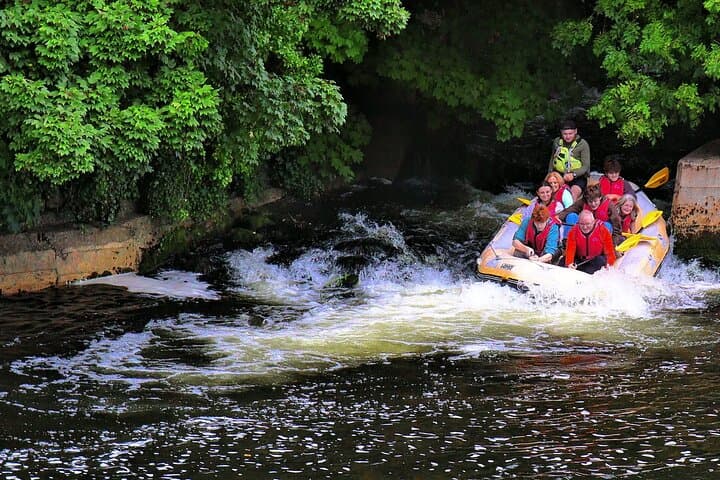
What the day feels like
You push the raft off a low stone slipway, the city noise folding behind you as the River Corrib takes charge. The water has a personality — quick-tempered in places, sly and glassy in others — and it seems to know exactly how close you are to the heart of Galway. For 90 minutes you alternate between being steered through playful surges and drifting past centuries of stonework, the Spanish Arch and old mill ruins nodding from their banks as if surprised to see modern-day cityfolk arrive by raft rather than road. By the end of the run you pull ashore in the centre of Galway, wet, laughing, and oddly proud of having re-entered the city by water.
Galway’s urban raft trip is a study in contrasts. The Corrib is famously short — roughly six kilometres from Lough Corrib to Galway Bay — and that brevity concentrates energy. Meltwater and tides conspire to make the Corrib one of Europe’s fastest-flowing short rivers, churning over hidden drops and narrow chutes that make an otherwise tame city outing feel earnest and alive. Those drops are echoed in the city’s own history: medieval merchants, tide-driven trade, and fishermen have used this river for centuries. The Spanish Arch and stone quays you pass are not props. They were part of a living waterfront and remain threaded into local stories.
Geologically the corridor from Lough Corrib to the bay is the residue of glacial action. The river carves a skinny corridor through limestone and older bedrock, forming tight channels and sudden riffles that are the bones of the rafting experience. Ecologically the corridor is a salmon and trout migration route, so your guide’s briefing usually includes a short natural-history lesson: when to look for sleek salmon backs cutting upstream and where herons wait like sentinels.
Culturally, this run is as much about Galway as it is about the river. Galway insists on character — music on the quays, Gaelic in shopfronts, oysters and ale in the afternoons — and arriving by raft lands you in the middle of it. It changes how you remember the place. Rather than a postcard snapshot of a city square, Galway becomes a sequence of revealed doorways, bridges, and riverside conversations. Local guides often weave stories about families, old ferry crossings, and the river’s role in Galway’s maritime trade, offering a brief, lively local history lesson as you ride the water.
Why go? Because this is an efficient and surprising way to see a city. It’s family-friendly but still feels like a real outdoor adventure; children and adult beginners can both get a measured dose of excitement without all-day exertion. The trip is practical too: it starts minutes from Eyre Square and ends in Galway City Centre, which means you can plan a morning session and still be in time for lunch at the market.
Practicalities are simple. The guided run takes about 1.5–2 hours and all safety gear is provided. You’ll get a short onshore briefing, a life jacket, helmet, and an experienced guide who reads the river and picks lines through the chutes. Wetsuits aren’t required in the operator’s description, but Irish weather is famously changeable, so layers and quick-dry clothing are essential. Footwear with grip that can get wet is better than flip-flops. Expect the raft to ride both calm pools and sudden currents; the river demands attention but is forgiving under a good guide.
For photographers the corridor offers a compact portfolio: fast water close to stonework, birds on the bank, and a city that looks different from the mid-river perspective. Bring a small, secure dry bag for a phone or point-and-shoot and listen to your guide about when to use it. For families, guides usually adapt the pacing, and the run is a good introduction to paddling together with a professional at the helm.
Safety and respect matter. The Corridor is a working ecological route; follow your guide’s instructions, avoid touching or disturbing banks where fish spawn, and leave no waste. Operators run multiple trips per day at different tides and weather windows; booking ahead, especially in summer, is wise. COVID-era restrictions have waned, but operators still maintain group-size and equipment-cleaning standards.
If you’re drawn to quick outdoor adventures that double as cultural immersion, this is a rare urban offering that delivers both. Arrive with curiosity and waterproof layers, and you’ll leave with damp shoes, a fuller camera roll, and a new way to see Galway.
Length & logistics snapshot: roughly 90–120 minutes, all gear provided, meeting point minutes from Eyre Square, finish in Galway City Centre. Who it’s for: families, groups, travelers who want an active city experience without a full-day expedition. What it feels like: part local-history tour, part short whitewater run — a tidy, memorable blend of adrenaline and place.
Trail wisdom
Small choices, better day.
Expect Quick Weather Changes
Layer up and bring a waterproof shell—conditions can shift rapidly on the bay-fed Corrib.
Secure Small Electronics
Use a small dry bag or leave phones onshore during the rapids to avoid loss or damage.
Listen to Your Guide
Guides pick lines through narrow chutes; follow their paddle calls for a safe run.
Finish Into Town
Plan a post-raft lunch at the Galway City Market or Quay Street pubs—your trip finishes in the center.
Local knowledge
Read the place, not just the route.
Watch for native species including Atlantic salmon, Grey heron.
Keep an eye out for wildlife during the transition between areas and habitats. Respect distance guidelines.
Respect spawning seasons and riverbanks; local operators support cleanups and emphasize no-waste policies to protect fish habitat.
Follow the guide's instructions on size limits, ethical handling, and leave-no-trace practices.
The riverside stretch near the Salmon Weir for quiet birdwatching. Small stone inlets and old mill remains visible from the raft that are easy to miss from land
Locally recommended viewpoints and quiet spots known best to local operators.
The Corrib has shaped Galway’s fortunes for centuries, serving as a short but powerful trade and fishing corridor from Lough Corrib to the bay.
Maritime roots and regional tradition shape the waterways and working coasts.
Seasonal guide
Four versions of the same landscape.
Spring
Best forMigration viewing · Fewer crowds
ChallengesCool water temperatures · Unpredictable weather
Spring brings active bird and fish life and smaller crowds, but layers and a waterproof jacket are necessary against winds off the bay.
Summer
Best forWarmer weather · Peak accessibility · Evening trips
ChallengesHigher demand · Potential for sudden showers
Summer is the busiest and often the most pleasant season for urban rafting, so book ahead and arrive early.
Fall
Best forAutumn light for photography · Still-active river flows
ChallengesCooling temperatures · Shorter daylight
Fall offers dramatic light and lively river conditions; bring warmer base layers and plan trips earlier in the day.
Winter
Best forOff-season pricing · Brisk, atmospheric runs
ChallengesCold water and air · Limited schedule
Winter runs are possible but colder; check operator schedules and expect fewer daily departures.
Pack with intention
What to bring.
Good to know
Common questions.
No. The trips are guided and suitable for beginners; guides steer and pick lines while participants paddle when instructed.
Plan the edges
The details that make the day easier.
The River Corrib is one of the shortest rivers in Europe at roughly six kilometres, linking Lough Corrib to Galway Bay.
After the run, wander to the Galway City Market for oysters and local fare, then head to Quay Street for a pint and live traditional music — the city’s riverside eateries make a great compliment to a wet, adventurous morning.
- Closest airports
- Ireland West Airport Knock (~70 km) or Shannon Airport (~90 km). Meeting point minutes from Eyre Square. Driving distance from city center: negligible. Cell service: generally good in Galway. Permits: none required.
This river supports migratory fish and sensitive banks; pack out waste, avoid disturbing spawning areas, and support operators who run regular cleanups.
Explore by topic
Follow the threads.
Keep exploring
Make the story part of the trip.
Set out from Bass Harbor for a private, customizable day on Blue Hill Bay — lighthouses, puffins, seals, and the chance to feel Acadia from the water. Small groups, local captains, unforgettable views.
In four hours you can move from shaded canyon ferns to wind-scoured coastal ridgelines, guided by someone who knows where the light—and the hidden views—live. This private half-day hike on the Monterey Peninsula or Big Sur is compact, curated, and perfect for travelers who want depth without a multiday commitment.
 Related story
Beneath a sky of shifting light, Skaftafell’s ice reads like a map of time. This three-hour guided glacier hike mixes technical instruction with geology and culture: compact, safe, and unforgettable.