
What the day feels like
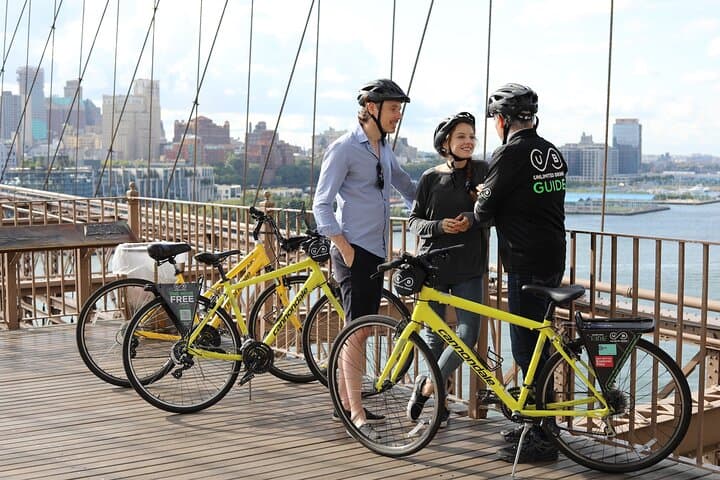
You push off from a side street in Lower Manhattan and the city rearranges itself around the rhythm of your pedals: a cab horn becomes punctuation, a newsstand becomes punctuation, and the cool sweep of the East River starts to insist that you look up. Within fifteen minutes you are clipping a steady grade up onto the Brooklyn Bridge—its stone towers and web of cables looming like a trained audience waiting for your arrival. The guide calls a soft cadence, the group falls into single file, and the pedestrian-and-bike promenade unspools ahead, framing Manhattan’s skyline with an intimacy that photos rarely capture.
This Private Brooklyn Bridge Guided Bike Tour is a compact education in New York City geography, engineering history, and urban choreography. In two hours you’ll cycle around the southern tip of Manhattan, climb through the City Hall area with its Beaux-Arts façades and municipal intrinsics, then ascend the bridge itself for a photo stop at the Brooklyn-side tower. It’s not a ferocious workout; the route is urban and steady—what makes it memorable is the combination of momentum and moments to pause, to listen to a guide’s quick historical précis, and to feel the river below daring you to slow down.
The bridge has been part of this choreography since 1883, when it opened as the world’s longest suspension bridge. John A. Roebling’s original plans, and later the tragic continuity of leadership by his son Washington Roebling, stitched together a feat of engineering that transformed trade and transit between Manhattan and Brooklyn. Ride across today and you can read that story in the textures of the bridge: the weathered granite towers, the iron cables like veins, and the crowds that still treat the span as both commuter corridor and civic theater.
Geologically the East River is not a true river but a tidal strait—water moving with the push and pull of the Atlantic, threading between boroughs and shaping the neighborhoods that grew up on its banks. On the Brooklyn side you’ll descend into DUMBO, where cobbled streets butt against former warehouse facades now converted to galleries, cafés, and tech offices. On the Manhattan side the City Hall area and Foley Square hold the civic pulse of the city—courthouses, historical statuary, and a certain organized grit that speaks to how New York tosses together policy, commerce, and everyday life.
A private bike tour gives you a curated path through that tangle: the guide reads the landscape, pointing out skylines and small cultural moments—where a Revolutionary War shipyard once stood, a hidden stair of municipal history, a perfect vantage for sunset photos—so that two hours feels like a plotted short story. Practicalities matter here: the bike path becomes a shared space with pedestrians, joggers, and sometimes the occasional stroller. Your guide manages pace and etiquette; your job is to watch the path, keep cadence, and soak up the view.
Why book private? For the small-group pacing and an ability to tailor stops—more photos, a detour to a bakery in DUMBO, or a longer look at the Brooklyn-side tower—without the pressure of a busier public ride. It’s also a safe choice: the guide handles the city’s traffic quirks and keeps the group together through tricky intersections.
For travelers who want both a sense of place and a manageable outdoor workout, this ride balances sensory reward with logistics. Riding across the bridge in the golden hour is cinematic but avoid peak commuter times (weekday mornings and late afternoons) if you want less congestion. Bring a compact camera or phone with a wide-angle lens to capture both skyline and bridge details; your guide will pick the precise moment for the best light.
Practical edge: plan for about 6–8 miles total distance covered in two hours, with a steady climb onto the bridge that will take roughly 10–20 minutes depending on pace. The terrain is entirely paved, mostly flat except for the approach ramps and the gentle rise of the bridge deck. You don’t need advanced cycling skills—basic bike handling and comfort in city traffic are sufficient. Helmet use is recommended (sometimes required) and the operator often provides bikes and helmets if you don’t bring your own. Water, layered clothing, and a willingness to yield to foot traffic will make the ride smoother.
This tour is a small urban ritual: a brief, moving way to chart Manhattan and Brooklyn on two wheels, to feel a living skyline shift as you cross borough lines, and to come away with images that are both personal and civic. When your guide drops you back near City Hall, you’ll dismount with a brisk appetite—for food, for more neighborhood wandering, and for the particular kind of owed confidence that comes from having ridden a city like New York on its own terms.
Trail wisdom
Small choices, better day.
Time it for light
Schedule the ride during mornings or the golden hour to avoid crowds and capture the best light for photos.
Helmet and bike check
Bring a properly fitted helmet and verify brakes and gears before you start; guides will inspect provided bikes but personal gear is best.
Respect the promenade
Yield to pedestrians, call out overtakes, and single up on narrow sections—safety keeps the pace steady.
Pack light hydration
Carry a small bottle or use a frame-mounted holder; you’ll want water but not bulk while mounting and dismounting.
Local knowledge
Read the place, not just the route.
Watch for native species including Gulls (Ring-billed and Herring Gulls), River fish visible from vantage points (striper sightings at certain tides).
Keep an eye out for wildlife during the transition between areas and habitats. Respect distance guidelines.
The bridge and adjacent waterfronts are part of a heavily used urban ecosystem—stay on designated paths, pack out any trash, and use bike racks where provided to avoid harming planted beds.
Follow the guide's instructions on size limits, ethical handling, and leave-no-trace practices.
Pebble Beach in DUMBO (small riverside green with skyline photo opportunities). The tiny, lesser-known Irish Hunger Memorial near South Street Seaport
Locally recommended viewpoints and quiet spots known best to local operators.
The Brooklyn Bridge opened in 1883 and was designed by John A. Roebling; it dramatically connected the formerly separate cities of Brooklyn and Manhattan and was a symbol of industrial-era ambition.
Maritime roots and regional tradition shape the waterways and working coasts.
Seasonal guide
Four versions of the same landscape.
Spring
Best forComfortable temperatures · Blossoming parks · Good light for photos
ChallengesUnpredictable rain showers · Occasional gusty days
Spring offers mild weather and fewer tourists than summer—bring a light rain layer and be ready for wind off the river.
Summer
Best forLong daylight hours · Warm evenings · Lively waterfronts
ChallengesHeat and humidity · Peak tourist crowds
Summer gives long, sunlit rides but expect more pedestrian traffic on the bridge and bring sun protection.
Fall
Best forCrisp air · Clear skyline views · Smaller crowds
ChallengesCooler mornings · Shortening daylight
Fall is ideal—crisp air and excellent visibility make photo stops rewarding; layer up for variable temps.
Winter
Best forQuiet cityscapes · Dramatic light on clear days
ChallengesCold, wind, potential icy patches
Winter rides are brisk and atmospheric; dress warmly and expect slower traffic through holiday weekends.
Pack with intention
What to bring.
Good to know
Common questions.
The private tour lasts about two hours and typically covers roughly 6–8 miles through Lower Manhattan and across the Brooklyn Bridge, including stops.
Plan the edges
The details that make the day easier.
When it opened in 1883, the Brooklyn Bridge was the longest suspension bridge in the world and took 14 years to build under the direction of the Roebling family.
After the ride, head to DUMBO for pizza at Grimaldi’s or a coffee at Butler, cross to Brooklyn Bridge Park for skyline views, or grab a local brew at Brooklyn Brewery—this is where waterfront history meets contemporary food and craft scenes.
- Closest airport
- LaGuardia (LGA) or JFK; Nearest subway: High St–Brooklyn Bridge (A
- 6); Typical driving distance from Midtown Manhattan
- ~4–6 miles; Cell service: reliable across route; Permits
- passes
- none required for casual riders (commercial tour operator handles group logistics).
Use public transit to reach the tour start, avoid single-use plastics, and stay on designated paths—this protects riverfront plantings and reduces congestion on the historic promenade.
Explore by topic
Follow the threads.
Keep exploring
Make the story part of the trip.
Set out from Bass Harbor for a private, customizable day on Blue Hill Bay — lighthouses, puffins, seals, and the chance to feel Acadia from the water. Small groups, local captains, unforgettable views.
In four hours you can move from shaded canyon ferns to wind-scoured coastal ridgelines, guided by someone who knows where the light—and the hidden views—live. This private half-day hike on the Monterey Peninsula or Big Sur is compact, curated, and perfect for travelers who want depth without a multiday commitment.
 Related story
Beneath a sky of shifting light, Skaftafell’s ice reads like a map of time. This three-hour guided glacier hike mixes technical instruction with geology and culture: compact, safe, and unforgettable.