
What the day feels like
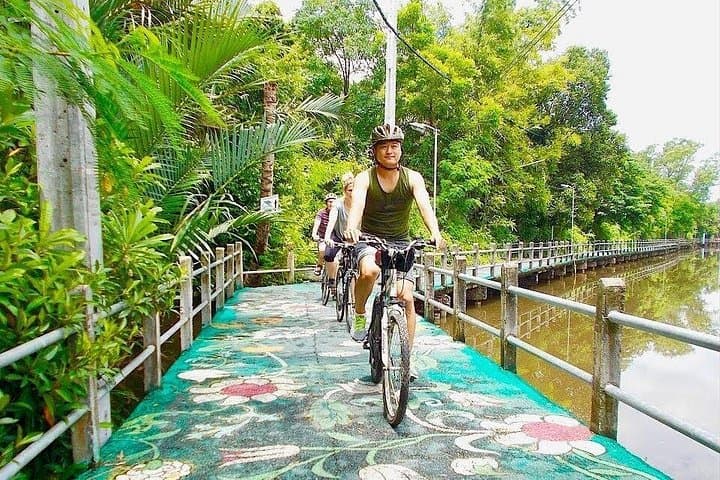
You step off the long-tail boat with the river still dripping from the gunwale, and the city’s noise—honking, air-conditioner hum, a distant tuk‑tuk chorus—shrinks to a memory. Ahead, a ribbon of packed-earth trail threads through green that’s almost anachronistic in the middle of a megacity: giant banyans, mangrove fringes, and roadside plots where villagers tend small orchards. The air is humid but alive, and the trail seems to breathe beneath your tires, urging you forward. This is Bang Krachao—the so-called “green lung” of Bangkok—and for three hours the jungle dares you to trade skyscrapers for shade.
The tour begins with a short ferry across the Chao Phraya River, a literal crossing from metropolis to mudflat forest. Bang Krachao is an oxbow of river and canal—low, flat, and surprisingly dense with vegetation. Historically, the area escaped Bangkok’s march of development partly because of land‑use patterns and partly through community stewardship: families on the island have farmed and fished here for generations, and a large portion was preserved as Sri Nakhon Khuean Khan Park and Botanical Garden. That history gives the place its character—faint temple smells mixing with earth and mango, wooden houses clustered along canals, and a slowing of pace so obvious it’s almost a relief.
Geologically, Bang Krachao is a floodplain: layers of alluvial silt deposited over centuries by the Chao Phraya. The soil supports a tangle of native and secondary forest, with bridges and raised boardwalks where water lingers after the rains. Culturally, the island is a patchwork of small-scale agriculture and community life; cyclists on this route pass rubber plots, vegetable beds, and the occasional family pavilion where elders sip tea and exchange news.
On the ride, you’ll encounter a mix of surfaces—compact dirt tracks, short stretches of asphalt, and wooden crossings across canals. The elevation is effectively negligible, so the effort comes from humidity and the occasional sandy patch that wants to eat your rear wheel. Along the way, the guide will point out local fauna: kingfishers darting over canals, monitor lizards warming on the bank, and egrets that punctuate the skyline like paper cranes. If you’re lucky during the dry season, schools of small fish will flash beneath oxbow pools where water sits still, and you might hear the murmured chorus of cicadas building to a summer crescendo.
Why do this ride? Because it’s two trips in one: a gentle exercise in nature immersion and a cultural snapshot of communities who resist Bangkok’s relentless urbanization. You get the simplicity of a rural loop—easy grades, manageable distances—and the novelty of traveling to a place that still feels off the map, despite its proximity to downtown. The boat ride alone is worth the outing; sitting on the ferry as the city recedes behind factories and condos, you’ll feel like you crossed into a different Thailand.
Practical side: the tour is three hours, and guides usually supply a city‑style bike with basic suspension and a basket. Pace is relaxed, with stops at park viewpoints and a short walk on shaded boardwalks. Expect 10–20 kilometers of riding on mostly flat terrain—enough to work up a sweat but not to exhaust you. Bring sun protection, a bottle of water (the guides often provide more), and shoes that can handle both pavement and mud.
Timing matters. Early morning tours catch cooler air and active wildlife; late afternoons offer flattering light for photos and fewer crowds. The wet months make some trails muddy and slow; the dry season is dustier but easier to navigate. Regardless of when you go, respect the place: stay on marked trails, avoid disturbing gardens, and treat local vendors and residents with the curiosity and courtesy you’d show visiting a friend’s neighborhood.
For travelers, this is an ideal half‑day escape that slots neatly into any Bangkok itinerary. It’s quick to arrange—many operators offer instant confirmation—and it’s an accessible way to add green time without a long drive or overnight gear. Whether you’re a casual rider who wants a breath of forest or a city-dweller seeking to reset, Bang Krachao delivers an immediate, restorative contrast to Bangkok’s tempo.
When the tour winds down, you’ll climb back onto the ferry with the taste of grilled fish or coconut pancakes still waiting at a riverside stall—simple food, strong coffee, and the knowledge that an hour from the CBD you found a place where trees still hold the city’s breath. The ride isn’t a mountain test or a technical descent; it’s a lesson in subtlety: nature here doesn’t shout. It leans in, invites, and—if you answer—reminds you why cities need lungs.
Trail wisdom
Small choices, better day.
Start early
Morning rides mean cooler temperatures and more active wildlife—aim to board the ferry before 9 a.m.
Bring a refillable bottle
Hydration stations may be limited; a 1–1.5L bottle keeps you comfortable in Bangkok humidity.
Choose grippy shoes
Sandy patches and wooden boardwalks can be slippery—trail or flat-soled shoes are best.
Respect private plots
Many orchards and fields are family-owned—stay on the route and ask before photographing people at work.
Local knowledge
Read the place, not just the route.
Watch for native species including Kingfisher, Monitor lizard.
Keep an eye out for wildlife during the transition between areas and habitats. Respect distance guidelines.
Community stewardship and local park protections keep much of Bang Krachao green—visitors should stick to trails, avoid littering, and support local vendors.
Follow the guide's instructions on size limits, ethical handling, and leave-no-trace practices.
Sri Nakhon Khuean Khan Park boardwalks (quiet birding spots). Small family-run orchards with seasonal fruit stands
Locally recommended viewpoints and quiet spots known best to local operators.
Bang Krachao has long been an agricultural and fishing community; large swaths were preserved as parkland to maintain green space near the growing city.
Maritime roots and regional tradition shape the waterways and working coasts.
Seasonal guide
Four versions of the same landscape.
Spring
Best forFewer tourists · Warm morning light
ChallengesIncreasing heat after March · Mosquito activity
Spring (mapped to Bangkok’s hot season) brings clearer skies and rising temperatures—plan early starts and carry sun protection.
Summer
Best forLush greenery · Active birdlife
ChallengesShort, heavy rains · Muddy trails after storms
Summer matches Bangkok’s rainy period—expect brief downpours and tacky trails; waterproof layers help.
Fall
Best forPost-rain freshness · Fewer mid-day showers
ChallengesTrail clearing after floods · Higher humidity
Autumn offers rejuvenated plant growth and dramatic skies after rains, but occasional soft ground in low areas.
Winter
Best forCooler, drier air · Comfortable cycling
ChallengesHigher visitor numbers on weekends · Early sunsets
Winter (Bangkok’s cool season) is ideal—temperatures are comfortable and trails are easiest to navigate.
Pack with intention
What to bring.
Good to know
Common questions.
Expect roughly 10–20 kilometers of riding over a relaxed three-hour tour—distance varies slightly by operator and detours.
Plan the edges
The details that make the day easier.
Bang Krachao is widely called Bangkok’s “green lung” and includes Sri Nakhon Khuean Khan Park, a large urban green space preserved from the city’s development.
After the ride, visit Bang Nam Phueng Floating Market (weekends) for grilled fish and coconut pancakes; back in Bangkok, continue the riverside theme with a seafood dinner in Chinatown (Yaowarat) or a cold beer by the Chao Phraya.
- Closest airport
- Suvarnabhumi (BKK); Typical meeting point: riverside pier in Bangkok with short ferry transfer; Driving distance: ~20–40 minutes from central Bangkok depending on traffic; Cell service: generally reliable; Permits: none, but park access fees may apply
Bang Krachao’s survival depends on local stewardship—pack out trash, avoid trampling vegetation, and choose operators who support community initiatives.
Explore by topic
Follow the threads.
Keep exploring
Make the story part of the trip.
Set out from Bass Harbor for a private, customizable day on Blue Hill Bay — lighthouses, puffins, seals, and the chance to feel Acadia from the water. Small groups, local captains, unforgettable views.
In four hours you can move from shaded canyon ferns to wind-scoured coastal ridgelines, guided by someone who knows where the light—and the hidden views—live. This private half-day hike on the Monterey Peninsula or Big Sur is compact, curated, and perfect for travelers who want depth without a multiday commitment.
 Related story
Beneath a sky of shifting light, Skaftafell’s ice reads like a map of time. This three-hour guided glacier hike mixes technical instruction with geology and culture: compact, safe, and unforgettable.