
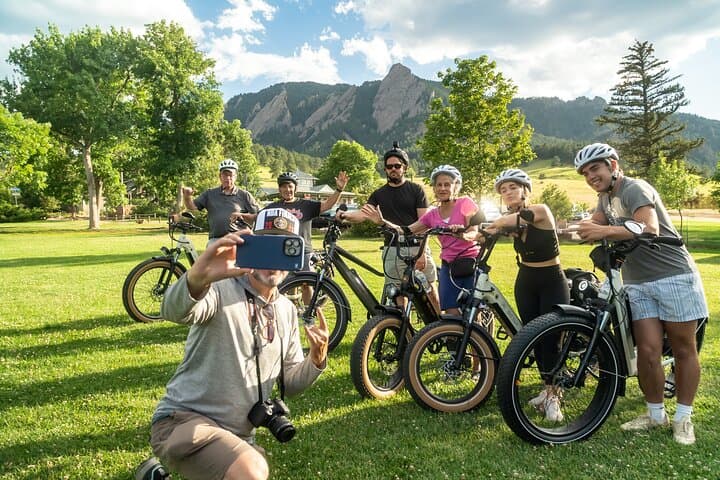
What the day feels like
You come for the Flatirons, but Boulder insists you notice everything in between. The guide clips on a helmet, gives a short nod, and the fleet of pedal-assist bikes hums like a small, eager chorus. We roll out from the shadow of Pearl Street, past public art and coffee lines, and quickly trade storefronts for cottonwoods and the thin, bright air of the Front Range. Boulder Creek, which will lead us for stretches of the route, chatters and dares us to slow down. The Flatirons tilt nearby like a row of upright books — geological punctuation marks that draw the eye and orient the ride. This is a family-friendly e-bike tour in the truest sense: relaxed, social, and built to stitch together town and trail in a single, breezy afternoon.
The ride itself is deceptively simple: expect roughly 8–12 miles of mixed paved paths and compact singletrack with around 400–700 feet of cumulative climbing, depending on the route chosen and the group’s pace. The pedal-assist takes the edge off the climbs, but the experience still rewards basic fitness and curiosity. Stops include historic Pearl Street, the University of Colorado campus and Folsom Field, quick viewpoints on the Flatirons foothills, and stretches along Boulder Creek where the water's current seems to push you forward. Guides from iRideColorado layer local history into the tour — telling stories about Boulder's early mining days, the rise of the university, and the city’s long-running love affair with outdoor culture.
Geology here reads like a layered book. The Flatirons are steeply tilted slabs of the Fountain Formation, coarse sandstone and conglomerate deposited roughly 300 million years ago and later exposed by uplift and erosion; they give the skyline its unmistakable postcard silhouette. Culturally, Boulder has always been at an intersection — of academic life, countercultural experiment, and athletic ambition. Pearl Street, once a trading hub, is now a pedestrian artery of buskers, independent shops, and the Dushanbe Teahouse, an ornate gift from Boulder's sister city in Tajikistan that hints at the city's global ties.
What makes the e-bike tour practical and magnetic is that it compresses these layers into a single outing. Parents with older kids can cover varied terrain without a day of logistics; visitors get a fast, interpretive snapshot of Boulder’s natural and civic life; photographers can hop off and chase the light without committing to miles of uphill lugging. The pedal assist means less effort and more options: you can cruise the creekside paths, boost up to viewpoint benches, or conserve battery when you want to linger at a coffee stop on Pearl.
Plan for timing. The tour runs two to three hours, best in the golden shoulder hours—late morning or late afternoon when the light softens on the Flatirons and temperatures are forgiving. In summer, start earlier to avoid heat and crowds; in fall, a mid-afternoon ride can coincide with spectacular color along the creek.
Practical notes matter: bring a comfortable helmet (some tours supply them), closed-toe shoes, and a water bottle with at least 1 liter per person. Dress in layers; the wind can feel sharper in the open foothills than in town. Guides do a short safety and bike-handling tutorial before setting off, but confidence with balancing and simple gear changes makes the day smoother. Battery charge is a non-issue on guided rides, but if you rent independently, confirm range relative to planned mileage and elevation.
Sustainability is part of the local ethic. Stick to designated paths, respect wildlife (you may catch sight of mule deer or a red-tailed hawk), and pack out what you bring in. Boulder’s network of trails and bike lanes is a living system — the more we treat it like public infrastructure rather than a playground, the longer it serves everyone. The tour providers generally emphasize low-impact practices and give cues about where e-bikes are appropriate versus where human-powered traction is better.
For families, the ride is an excellent middle ground between stroller-paced walks and full-day mountain biking. Guides adjust pace and stops to the group, often including an ice cream break on Pearl Street or a short, easy detour up to a Flatirons viewpoint where kids and adults alike can spread jackets and watch paragliders drift off the ridgelines. For photographers and culture-seekers, the blend of urban scenes and foothill panoramas yields a satisfying variety: artisan storefronts and public murals one moment, rock faces and open sky the next.
If you want to extend the adventure after dismounting, Boulder has plenty to offer. Walk more of Pearl Street’s galleries, sample local brews at a nearby brewery, or stroll the University of Colorado campus to feel the student pulse. Logistics are forgiving — Denver International Airport sits about 40 miles east, and downtown Boulder is roughly a 30–45 minute drive from the airport depending on traffic.
There’s a practical satisfaction to an e-bike tour that’s hard to overstate: it gives you a chance to be active, curious, and comfortable all at once. The bikes smooth the bumps but don’t flatten the landscape’s drama; the town’s commerce and the foothills’ geology keep trading places in your window until you understand why Boulder attracts people who want a short walk to nature with a long conversation about why it matters.
Trail wisdom
Small choices, better day.
Start With a Short Helmet Fit Check
Make sure helmets are snug and straps fastened; a quick fit prevents uncomfortable shifting on bumpy sections.
Hydrate for the Altitude
Bring at least 1 liter of water per person; the Front Range is high and drier than it feels.
Use Low Gear on Short Steep Pulls
Let the motor help, but downshift to maintain cadence and control on steeper trail sections.
Keep to Designated Paths
Respect signs and singletrack rules—e-bikes can be fast; yield to hikers and horses where posted.
Local knowledge
Read the place, not just the route.
Watch for native species including Mule Deer, Red-tailed Hawk.
Keep an eye out for wildlife during the transition between areas and habitats. Respect distance guidelines.
Boulder emphasizes trail stewardship and low-impact recreation—stay on designated routes, pack out trash, and respect seasonal closures to protect habitat.
Follow the guide's instructions on size limits, ethical handling, and leave-no-trace practices.
Hidden overlooks along Foothills Parkway with fewer crowds. Less-visited stretches of Boulder Creek where local anglers cast in summer
Locally recommended viewpoints and quiet spots known best to local operators.
Boulder’s growth accelerated after the arrival of the railroad in the late 19th century and the University of Colorado, founded in 1876, shaped much of the city’s cultural life.
Maritime roots and regional tradition shape the waterways and working coasts.
Seasonal guide
Four versions of the same landscape.
Spring
Best forWildflowers · Cool riding temperatures
ChallengesMuddy trails after storms · Unpredictable weather
Spring brings green shoots and flowing creeks; plan for damp sections and bring a lightweight rain layer.
Summer
Best forLong daylight hours · Evening rides
ChallengesHeat and sun exposure · Higher visitor numbers
Summer offers warm, long days—start early to avoid midday heat and pack sun protection and extra water.
Fall
Best forCrisp air and golden leaves · Milder temperatures
ChallengesCooler mornings · Shorter daylight
Fall is ideal: cooler temps and excellent light for photos; layer up for temperature swings during the ride.
Winter
Best forQuiet streets · Snow-dusted vistas
ChallengesCold, icy paths · Some trails closed
Winter rides are scenic but require warm layers and caution on icy or salted sections; check conditions before booking.
Operator details
What the booking data adds.
Included
- ✓Bottled water
- ✓Helmet
- ✓Use of electric bike
Good to know
- ✓Public transportation options are available nearby
- ✓Suitable for all physical fitness levels
Pack with intention
What to bring.
Good to know
Common questions.
No — guided tours include a tutorial and e-bikes provide pedal-assist that makes climbs much easier; basic balance and braking familiarity is helpful.
Plan the edges
The details that make the day easier.
The Flatirons are part of the Fountain Formation — Pennsylvanian-age sedimentary rock exposed by uplift roughly 300 million years ago.
After the ride, stroll Pearl Street for local shops and street performers, grab tea at the Dushanbe Teahouse, and try a post-ride pint at a nearby brewery to sample Colorado ales and meet locals.
- Closest airport
- Denver International Airport (DEN) ~40 miles; Typical meeting point: Pearl Street
- downtown Boulder; Driving time from Denver
- 35–50 minutes; Cell service: good in town, patchy in foothills; Permits: none for guided urban
Boulder’s trails are managed to balance recreation and habitat protection—ride only on designated routes, avoid off-trail shortcuts, and carry out all waste.
Explore by topic
Follow the threads.
Keep exploring
Make the story part of the trip.
Set out from Bass Harbor for a private, customizable day on Blue Hill Bay — lighthouses, puffins, seals, and the chance to feel Acadia from the water. Small groups, local captains, unforgettable views.
In four hours you can move from shaded canyon ferns to wind-scoured coastal ridgelines, guided by someone who knows where the light—and the hidden views—live. This private half-day hike on the Monterey Peninsula or Big Sur is compact, curated, and perfect for travelers who want depth without a multiday commitment.
 Related story
Beneath a sky of shifting light, Skaftafell’s ice reads like a map of time. This three-hour guided glacier hike mixes technical instruction with geology and culture: compact, safe, and unforgettable.