
What the day feels like
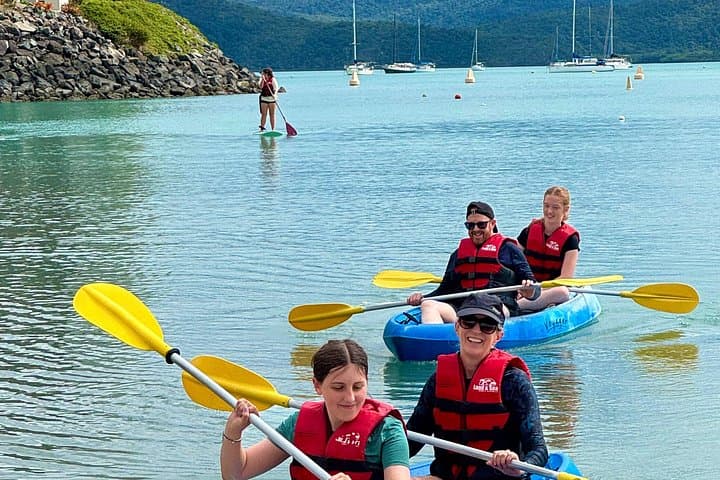
The first light on the Coral Sea is a hard-edged coin—bright, cool, and immediate. You shove off from the Cannonvale foreshore and the town's murmur falls away until all you hear are paddle strokes and the soft, impatient breathing of the ocean. The kayak slips through turquoise shallows that will change hue with every stroke, and somewhere ahead a turtle lifts its round, barnacled head as if checking whether you belong in this world. For 90 minutes the sea dares you into a quieter scale of time: small, repeatable movements, the occasional click of tern wings, and a coastline that’s readable up close—mangroves here, a hidden sand flat there—rather than the postcard of an island viewed from a boat.
This private Cannonvale kayaking experience is built around that intimacy. It's not about long-distance crossing or technical lines; it’s about choosing a path along the foreshore at your own pace, paddling a double kayak with a partner, and easing into the kind of wildlife encounters that are improbable from a speedboat. The operator keeps numbers low and routes flexible—90 minutes to skim the edges of Turtle Bay and claim a stretch of ocean that, in the right season, is reliably hospitable to green and hawksbill turtles.
Geology and context sit quietly beneath the colors. The Whitsundays are continental islands—peaks and ridges left behind when sea level rose at the end of the last Ice Age—fringed by reefs and sandbars. The water here reads like a topographical map: shallow shelves that warm quickly, deeper channels that hold darker, cooler currents. From Cannonvale the view traces out to the Whitsunday Islands, a scattering of white beaches and forested ridgelines that have been a crossroads for millennia.
Aboriginal history threads through that landscape. The Ngaro people are the Traditional Owners of the Whitsundays, and their connection to the sea, reefs, and islands predates modern tourism by thousands of years. Local guides emphasize respect for Country—keep distance from nesting sites, avoid disturbing grazing turtles, and listen when elders talk about place names and practices. That cultural context makes a small tour feel less like entertainment and more like joining a custom with rules.
Wildlife is the clear draw. Turtles here are not manufactured attractions; they’re habitual, surfacing in predictable bays to breathe and graze. Birdlife is abundant—oystercatchers and terns patrol the horizons, and if you’re quiet you can watch sea eagles drift above the islands. The operator's quiet approach matters: low-impact routes and patient paddling increase the odds of observation without causing stress to animals.
Practicality is at the core of the trip. The tour is fixed at 90 minutes (expect about 4–6 kilometers paddled depending on wind), private by default, with double kayaks that make navigation stable for pairs and newcomers. Priceing from USD 62.77 at the time of booking, the adventure gives you a high ratio of personal space to value—ideal for families, couples, or anyone who prefers their nature un-pressured.
Timing matters. Early morning is the sweet spot: water is glassier, winds are lighter, and turtles are more active. Late afternoon paddles have a different mood—long shadows, softer light—and can be excellent if you’re chasing a sunset glow. Avoid midday on hot summer days when UV is intense and afternoon sea breezes pick up.
What to expect physically: the paddling is moderate—steady, rhythmic effort rather than a sprint. You’ll be seated low, stabilised by a tandem kayak; transfers to and from the shore are straightforward. Guides give a short safety and paddle technique briefing before launch, map a loose route, and watch from a respectful distance. You don’t need advanced skills, but a basic understanding of how to brace and steer helps keep the experience smooth.
Local logistics are refreshingly simple. Meeting point is the Cannonvale/Airlie Beach foreshore—easy to reach from the town center and close to facilities. Proserpine (Whitsunday Coast) Airport is the nearest major entry point, about a 30–40 minute drive inland. Bring reef-safe sunscreen, a hat, and a dry bag for your phone; expect limited phone reception once you are a few hundred meters offshore.
Sustainability is not an optional extra here. The tour operates adjacent to the Great Barrier Reef Marine Park, and the best providers fold conservation into the experience: no-touch policies, advice on not feeding marine life, and encouragement to use biodegradable sunscreen. If you want to enhance the trip, ask your operator about local volunteer opportunities or reef-supporting charities you can visit while in town.
At the end of your paddle, you’ll return to the foreshore with salt on your lips and a clearer understanding of why shallow shorelines are worth slow travel. This is a small-scale, high-reward outing—not a hardcore expedition, but an elegantly simple way to encounter marine life and read the coastline in human time. If you like the idea of wildlife that approaches on its own terms, and an activity that feels equal parts calm and curious, a private Cannonvale kayak tour is a compact, very do-able piece of the broader Whitsundays mosaic.
If you go: book early for the best launch windows, respect wildlife guidelines, and treat the sea as an invite you don’t punch back. In return, you’ll get a sliver of ocean that reveals itself slowly—a turtle, unbothered; a sand flat exposed like a secret; the sound of a seabird deciding whether to land. It’s intimate, transportive, and maddeningly simple: the ingredients of a proper adventure.
Trail wisdom
Small choices, better day.
Go early
Morning launches offer calmer water and higher chances of seeing turtles at the surface.
Use reef-safe sunscreen
Many operators require biodegradable sunscreen to protect nearby reefs and marine life.
Pack a dry bag
Keep phones, snacks, and a spare layer dry—most kits have basic storage but a small dry bag helps.
Watch your wake
Paddle quietly near wildlife and avoid sudden approaches to turtles or nesting sites.
Local knowledge
Read the place, not just the route.
Watch for native species including Green Turtle, Hawksbill Turtle.
Keep an eye out for wildlife during the transition between areas and habitats. Respect distance guidelines.
The area sits adjacent to the Great Barrier Reef Marine Park; operators encourage no-touch policies, reef-safe sunscreen, and minimal disturbance to wildlife.
Follow the guide's instructions on size limits, ethical handling, and leave-no-trace practices.
Shallow sand flats exposed at low tide that are excellent for spotting juvenile fish and feeding turtles. Quiet mangrove channels reachable during calm mornings, rich in birdlife
Locally recommended viewpoints and quiet spots known best to local operators.
The Whitsunday Islands are continental islands shaped by rising sea levels after the last Ice Age; the Ngaro people are recognized as Traditional Owners of parts of the region.
Maritime roots and regional tradition shape the waterways and working coasts.
Seasonal guide
Four versions of the same landscape.
Spring
Best forCalm water paddling · Turtle activity · Shoulder-season rates
ChallengesVariable spring storms · Increased weekend crowds
Spring (Sep–Nov) offers warm weather and stable sea conditions; mornings are usually calm and wildlife is active.
Summer
Best forLush island greenery · Long daylight hours
ChallengesHigher UV and heat · Possible afternoon storms and stronger winds
Summer (Dec–Feb) is hot and humid; paddle early to avoid heat and afternoon breezes.
Fall
Best forWarmer water · Fewer tourists than summer
ChallengesOccasional cyclone season remnants · Variable seas
Autumn (Mar–May) can offer still, warm paddles, but check weather updates during cyclone season.
Winter
Best forClear skies and cool mornings · Good visibility for photos
ChallengesCooler mornings · Possibly stronger southerly winds
Winter (Jun–Aug) brings dry, clear days—excellent for visibility though mornings can be brisk.
Pack with intention
What to bring.
Good to know
Common questions.
The experience is 90 minutes from launch to return—expect about 4–6 km paddled depending on route and wind.
Plan the edges
The details that make the day easier.
Airlie Beach is the mainland gateway to the Whitsunday Islands and lies adjacent to the Great Barrier Reef Marine Park, a UNESCO World Heritage site.
After your paddle, head back to the Airlie Beach foreshore where waterfront cafés and the public lagoon offer casual seafood, cold beers, and a place to dry off and compare sightings—look for venues on the foreshore and near the lagoon for the most local atmosphere.
- Closest airport
- Proserpine (Whitsunday Coast Airport, ~30–40 min drive). Meeting point: Cannonvale
- Airlie Beach foreshore. Driving distance from Airlie Beach town center
- under 10 minutes. Cell service: patchy on the water beyond the foreshore. Permits: none required for recreational kayaking, but follow marine park rules.
This tour operates beside the Great Barrier Reef Marine Park—avoid touching marine life, use reef-safe sunscreen, and carry out all litter to reduce impact.
Explore by topic
Follow the threads.
Keep exploring
Make the story part of the trip.
Set out from Bass Harbor for a private, customizable day on Blue Hill Bay — lighthouses, puffins, seals, and the chance to feel Acadia from the water. Small groups, local captains, unforgettable views.
In four hours you can move from shaded canyon ferns to wind-scoured coastal ridgelines, guided by someone who knows where the light—and the hidden views—live. This private half-day hike on the Monterey Peninsula or Big Sur is compact, curated, and perfect for travelers who want depth without a multiday commitment.
 Related story
Beneath a sky of shifting light, Skaftafell’s ice reads like a map of time. This three-hour guided glacier hike mixes technical instruction with geology and culture: compact, safe, and unforgettable.