
What the day feels like
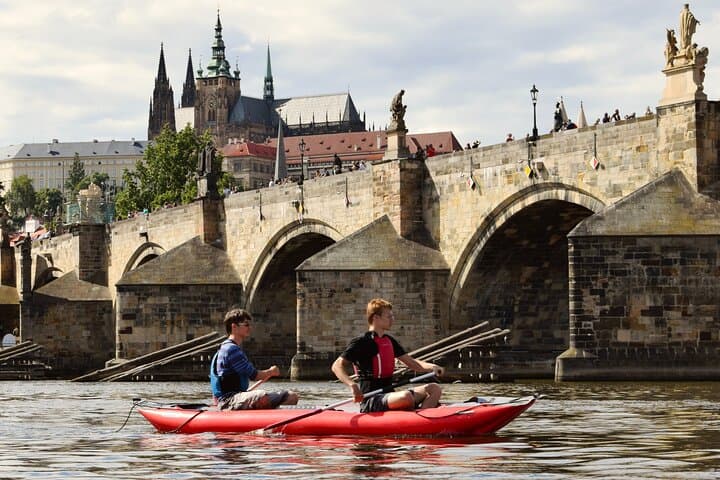
You push off beneath a low winter sky or a summer sun and the city rearranges itself. Granite facades and Baroque spires slide past at water level; the usual tourist flow—buses, tramlines, souvenir stands—melts into the soft scrape of canoe hulls. The Vltava doesn’t just carry you through Prague, it insists you see the city from its most intimate vantage: under the arches of Charles Bridge, alongside the willows of the Devil’s Channel (Čertovka), and with the National Theatre’s gilded roof glinting like a punctuation mark. For two-and-a-half hours you’re in motion and in conversation with a river that has shaped Prague’s contours for centuries.
This is not a whitewater test of will. The advertised two easy rapids add a flirt of excitement—little bumps that punctuate long stretches of placid current. Mostly, the trip is about slow revelation: how the Vltava curves through medieval neighborhoods, how the city’s stones change tone with light, how bridges frame views and refuse to be reduced to postcards. The tour’s route privileges perspective. From the seat of a canoe, the Devil’s Channel feels like a secret street; from the channel you see nooks of Malá Strana that are invisible from the roads above. The grouping of landmarks—Charles Bridge, Kampa Island, Národní divadlo—reads differently when the river is your guide.
The Vltava is Prague’s structural spine. It is also a geological editor: its banks were a decision-maker in the city’s earliest settlements and later in the siting of mills and gardens. Charles Bridge, begun in 1357 under Emperor Charles IV, stands as a medieval sentence linking the Old Town and the castle hill; paddling beneath it gives you the sense of a living architecture, stones that still hold the passage of centuries. The Devil’s Channel itself was dug in the 12th century to power mills—today the old mill foundations and narrow alleys are quieter, but the channel’s mischievous nickname remains apt. The river is a character—sometimes reflective, sometimes restless, always opinionated.
Culturally, a float down the Vltava is a compact tour of Bohemian life. Náplavka—the riverside embankment—turns into a marketplace on weekends, with small-batch food, craft stalls, and people leaning on railings with beers in hand. The National Theatre looms as a reminder that Prague’s artistic identity is inseparable from its urban form: opera and drama have been performed here for well over a century. The canoe tour hands you a condensed civics lesson—how commerce, culture, and hydrology layered into the modern city.
Why book this? The value is immediate: for about $35 and 150 minutes, you trade a crowded square for a quiet lane of water. The itinerary is designed for accessibility—no technical whitewater skills required—but it rewards attention. You’ll notice things most visitors miss: the chain of small murals under a bridge, the gap between two buildings where a narrow courtyard hides, the different angles at which light hits Prague’s red roofs. For photographers, it’s an economy of a thousand frames with an easy path from one visual highlight to the next.
Practical edge: confirm what the operator supplies. Many Prague canoe operators provide boats, paddles, and personal flotation devices, but check when you book. Expect to be outdoors for roughly two-and-a-half hours—dress in quick-drying layers, bring a small dry bag for phones and wallets, and plan on sunscreen even on cloudy days; reflections off the water can intensify sun exposure. If you’re traveling in peak tourism months, an early start shifts the light and gives you calmer water and fewer boats.
Timing matters beyond comfort. Late spring through early fall is the sweet spot for temperature and flow; after heavy rains the river runs higher and faster and operators may alter or reschedule trips. This tour’s “two easy rapids” are sensory punctuation into an otherwise gentle journey—fun and not technical—but if you have mobility concerns check access points at booking. The trip fits a range of travelers: couples seeking a different city-viewing mode, families looking for a memorable city activity, and solo travelers wanting a group setting that isn’t a walking tour.
Leave no trace is simple here: avoid paddling close to nesting birds in spring, don’t dangle feet in the water in busy sections, and pack out any trash. The Vltava is the longest Czech river at roughly 430 kilometers; it carries Prague’s history downstream, and it’s the responsibility of paddlers to keep it readable.
On logistics: the tour is an easy add-on to most Prague itineraries—meeting points are within the city’s central islands and neighborhoods, and Václav Havel Airport is a 30–40 minute drive depending on traffic. For first-time paddlers, the small learning curve is outweighed by the payoff of a water-level perspective on one of Europe’s most photographed cities.
End with a plan: think of this as a morning or late-afternoon promise. Map a coffee or a local beer for after—the Náplavka market and nearby beer gardens provide a civilized transition back to land. The city keeps moving around you; the canoe marks a pause.
This is a compact, affordable civic adventure: 150 minutes, two easy rapids, a new way to understand Prague. The river will insist on your attention—and reward it with a view only a few discover.
Trail wisdom
Small choices, better day.
Confirm Equipment
Ask the operator if canoes, paddles, and life jackets (PFDs) are included—bring a small dry bag for valuables.
Early Start Advantage
Launch early in the morning for calmer water, softer light, and fewer tourist boats near Charles Bridge.
Pack Light and Safe
Use grippy, quick-dry footwear and secure phones in a waterproof case—river spray is frequent near bridges.
Watch for River Traffic
Stay aware of other recreational boats and sightseeing craft; follow your guide’s signals in narrow sections like the Devil’s Channel.
Local knowledge
Read the place, not just the route.
Watch for native species including Mute swan, Kingfisher (seasonal).
Keep an eye out for wildlife during the transition between areas and habitats. Respect distance guidelines.
The Vltava is a living urban ecosystem—avoid disturbing shorelines, pack out all trash, and use refillable water bottles to reduce single-use plastic.
Follow the guide's instructions on size limits, ethical handling, and leave-no-trace practices.
Kampa Island's quiet courtyards visible from the water. A narrow alley at the Devil’s Channel where old mill stones peek out
Locally recommended viewpoints and quiet spots known best to local operators.
Charles Bridge construction began in 1357 and the Devil’s Channel was historically dug to power medieval mills—both played central roles in Prague’s development.
Maritime roots and regional tradition shape the waterways and working coasts.
Seasonal guide
Four versions of the same landscape.
Spring
Best forMild temperatures · Blooming riverside foliage · Fewer crowds than summer
ChallengesVariable water levels · Cool mornings · Possible spring maintenance closures
Spring offers fresh light and quieter banks; expect cool starts and occasional higher flows after rain.
Summer
Best forWarm water and air · Long daylight hours · Náplavka markets and events
ChallengesHigher tourist traffic · Stronger sun exposure · Busy river traffic
Summer is peak season—great weather and atmosphere, but paddle early or late to avoid crowds and glare.
Fall
Best forGolden light on red roofs · Crisp air for hiking before/after · Lower crowds than summer
ChallengesCooler water temps · Shortening days · Possible windier conditions
Fall yields dramatic color and comfortable temperatures; wear layers for cooler mornings and evenings.
Winter
Best forQuiet city views · Unique moody photography · Lower prices on tours
ChallengesCold temps and possible ice · Short daylight hours · Reduced operator schedules
Winter trips are less common; check operator availability and expect cold conditions and brief daylight.
Operator details
What the booking data adds.
Included
- ✓Paddles
- ✓Life jacket
- ✓Canoe for two people
Not included
- —Swimwear
- —Spare shoes
Good to know
- ✓Public transportation options are available nearby
- ✓Not recommended for pregnant travelers
- ✓Not recommended for travelers with poor cardiovascular health
- ✓Travelers should have at least a moderate level of physical fitness
Pack with intention
What to bring.
Good to know
Common questions.
No—this tour is suitable for beginners; guides give a short paddling orientation before launch.
Plan the edges
The details that make the day easier.
The Vltava is the longest river entirely in the Czech Republic at roughly 430 km; construction on Prague’s Charles Bridge began in 1357 under King Charles IV.
After your paddle, walk to Náplavka for seasonal markets and casual riverside eateries; for beer and a view, the nearby Letná beer gardens offer local brews and skyline panoramas—try a classic Czech dish with your pint to connect the river experience to the city’s flavors.
- Closest airport
- Václav Havel Airport Prague (30–40 min drive); Meeting point: central riverside near Malá Strana
- Devil’s Channel (within city center, often a short walk from Old Town Square); Driving distance
- within Prague—no long transfers; Cell service: generally good in the city; Permits: none typically required for commercial tours—confirm with operator.
This river is a vital city ecosystem—pack out all trash, avoid disturbing shorebirds in spring, and use refillable bottles to reduce waste.
Explore by topic
Follow the threads.
Keep exploring
Make the story part of the trip.
Set out from Bass Harbor for a private, customizable day on Blue Hill Bay — lighthouses, puffins, seals, and the chance to feel Acadia from the water. Small groups, local captains, unforgettable views.
In four hours you can move from shaded canyon ferns to wind-scoured coastal ridgelines, guided by someone who knows where the light—and the hidden views—live. This private half-day hike on the Monterey Peninsula or Big Sur is compact, curated, and perfect for travelers who want depth without a multiday commitment.
 Related story
Beneath a sky of shifting light, Skaftafell’s ice reads like a map of time. This three-hour guided glacier hike mixes technical instruction with geology and culture: compact, safe, and unforgettable.