
What the day feels like
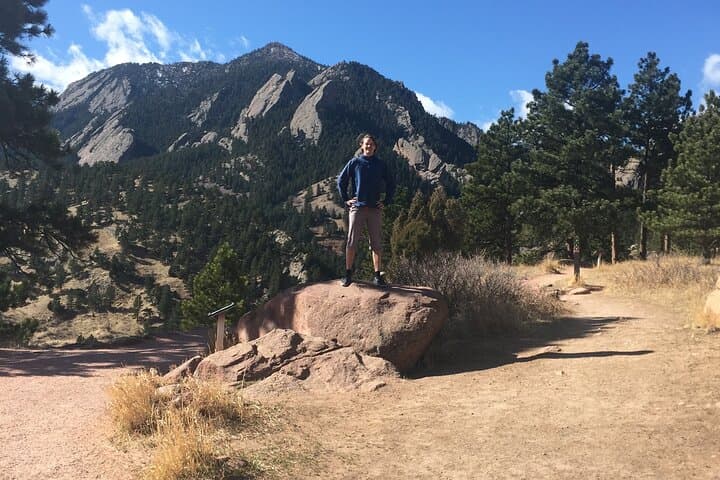
Morning comes quick on the Front Range. At the NCAR trailhead above Boulder, the Flatirons tilt toward the sun like stone sails catching a new day. Pine air moves in slow breaths. A guide—Ryan or Aylyn—checks the sky and nods you onto the trail, where sandstone steps invite you into the foothills. The path rises steadily, not harshly, and every few minutes the city slips away as the mountains take over the conversation. You can hear the breeze in the needles. Occasionally a Steller’s jay cuts the quiet with a sharp remark, then glides into the next stand of ponderosa.
This is the Mallory Cave Trail, a classic Boulder ramble that packs a surprising amount into a short window—views, geology, wildlife sign, and quiet corners where you can feel the foothills working. The route leaves from NCAR’s Mesa Laboratory complex—an architectural landmark—and lopes west on well-worn singletrack before angling into rockier terrain. It’s a private, guide-led hike, typically two to three hours, and calibrated to conditions on the day you go. In summer, that may mean an early start to dodge afternoon thunderheads. In winter, it’s waiting for the sun to soften icy patches on north-facing slopes.
The Flatirons themselves are the show and the storyteller. Their red-and-tan planes are ancient sand and gravel—Fountain Formation rock born around 300 million years ago, then lifted and tilted during mountain-building ages later. On this route you’ll get close enough to see the cross-bedded layers, the grain lines that whisper of old rivers and wind. The trail narrows, then widens, and the terrain insists you pick your feet with care in a few rocky gullies. Sandstone underfoot can feel like it wants to skitter; your shoes answer back with their own grip.
Guides here keep it casual but purposeful. You’ll move through piñon-juniper pockets and airy pinewoods, with views opening toward the plains. They’ll point out how fire and drought shape this landscape, why log bridges are angled the way they are, and how to read the trail for wildlife sign. You might spot mule deer holding the shade along Skunk Canyon, or a red-tailed hawk making the most of a thermal. At a junction, the Mallory Cave spur rises steeper, folding the hike into a short, spirited finish—stone steps, a few bigger moves, and a final traverse to the closure gate. The cave itself has been off-limits for years to protect a sensitive bat colony; your guides are clear about this from the start. You don’t go in. You listen. The cave breathes cool air through the rock and reminds you that not every door in the mountains is ours to open.
Boulder’s relationship to these hills is old and steady. The city’s open space system—one of the first of its kind—wraps the foothills in a protective ring, and locals learn early the etiquette of moving through it: stay on trail, pack out, give wildlife room. The NCAR Mesa Lab you started from is part of that heritage too, a research hub designed by I.M. Pei in the 1960s that looks like it was carved from the rock itself. Inside, free exhibits give context to the weather that shapes your day, from chinook winds to summer lightning that rattles windows and hikers in equal measure.
The distance is friendly—about 3 to 4 miles round-trip depending on small detours—with roughly 800–1,000 feet of gain. Plan for a steady, moderate outing rather than a sufferfest. The beauty lies in the pacing: gradual mesa walking, brief steeper pushes, then a patient descent that lets quads relax while the views keep working. It’s the kind of hike that rewards attentiveness. Look for saffron lichen crawling across boulders. Listen for the soft clack of grasshoppers in late summer. In spring, wildflowers pop in color bursts—pasqueflower first, then golden banner and penstemon announcing the season’s turn.
What makes this guided version worthwhile is the blend of access and insight. Ryan and Aylyn, long-time Boulder hikers, tailor the start time to weather—crucial during monsoon season—and keep you on the best lines when slopes get loose. They’re part trail naturalists, part route sherpas, reading the foothills’ mood and setting the right tempo. You get the fun sections without the false turns, and local context without the lecture.
Afterward, the city feels like a proper base camp. The trailhead is minutes from Boulder’s food scene: burritos at The Sink on The Hill, a burger and pint at Southern Sun, or a post-hike plate of momos at Sherpa’s. If you want to keep the learning arc, duck back into NCAR to catch an exhibit on climate and wind, or stand on the terrace and watch clouds build above Bear Peak—the same engines that shaped your morning still at work.
Practical notes: expect variable footing—packed dirt, sandy slabs, and sections of rough rock. Sun exposure is real across the mesa, even on cool days; carry more water than you think you need. In winter, shaded switchbacks can hold ice, and microspikes make the difference between concentrating on balance and actually looking up. Cell service is decent near NCAR and spottier as you push west. There are restrooms at the trailhead; none on the route. Most of the time you won’t need a permit, but parking can fill fast on bluebird weekends.
The Flatirons have a way of pulling you forward, and the trail plays along, offering small surprises for the attentive: an overlook where the city flattens into the plains, a chorus of jays scolding an unseen fox, the cave gate with its quiet boundary. It’s not a summit day, and it doesn’t need to be. This is a foothills conversation, the kind that leaves you both grounded and a little more curious about the ridgelines above. On the walk back, the mountains loosen their grip. Boulder reappears. The path widens, the wind settles, and you carry the cadence of the hills with you into town—ready for a late lunch, a cold beer, and the sense that you saw the Flatirons not just as shapes on a skyline, but as a living place that moves at its own, confident pace.
Trail wisdom
Small choices, better day.
Beat the Afternoon Boomers
In summer, lightning-prone storms often pop after 1 p.m. Start early to maximize shade and minimize weather risk.
Footwork for Sandstone
Wear grippy hiking shoes—sand-on-slab sections can feel slick, especially after dry spells or a dusting of snow.
Hydrate at Altitude
Carry at least 1–2 liters of water and a salty snack; the dry air at 5,700–6,700 feet sneaks up fast.
Honor the Cave Closure
The cave is closed to protect sensitive bat habitat. Enjoy the overlook at the gate and skip off-trail detours.
Local knowledge
Read the place, not just the route.
Watch for native species including Mule deer, Red-tailed hawk.
Keep an eye out for wildlife during the transition between areas and habitats. Respect distance guidelines.
Stay on established trails to protect fragile sandstone soils and cryptobiotic crusts. Respect wildlife closures and seasonal advisories—these foothills are a living habitat first, recreation area second.
Follow the guide's instructions on size limits, ethical handling, and leave-no-trace practices.
NCAR Mesa Lab exhibits—small, free, and a perfect pre- or post-hike stop to understand local weather. Skunk Canyon overlook spur for a quieter view into a protected drainage
Locally recommended viewpoints and quiet spots known best to local operators.
The NCAR Mesa Laboratory, your trailhead hub, was designed by architect I.M. Pei and opened in 1967. Mallory Cave has been closed for years to protect roosting bats after the spread of white-nose syndrome in North America.
Maritime roots and regional tradition shape the waterways and working coasts.
Seasonal guide
Four versions of the same landscape.
Spring
Best forWildflowers · Cooler temperatures
ChallengesMud on shaded slopes · Unpredictable storms
Shoulder-season hiking with fresh green hills and early blooms. Expect variable trails and keep a rain layer handy.
Summer
Best forLong daylight · Clear morning views
ChallengesStrong sun exposure · Afternoon thunderstorms
Start early for shade and calmer skies. Midday heat and lightning are the main obstacles.
Fall
Best forStable weather · Golden grasses and crisp air
ChallengesShortening days · Early-season ice on north aspects
Arguably the best season—cool, dry, and luminous. Watch for icy patches after cold snaps.
Winter
Best forQuiet trails · Sharp, photogenic light
ChallengesIce on shaded switchbacks · Wind-chill
Pack traction for icy sections and dress in layers. Calm days can be spectacular; windy days bite.
Operator details
What the booking data adds.
Included
- ✓Snacks
Good to know
- ✓Public transportation options are available nearby
- ✓Not recommended for travelers with spinal injuries
- ✓Not recommended for pregnant travelers
- ✓Not recommended for travelers with poor cardiovascular health
- ✓Travelers should have a high level of physical fitness
Pack with intention
What to bring.
Good to know
Common questions.
Plan on 3–4 miles round-trip and about 800–1,000 feet of elevation gain. Most hikers find it moderately strenuous with a short, steeper finish to the cave gate.
Plan the edges
The details that make the day easier.
The NCAR Mesa Laboratory at the trailhead was designed by I.M. Pei and completed in 1967, blending modernist forms with the surrounding sandstone mesas.
Refuel at Southern Sun for a burger and a house-brewed IPA, or try Sherpa’s for steaming momos on a sunny patio. Coffee at Ozo on Arapahoe pre-hike, and if you’re curious about the science behind those thunderheads, pop into the free NCAR exhibits before heading back down to town.
- Closest airport
- Denver International (DEN), ~50 minutes by car. Trailhead: NCAR Mesa Laboratory, 1850 Table Mesa Dr. Drive time from downtown Boulder: ~10–15 minutes. Cell service: Good near NCAR, spottier deeper on the trail. Permits: None required; parking is free at NCAR. Facilities: Restrooms at trailhead only.
Mallory Cave is closed to protect sensitive bat populations affected by white-nose syndrome—honor closures and avoid creating social trails. Pack out all trash, stay on durable surfaces, and yield to wildlife by giving animals distance.
Explore by topic
Follow the threads.
Keep exploring
Make the story part of the trip.
Set out from Bass Harbor for a private, customizable day on Blue Hill Bay — lighthouses, puffins, seals, and the chance to feel Acadia from the water. Small groups, local captains, unforgettable views.
In four hours you can move from shaded canyon ferns to wind-scoured coastal ridgelines, guided by someone who knows where the light—and the hidden views—live. This private half-day hike on the Monterey Peninsula or Big Sur is compact, curated, and perfect for travelers who want depth without a multiday commitment.
 Related story
Beneath a sky of shifting light, Skaftafell’s ice reads like a map of time. This three-hour guided glacier hike mixes technical instruction with geology and culture: compact, safe, and unforgettable.