
What the day feels like
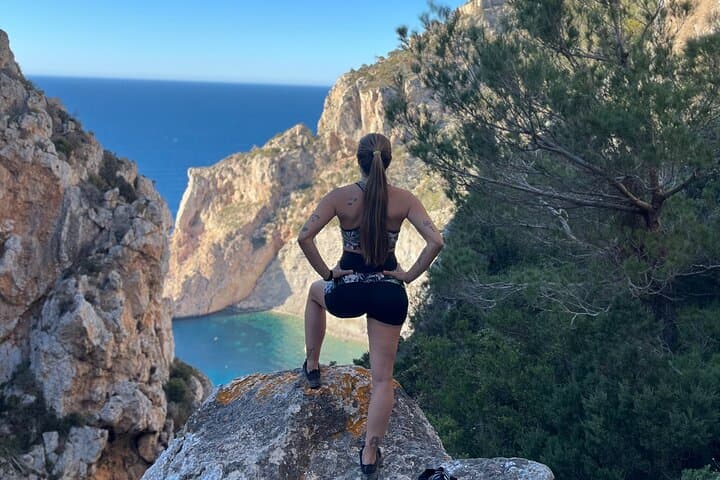
The path slants toward the sea through a lantern glow of Aleppo pines, resin and rosemary lifting with each step. Red earth crunches underfoot. Ahead, the cliff-line of Es Amunts rears like the island’s weathered rampart, a honeyed limestone wall shouldering the sky. Far below, the Mediterranean works the rocks with patient rhythm, daring you to come closer. The wind scouts ahead, testing the edges for you, tugging at loose strands and telling you, quietly: keep moving.
This is Ibiza away from the DJs and marinas—a north-coast hike that braids slick geology, stubborn local history, and open-sky views into a half-day adventure. With Discover Ibiza Hikes, the route aims for Ses Balandres, a dramatic scar in the coast where stacked boulders, juniper, and sea caves meet an impossible sapphire. It’s not just a lookout. It’s a conversation with a rawer Ibiza, the parts that still shrug off polish.
Leaving the almond orchards of Santa Agnès de Corona, you ease into a singletrack with stone terraces to your left—evidence of old subsistence farming and a reminder that every flat here was earned. Beneath your boots sits uplifted limestone, a Map Room for anyone who reads rock: eroded ledges, fossil-studded bands, and cavities gnawed by wind and salt. The cliffs funnel you toward the rim, and then the world opens—jagged islets, a comb of sea stacks, the horizon braided with light.
Guides share stories that cool the calves. Carthaginian traders moored along these coasts in the 7th century BCE, drawn by salt and safe harbor. Later, these same inlets thieved back the night, sheltering contraband and whispers when Spain’s coasts hid more than they revealed. On spring afternoons, Eleonora’s falcons ride the thermals, tracing tight mathematical arcs; the island’s emerald sargantana lizards scatter across stones like living punctuation. Nature here has personality: junipers stoop like elders in conversation, thyme clings stubbornly to cracks, and the sea keeps the last word.
The standard Ses Balandres outing runs about 6 kilometers (3.7 miles) with roughly 350 meters (1,150 feet) of elevation gain. Expect uneven limestone, loose scree, and a brief rope-assisted scramble if conditions and group comfort allow a descent toward the cove. Your guide sets the pace, choosing balcony viewpoints, a juniper-framed snack stop, and—if the wind is kind—a safe angle down for a closer look at the amphitheater of boulders below. For some, the dramatic vantage points are the point; for others, the descent is the pulse-quickener. Either way, the payoff is constant: cobalt sea, far-off sail lines, the smell of warm pine and sunlit sage.
Ibiza’s north is a study in restraint. The Es Amunts protected area preserves a skein of cliffs and coastal scrub where silence does its best work. Winter rains green the terraces; spring paints them with wildflowers. In summer, the sea steals the show, but the heat pushes you to early starts or late light. Fall brings clear visibility and patient breezes—good news for anyone hoping to string together photos in soft gold. The island’s UNESCO-listed Posidonia oceanica meadows lie offshore, invisible but essential, filtering the water until the color snaps into that impossible Mediterranean blue. You don’t see them from the rim, but you feel their work in the clarity below.
Hiking with Discover Ibiza Hikes tilts the day toward nuance. A local guide reads trail whispers—when the rock turns to marbles, when a gust hides in the notch, which juniper snag marks the hidden lookout. The routes dodge the well-worn tourist tread, and the pacing respects the heat. Expect breaks, those quick map-on-knee moments, and small interpretive notes that stitch this landscape to its people—why almonds still matter here, when the blossom snow comes, and how the old dry-stone walls are mended when winter tears them.
Practicalities sharpen the beauty. Wear shoes with real bite—a lug that trusts limestone and won’t fold on scree. Bring 1.5 to 2 liters of water, more in summer, and a wind layer even on bright days; the cliff edge has its own weather. Sunscreen is non-negotiable; the sun doesn’t blink. If the rope section is part of your day, you’ll get guidance on footing, balance, and body position, with the option to skip if exposure makes your knees talk.
Timing matters. For cooler temperatures and forgiving light, spring and fall are ideal. The low sun catches the limestone’s texture and gives the sea an inky depth that photographs cleanly. Dawn hikes trade spectacle for solitude; late-afternoon walks pay dividends at golden hour, when the island exhale is audible. On windy days, the sea presses hard against the base of the cliffs and reminds you, firmly, to keep your distance.
At the end, the trail draws you back into the pines. The wind settles. The sea keeps working—always working—but you carry a quieter version of it with you. Back in Santa Agnès, the terraces tilt toward evening. You’ll find a café that handles the day’s dust and a table that understands what your legs have done. The island has many faces; this one—Ibiza’s wild edge—is worth meeting on foot.
Trail wisdom
Small choices, better day.
Grip Matters
Wear trail shoes with aggressive lugs; polished limestone and small scree marbles can be slick, especially after humidity or spray.
Water Before Views
Carry 1.5–2L per person and start hydrated; there’s zero shade once you leave the pines and the cliff rim reflects heat.
Mind the Wind
Gusts accelerate at the cliff edge—keep cameras on straps and step back during strong bursts; follow your guide’s safe standoff distances.
Choose the Descent
The rope-assisted section to the boulder amphitheater is optional—if you’re exposure-averse, enjoy the panoramic balconies instead.
Local knowledge
Read the place, not just the route.
Watch for native species including Eleonora’s falcon, Ibizan wall lizard (sargantana).
Keep an eye out for wildlife during the transition between areas and habitats. Respect distance guidelines.
Es Amunts is a protected landscape—stick to durable surfaces, avoid disturbing nesting birds on the cliffs, and never collect plants like juniper, thyme, or rosemary.
Follow the guide's instructions on size limits, ethical handling, and leave-no-trace practices.
Juniper-framed balcony just west of the main overlook with a clean sightline to offshore stacks. Almond terraces above Santa Agnès that glow pink-white during late winter blossom
Locally recommended viewpoints and quiet spots known best to local operators.
The north-coast cliffs of Es Amunts once hid small-scale smuggling routes; earlier, Phoenicians and Carthaginians used Ibiza as a strategic trade hub in the western Mediterranean.
Maritime roots and regional tradition shape the waterways and working coasts.
Seasonal guide
Four versions of the same landscape.
Spring
Best forWildflowers and almond terraces · Cooler temperatures for longer routes
ChallengesUnpredictable winds · Occasional muddy patches after rain
Mild days and clear air make spring the sweet spot for distance, views, and photography without the heat.
Summer
Best forSunset and sunrise hikes · Swimming options on calmer days
ChallengesHigh heat and intense UV · Busier roads and parking near trailheads
Beat the heat with early starts or golden-hour departures; bring extra water and sun protection.
Fall
Best forStable weather and clear horizons · Quieter trails after peak season
ChallengesShortening daylight · Occasional late-summer storms lingering
Cool evenings and soft light make fall ideal for panoramic photography and unhurried breaks.
Winter
Best forCrisp air and solitude · Almond blossom nearby (late Jan–Feb)
ChallengesChilly winds on the rim · Slippery rock after showers
Expect near-empty trails and quick-changing conditions; pack a windproof layer and watch footing after rain.
Operator details
What the booking data adds.
Included
- ✓Use of Snorkelling equipment
Not included
- —Private transportation
Good to know
- ✓Public transportation options are available nearby
- ✓Not recommended for pregnant travelers
- ✓Not recommended for travelers with poor cardiovascular health
- ✓Travelers should have at least a moderate level of physical fitness
Pack with intention
What to bring.
Good to know
Common questions.
It’s a challenging half-day with uneven limestone, short steep sections, and an optional rope-assisted descent. If you skip the rope section, it’s a solid moderate hike to exceptional viewpoints.
Plan the edges
The details that make the day easier.
Ibiza’s Posidonia oceanica seagrass meadows—part of the UNESCO World Heritage listing 'Ibiza, Biodiversity and Culture'—help make the island’s waters exceptionally clear by filtering and oxygenating the sea.
Post-hike, grab a tortilla and a cold drink at Can Cosmi in Santa Agnès, a tiny institution facing the church square. For sunset, head to Hostal La Torre above Cala Gració—terrace views, mellow soundtrack. On Saturdays, the Forada market brings local produce and crafts; it’s a good spot to taste island almonds and olives.
- Closest airport
- Ibiza Airport (IBZ). Trailhead: near Santa Agnès de Corona, 20–25 minutes by car from Sant Antoni de Portmany. Cell service: patchy to none along the cliff rim—download maps. Permits: none required; parking is limited on rural lanes—arrive early and never block farm access.
You’re walking in the Es Amunts protected landscape. Stay on established paths to prevent erosion, keep voices low around nesting cliffs, pack out all waste, and leave stones and plants undisturbed—this coast is resilient but not invincible.
Explore by topic
Follow the threads.
Keep exploring
Make the story part of the trip.
Set out from Bass Harbor for a private, customizable day on Blue Hill Bay — lighthouses, puffins, seals, and the chance to feel Acadia from the water. Small groups, local captains, unforgettable views.
In four hours you can move from shaded canyon ferns to wind-scoured coastal ridgelines, guided by someone who knows where the light—and the hidden views—live. This private half-day hike on the Monterey Peninsula or Big Sur is compact, curated, and perfect for travelers who want depth without a multiday commitment.
 Related story
Beneath a sky of shifting light, Skaftafell’s ice reads like a map of time. This three-hour guided glacier hike mixes technical instruction with geology and culture: compact, safe, and unforgettable.