
What the day feels like
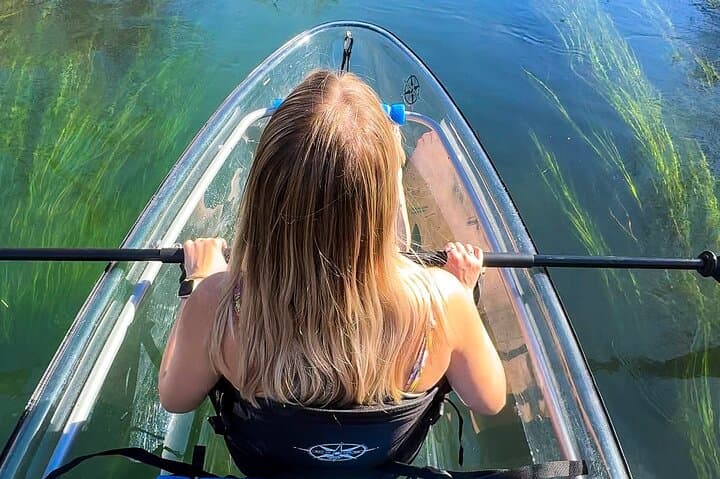
You push off from a low grassy bank and the world flips. The kayak beneath you is a bubble of transparency — a ghost-boat — and the river answers by making its secrets visible. Beneath your paddle the current moves like a clear belt of glass, riffles and eddies tracing the sandy bottom. Small fish scatter in geometric flashes. An otter peeks up for a breath and then becomes a dark comet under the hull. A deer pauses at the shoreline to drink; the current seems to hush for the pause. For 75 minutes you glide on water that refuses to hide anything, and the river dares you to pay attention.
The San Marcos River is fed by one of Texas’s most productive karst aquifer systems. Springs bubbling from limestone feed a ribbon of turquoise that feels more alpine than central Texas; the color comes from the clean, cold, mineral-rich springwater that pours from the Edwards Aquifer. For centuries the waters have dictated how people live here: Indigenous peoples who fished and camped on the banks; settlers who built mills and small towns; later a university town that grew around the river’s steady supply. Today the river’s clarity has given rise to a small but exacting tourism — glass-bottom boats, spring-viewing platforms, and these clear kayaks that let you sit with the water rather than above it.
This is not a technical whitewater run but a slow-motion natural cinema. Geology is in every ripple: dissolved limestone creates windows and scalloped channels; springs force cool water up through warm stations and the temperature shift gathers life. You’ll see a cross-section of river ecology — emergent grasses sheathing soft banks, freshwater fish that flash like coins, and sometimes the thin, darting shapes of endangered species that have made the springs their only home. Birdsong chisels the soundtrack; kingfishers and herons perform quick, efficient stunts while turtles sun themselves on exposed logs.
The tour’s appeal is equal parts sensory and practical. It’s accessible — short, centered on calm water, and beginner-friendly — yet surprising. Because the hull is clear, your attention is split between surface drama and underwater choreography. For families this is a rare encounter with aquatic life at eye level; for photographers and naturalists it’s an exercise in patient observation. For anyone accustomed to opaque, traffic-lined urban waterways, the San Marcos River feels like a restoration project for the soul.
Local culture is low-key but genuine. San Marcos is a college town — Texas State University lends a youthful undercurrent — and downtown is where you’ll stitch the river day into a larger visit: breakfast tacos, craft beer, and a laid-back main street scene. The Meadows Center and Spring Lake are not only scenic; they’re active research hubs, and many local guides are as likely to point out a fountain darter or the karst formation as they are to teach stroke technique.
What to expect logistically: the Viator-bookable Clear Kayak Day Adventure is a fixed 75-minute experience, priced from about $65 and usually operating in daylight hours when visibility is best. Tours are typically guided, with basic paddling instruction and lifejackets provided; the water is calm but cold by Texas standards year-round. The float is short, intimate, and designed to highlight wildlife and spring-fed clarity rather than endurance.
Practical edge: timing matters. Early morning light makes the river glow and wildlife is more active; mid-summer afternoons bring heat and more visitors. Footwear that can get wet is essential, as are sun protection and a small dry bag for phone and keys. If photography is your motive, aim for side-light to avoid reflections on the clear hull — polarizing filters are a small but effective investment.
Why you should do it: it’s an efficient, high-reward nature immersion that requires minimal fitness and yields maximum intimacy with a river system that’s ecologically unusual for Texas. You come away not only with good photos and a cool, watery memory but with a clearer sense of why water quality matters: these springs support species found nowhere else, and getting on the water is a persuasive way to feel protective about them.
If you go, be mindful. The river’s clarity makes it fragile; noise and tossing trash are as much harm as physical disturbance. Keep distance from nesting birds and avoid touching or chasing animals. In return, the river will deliver a kind of transparency you won’t find in an ordinary day trip — a conversation between limestone, water, and life that’s visible to anyone who knows how to look.
Trail wisdom
Small choices, better day.
Bring a Dry Bag
Even short trips are photo opportunities; protect phone, keys, and sunscreen in a small dry bag.
Wear Secure Water Shoes
Banks and launch points can be slippery and rocky; closed-toe water shoes prevent twisted ankles.
Go Early for Wildlife
Morning light and cooler temps mean more otter and bird activity and fewer crowds.
Respect Buffer Zones
Keep distance from wildlife and nesting areas—your guide will point out where to watch without disturbing.
Local knowledge
Read the place, not just the route.
Watch for native species including North American river otter, Great blue heron.
Keep an eye out for wildlife during the transition between areas and habitats. Respect distance guidelines.
The spring ecosystem supports several species of conservation concern; operators encourage no-touch viewing, no feeding, and strict pack-in/pack-out policies.
Follow the guide's instructions on size limits, ethical handling, and leave-no-trace practices.
Meadows Center spring viewing platforms for a different perspective. Short riverside walks near downtown San Marcos for birding before or after your paddle
Locally recommended viewpoints and quiet spots known best to local operators.
San Marcos Springs fed early Indigenous communities and later powered mills; the springs are central to the town’s growth and to research at the local university.
Maritime roots and regional tradition shape the waterways and working coasts.
Seasonal guide
Four versions of the same landscape.
Spring
Best forWildflower-lined banks · Active wildlife viewing
ChallengesVariable temps · Occasional heavy rain
Spring brings clear water and active bird and mammal life; mornings are ideal before afternoon warmth appears.
Summer
Best forWarm weather paddling · Extended daylight hours
ChallengesHeat and sun exposure · Peak visitor numbers
Summer offers long days and warm water but bring sun protection and plan early or late floats to avoid crowds.
Fall
Best forMilder temps · Fewer tourists
ChallengesPossible fallen leaves in water · Cooling evenings
Fall is a comfortable season for paddling with steady clarity and fewer groups on the river.
Winter
Best forCrisp, clear visibility · Quiet paddles
ChallengesCold water temps · Shorter days
Winters are chilly but the water stays clear; dress warmly and bring layers for the launch and return.
Operator details
What the booking data adds.
Included
- ✓English licensed or certified guide
- ✓Sunscreen
- ✓dry bag
- ✓safety equipment
- ✓Clear kayaks
- ✓bug spray
- ✓seats
- ✓paddles
Not included
- —No food or drinks provided
Good to know
- ✓Not recommended for travelers with spinal injuries
- ✓Not recommended for travelers with poor cardiovascular health
- ✓Service animals allowed
- ✓Public transportation options are available nearby
- ✓Travelers should have at least a moderate level of physical fitness
- ✓Each person under the age of 18 must be accompanied by an adult 18 years or older in a kayak.
- ✓Weight limit of 250lbs per seat and 425lbs per kayak
Pack with intention
What to bring.
Good to know
Common questions.
The tour is a fixed 75-minute experience—long enough to see spring-fed channels and wildlife without requiring advanced paddling skills.
Plan the edges
The details that make the day easier.
San Marcos Springs are among Texas’s most biologically diverse springs and host several species found nowhere else, including the endangered fountain darter and San Marcos salamander.
After the river, head into downtown San Marcos for casual Tex‑Mex, local breweries, and a college-town vibe—plan for tacos or barbecue and a cold beer to round out the day.
- Closest airport
- Austin-Bergstrom (AUS) ~30–45 minutes north; Driving: ~30 minutes from Austin, ~1 hour from San Antonio; Cell service: generally available but can be patchy along wooded stretches; Permits: none for short commercial tours, but confirm with operator.
These spring-fed waters are ecologically sensitive—pack out all trash, avoid touching or feeding wildlife, and stick to operator guidance to minimize disturbance.
Explore by topic
Follow the threads.
Keep exploring
Make the story part of the trip.
Set out from Bass Harbor for a private, customizable day on Blue Hill Bay — lighthouses, puffins, seals, and the chance to feel Acadia from the water. Small groups, local captains, unforgettable views.
In four hours you can move from shaded canyon ferns to wind-scoured coastal ridgelines, guided by someone who knows where the light—and the hidden views—live. This private half-day hike on the Monterey Peninsula or Big Sur is compact, curated, and perfect for travelers who want depth without a multiday commitment.
 Related story
Beneath a sky of shifting light, Skaftafell’s ice reads like a map of time. This three-hour guided glacier hike mixes technical instruction with geology and culture: compact, safe, and unforgettable.