
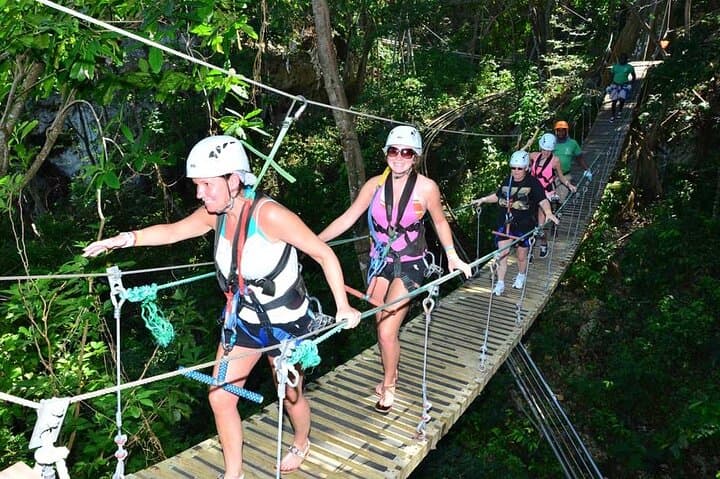
What the day feels like
The guide clips your harness with a calm efficiency that betrays the adrenaline simmering under your skin. Behind you, the valley folds like a green accordion—patchwork farms, ragged gullies and the glint of water where a river dares to push toward the sea. Ahead, the cable drops away into a throat of cloud and canopy; the island has its own gravity here, pulling you forward. You step off, the world rearranges, and gravity becomes motion—fast, clean, and startlingly precise.
This is the feel of a private zipline tour out of Montego Bay: a measured crescendo of trust, speed, and landscape. The trip’s variable length (from an hour to a half-day) lets it behave like both a quick thrill for cruise-day travelers and a fuller excursion that samples mountains, rivers, and the small communities that anchor Jamaica’s northwest coast. At roughly $105 and up, private transport and a dedicated guide are part of the deal—comfort and local knowledge wrapped into a single, safe experience.
The islands’ geology is quiet but honest. Jamaica’s northwestern ridges are ancient limestones capped by rich topsoil that supports a dense canopy. Those same ridgelines create the drop and distance that make ziplines sing: tensioned steel mapping the curves of valleys cut over millennia. On clear days you can see the coastline’s pale teeth of sand and reef—on cloudy days the fog hangs low and the forest feels like it’s been given voice.
Culturally, a zipline tour in Montego Bay is a slotted window into ordinary island life. Drivers wind through towns where music leaks from small shops, and guides often double as cultural interpreters—pointing out roadside stands selling patties, small rum shops where locals trade gossip, and the kinds of mango trees that reliably yield the sweetest fruit. Your private driver isn't only there for logistics; they carry decades of local knowledge and an ability to read the weather and the mood of the land.
Safety and sustainability have become part of the modern zipline story. Reputable outfits emphasize redundant harnesses, trained catch crews at platforms, and frequent inspections of cables and anchors. Similarly, the best operators are conscious of their footprint—siting platforms to minimize tree damage and educating guests on staying on trails and not disturbing fragile understory plants.
Why do this as a private tour? Beyond the tailored schedule and a guide who can match your comfort level, a private option allows time to linger on the non-zipping parts: a shaded riverside picnic, a walk through a small mountain village, or a stop at a local food stall for jerk pork and a cold Red Stripe. It’s the difference between a checklist experience and one that feels like a quick apprenticeship in place.
Practical realities: the trip’s timing matters. Early morning runs mean crisper air, fewer clouds, and calmer winds; midafternoon can bring the island’s signature brief showers and stronger winds. Wear closed-toe shoes with a firm sole—the platforms are often wooden and can be slick after rain. Bring a small, secure pack for camera gear; many tours allow you to clip a wrist-cam but not free-hold a phone while zipping. Hydration is simple: Jamaica’s heat is steady, not extreme, but exertion plus humidity will make you sweat.
If you’re packing for the day, think modular. Lightweight layers that can be shed, a breathable long-sleeve for sun and insect protection, and a small first-aid kit are all smart. For photographers: plan for wide-angle lenses to capture the sense of scale from platform to platform, and use a polarizer to deepen the greens of the canopy and cut glare from the sea.
A zipline tour out of Montego Bay is more than a string of adrenalized moments; it’s a conversation with the island. The forest answers your passage with birdsong and the occasional drum of a distant waterfall. The river below keeps going on its own timetable, indifferent and constant—reminding you that the best travel is partly about surrender. When the line stops and the guide unclips you, the scramble back to land comes with a small, honest ache in the legs and the clearer sense that you’ve moved across a slice of Jamaica few visitors see from ground level.
For anyone considering it: this is a do-able adventure. It requires no technical climbing skills, and a moderate level of fitness is enough. Whether you’re on a short shore excursion from a cruise ship or carving out a private morning from Montego Bay, the zipline thriller is a compact way to experience the island’s interior—fast, thoughtful, and human-paced. Book with a company that emphasizes safety certifications, asks about your comfort with heights in advance, and can offer a private vehicle to make the day seamless. If you leave with a dusty harness, a handful of photos and a grin, consider that a fair exchange for a few hours spent high above the habits and rhythms of Jamaica’s northwest coast.
Trail wisdom
Small choices, better day.
Go Early
Morning runs mean calmer winds, clearer views, and less chance of afternoon showers.
Secure Your Camera
Use a wrist strap or small action-cam mount—loose phones aren’t allowed while zipping.
Wear Closed-Toe Shoes
Sturdy trainers or hiking shoes protect your feet on platforms and trails.
Hydrate Before You Go
Bring water; humidity and short bursts of exertion add up quickly.
Local knowledge
Read the place, not just the route.
Watch for native species including Jamaican Toddy (nectar-feeding birds), Green vervet monkey (seen in some inland areas).
Keep an eye out for wildlife during the transition between areas and habitats. Respect distance guidelines.
Choose operators that minimize tree impact when building platforms, support local planting initiatives, and ask how they manage waste—pack out what you bring in.
Follow the guide's instructions on size limits, ethical handling, and leave-no-trace practices.
Roadside jerk stands en route for authentic, inexpensive meals. Small riverside picnic stops where local guides will point out medicinal plants
Locally recommended viewpoints and quiet spots known best to local operators.
Montego Bay’s name comes from the Spanish 'Bahía de Manteca' (Bay of Lard), a nod to colonial-era trade; the region later developed as a sugar and shipping hub under British rule.
Maritime roots and regional tradition shape the waterways and working coasts.
Seasonal guide
Four versions of the same landscape.
Spring
Best forFewer crowds · Fresh foliage
ChallengesIntermittent showers · Variable wind
Spring (March–May) offers warm days and lush canopy growth—pack a light rain layer for surprise showers.
Summer
Best forLong daylight hours · Lush vegetation
ChallengesHotter temps · Higher chance of brief storms
Summer brings strong sun and sporadic afternoon storms; plan for sun protection and flexible scheduling.
Fall
Best forWarmer sea temps · Shoulder-season rates
ChallengesHurricane season peaks early fall · Humidity
Fall is quieter but overlaps with hurricane season—check forecasts and flexible cancellation policies.
Winter
Best forDry, clear days · Peak visibility
ChallengesHigher visitor numbers · Warmer crowds
Winter (Dec–Feb) is Montego Bay’s dry season—expect the best visibility and steady conditions for zipping.
Operator details
What the booking data adds.
Included
- ✓Private transportation
- ✓Air-conditioned vehicle
- ✓Restroom stop if requested
Not included
- —Entrance fees.
Good to know
- ✓Specialized infant seats are available
- ✓Public transportation options are available nearby
- ✓Suitable for all physical fitness levels
Pack with intention
What to bring.
Good to know
Common questions.
No—guides provide a safety briefing and handle harnessing; tours are suitable for first-timers with a moderate fitness level.
Plan the edges
The details that make the day easier.
Montego Bay’s name derives from the Spanish 'Bahía de Manteca' (Bay of Lard), reflecting the town’s colonial-era role in trading lard and other goods.
After your run, head to Scotchies for authentic jerk chicken and pork (casual, smoky, and local), try a local rum punch at a small bar in town, and listen for live reggae—food stalls and music make Montego Bay’s evenings as immediate as its mornings.
- Closest airport
- Sangster International Airport (MBJ)
- Typical drive from Montego Bay
- 20–60 minutes depending on site
- Cell service
- generally available on main roads; spotty on higher ridges
- Permits
- none typically required for tourists, but confirm admission fees and operator policies
Choose operators who anchor platforms without excessive tree cutting, avoid single-use plastics, and support local conservation efforts—pack out all trash and stick to established trails.
Explore by topic
Follow the threads.
Keep exploring
Make the story part of the trip.
Set out from Bass Harbor for a private, customizable day on Blue Hill Bay — lighthouses, puffins, seals, and the chance to feel Acadia from the water. Small groups, local captains, unforgettable views.
In four hours you can move from shaded canyon ferns to wind-scoured coastal ridgelines, guided by someone who knows where the light—and the hidden views—live. This private half-day hike on the Monterey Peninsula or Big Sur is compact, curated, and perfect for travelers who want depth without a multiday commitment.
 Related story
Beneath a sky of shifting light, Skaftafell’s ice reads like a map of time. This three-hour guided glacier hike mixes technical instruction with geology and culture: compact, safe, and unforgettable.