
What the day feels like
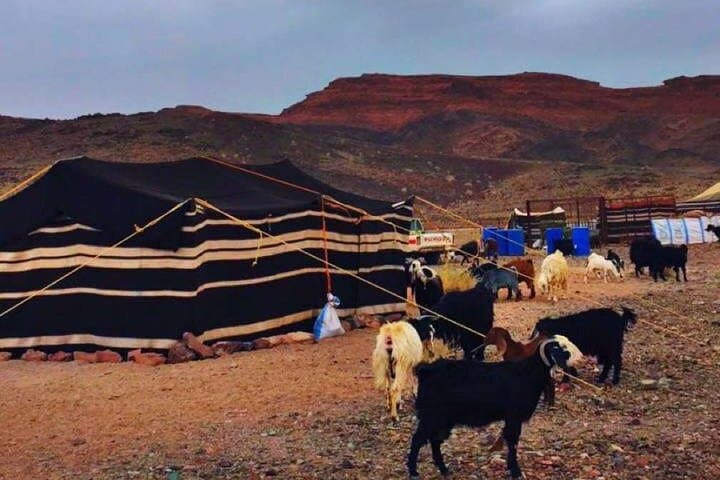
You arrive before dawn when the desert still holds its cool breath. A low, rose-gold horizon outlines an expanse of sculpted sand and broken stone; wind-softened ridges look like the backs of sleeping giants. Abu Mishaal waits by a low pickup, his smile immediate and unhurried. He speaks little at first— Bedouin hospitality is a rhythm, not a script—then offers steaming cups of Arabic coffee that smell of cardamom and of welcome. This is not a museum of tradition; it is a day lived in an age-old register, with camels ambling, sheep nudging toward open scrub, and a sky so wide it seems to sharpen the edges of thought.
The Full-Day Desert Adventure with Abu Mishaal centers on the Shegri sands outside Tabuk, a human-scale immersion into nomadic life. You learn to handle a camel, to lead a few sheep across rocky washes, and to read, in a half-hour lesson, how wind and feet change the shape of the land. At midday, a shade shelter and a slow-cooked Bedouin meal of rice, spiced meat, and flatbread make the heat bearable; in the afternoon, Al-Shaq—a quiet curve of dune and open plain—becomes the kind of place where time pauses, and you sip tea while the sunset stages its gradual burn.
There is history written into this place. Tabuk sits in northwestern Saudi Arabia near routes that have linked the Arabian interior to the Red Sea and the Levant for millennia. Nomadic families formed the human map here, trading passage, stories, and goods along caravan roads that predate modern borders. The Bedouin culture you encounter is adaptive and practical: tents that fold like living furniture, coffee rituals that signify welcome and respect, and animal husbandry tuned to scarce water and fickle grazing.
Geologically, the landscape is a mix of wind-carved sand and older volcanic and sedimentary outcrops. You’ll notice pumice-like rock and dark basalt islands set against pale sand—evidence of the region’s complex past. The dunes near Shegri are modest by global standards, but their angles change with the wind, and walking them is different from hiking a forest trail: footing shifts underfoot, slopes can be deceptively soft, and the sun makes a single dune an entire world.
Culturally, the day is as instructive as it is sensory. Abu Mishaal will demonstrate the etiquette of Bedouin greeting, the correct way to accept a cup (use the right hand), and the barter of small kindnesses—dates shared, a shade offered, a helping hand with saddle rope. Photography is welcome, but ask before you take portraits; privacy and respect matter.
For travelers, the appeal is both simple and rare: authentic contact with local life without spectacle. This is not a reenactment in costume; it is a working day with animals and stories. The experience is private and customizable—good for travelers who want direct cultural exchange without a tour-bus buffer.
Practical realities: the experience is a full 8-hour day, often priced at a premium given the private guide model and the remote logistics. Dress in breathable layers, bring sun protection, and expect dust. Footing varies from packed desert gravel to loose sand; shoes with good tread and ankle support matter. Hydration is critical—drink steadily and carry more water than you think you need. The best windows are early morning and late afternoon; the middle of summer is punishing, so plan for the cooler months if possible.
Safety and sustainability thread through the day. Bedouin animal husbandry relies on fragile grazing cycles; avoid littering, do not offer foreign food to camels, and follow your guide’s directions around animals. The experience also provides a model for low-impact tourism: by spending directly with a local guide you help keep value in the community rather than in distant chains.
How to make this day work for you: confirm pickup logistics with the operator—many meet in Tabuk city—and check whether the price includes transfers. Bring cash in small bills for tips and small purchases. If you want photographs of the low light, ask to linger at Al-Shaq; golden hour here can be cinematic. Bring a compact binocular if you enjoy watching distant grazing animals or scanning the rippled horizon.
Why go? A day like this recalibrates expectations about travel. Instead of bundled attractions, you get a living system: animal movement, food prepared over embers, and a human geography that makes generosity its own architecture. For an afternoon and a handful of moments, the desert stops being a backdrop and becomes a teacher—its arid hold teaching patience, and its horizons teaching proportion.
If you leave with sand in your pockets and a new word learned from Abu Mishaal, you’ll understand the appeal. It’s quiet, tactile, and rooted in hospitality; it’s also straightforward and practical, built for travelers who want to engage, ask questions, and walk away wiser about how landscapes and lives have been braided together in this corner of Arabia.
Trail wisdom
Small choices, better day.
Start early or late
Avoid the midday sun—plan arrival at dawn or stay through golden hour for more comfortable temperatures and better photos.
Footwear matters
Choose closed-toe shoes with good tread to handle both sharp gravel and soft sand; a gaiter can keep sand out.
Hydrate proactively
Carry at least 2–3 liters of water for a full-day desert excursion and sip regularly to avoid heat fatigue.
Ask before photographing
Respect personal boundaries—ask permission before photographing people and domesticated animals.
Local knowledge
Read the place, not just the route.
Watch for native species including Dromedary camels, Desert fox (occasional).
Keep an eye out for wildlife during the transition between areas and habitats. Respect distance guidelines.
Water and grazing are limited resources; follow your guide’s instructions, avoid leaving waste, and do not feed or overburden animals with unfamiliar food.
Follow the guide's instructions on size limits, ethical handling, and leave-no-trace practices.
Dune viewpoint at Al-Shaq for sunset photography. Nearby rock outcrops that reveal basalt islands and fossil-bearing sediment
Locally recommended viewpoints and quiet spots known best to local operators.
The Tabuk region has been a crossroads for caravan routes linking the Red Sea with interior Arabia; Bedouin lineages here reflect centuries of mobile pastoralism.
Maritime roots and regional tradition shape the waterways and working coasts.
Seasonal guide
Four versions of the same landscape.
Spring
Best forCooler daytime temperatures · Clear skies for photos · Wildflower blooms in some years
ChallengesWindy afternoons · Occasional dust storms
Spring brings comfortable days and dramatic light; winds can pick up, so pack a light scarf and windproof layer.
Summer
Best forExtended daylight · Sunrise and sunset colors
ChallengesExtreme heat · Limited activity during midday
Summer temperatures can be extreme—schedule activities in the cooler hours or avoid this season altogether.
Fall
Best forPleasant temperatures · Stable weather · Comfortable hiking and riding
ChallengesShorter daylight hours later in the season
Fall is balanced and often the best overall time for a full-day experience—comfortable and predictable conditions.
Winter
Best forMild daytime temps · Clear skies and crisp air · Comfortable camel rides
ChallengesCold mornings and evenings · Need for warm layers
Winter is ideal for most travelers—days are mild, but bring layers for cool mornings and nights.
Pack with intention
What to bring.
Good to know
Common questions.
The experience is a full-day tour lasting approximately 8 hours.
Plan the edges
The details that make the day easier.
Tabuk sits along ancient trade corridors and has been a crossroads for caravans moving between the Red Sea and the Arabian interior for millennia.
After the day, head back to Tabuk’s central souq for fresh dates and a plate of mandi or a small coffee house for strong Arabic coffee; local eateries near the city center offer grilled meats and simple, hearty stews.
- Closest airport
- Tabuk Regional Airport (TUU)
- Driving from Tabuk
- ~45–60 minutes to Shegri areas (confirm with operator)
- Cell service
- intermittent in the dunes
- Permits
- standard tourist visa required—no special permits typically needed for day tours.
Support local guides, avoid single-use plastics, don’t disturb grazing routes, and pack out all trash; small actions help protect fragile desert ecosystems.
Explore by topic
Follow the threads.
Keep exploring
Make the story part of the trip.
 Related story
Less than two hours from Nairobi, Kereita Forest pairs hands-on canopy adventure with quiet montane trails and a sobering colonial history—perfect for families, teams, and curious travelers seeking a full-day pulse of nature.
Set out from Bass Harbor for a private, customizable day on Blue Hill Bay — lighthouses, puffins, seals, and the chance to feel Acadia from the water. Small groups, local captains, unforgettable views.
In four hours you can move from shaded canyon ferns to wind-scoured coastal ridgelines, guided by someone who knows where the light—and the hidden views—live. This private half-day hike on the Monterey Peninsula or Big Sur is compact, curated, and perfect for travelers who want depth without a multiday commitment.