
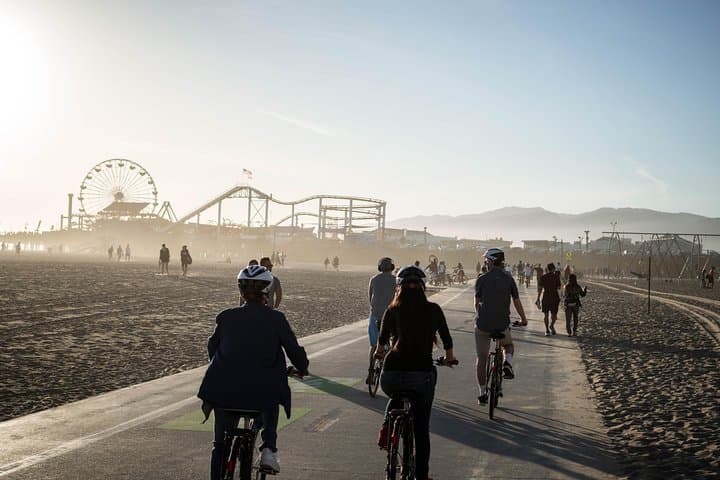
What the day feels like
You push off from the Santa Monica Pier and the Pacific immediately takes the conversation. The ocean doesn’t whisper here — it speaks with salt and wind, pulling a steady rhythm that matches the click of your pedal. Your guide falls in step beside you, nodding to the boardwalk characters as if offering introductions: a muralist varnishing color into a wall, a skateboarder tracing history on concrete, a busker tuning a guitar that will thread the whole ride with notes. The ride is small in distance but wide in context — an urban coastal artery where surf, art, and the city rub shoulders.
This is a tour built for curiosity. Over two to three hours you’ll ride the separated bike path and city lanes from the piers and promenades of Santa Monica south toward the nutty, brilliant collage of Venice Beach. The terrain is flat — a rare and welcome respite — so the work of the ride is sensory: salt spray daring your sunhat to stay on, murals calling you over, and pockets of history tucked behind palm trunks.
Santa Monica and Venice were stitched into their modern characters by waves of culture and commerce. Santa Monica’s beachfront became a leisure destination as early as the 1900s; the Pier opened in 1909 and has been an anchor of seaside amusements ever since. Venice was envisioned in 1905 by Abbot Kinney as “Venice of America,” canals and all; over the 20th century it evolved into much more — a crucible for counterculture, skateboarding, and street art. Those layered stories are visible: historic carousel houses next to murals that rotate with the artists who claim them, seafood stands beside storefronts selling vintage surfboards.
Geologically, the coast here is the face of the Pacific Plate’s long, slow negotiation with the continent: a narrow coastal plain that runs into bluffs and artificial piers. The bike path itself is a modern infrastructure response to a simple demand — give people a safe way to move along the shore — and it’s been an engine of neighborhood life and tourism. Culturally, the route is a study in contrasts. Santa Monica leans polished — wide sidewalks, manicured parks, and an oceanic economy built in part on tourism — while Venice keeps a raw, improvisational edge: artists occupying storefronts, legal graffiti walls that act as living galleries, and a boardwalk that never fully sleeps.
Why ride with a guide? Because the corridor is dense with things that don’t always read in a map pin. Your guide will put local histories next to the sites you pass — the skateboard culture that sprouted from skate parks and empty pools, the public art projects that doubled as neighborhood reclamation, and the architectural quirks that speak to earlier visions for the coastline. The group pace keeps the experience social; the rhythm of stops and starts gives you time to photograph, ask questions, and buy a taco from a vendor whose recipe is four decades deep.
Pragmatically, this is a do-able day activity. Expect a mostly flat 4–6 miles of riding with frequent stops, making it accessible to a broad range of fitness levels if you know how to ride a bike. Wear sunscreen and sunglasses; the sun off the water is a different kind of bright. Bring a small daypack — you’ll want water, a camera, and maybe some cash for a boardwalk vendor. The path is separated in places and moves into bike lanes on city streets in others, so be prepared for occasional traffic and pedestrians.
If you want to extend the day, the neighborhoods reward a slower exploration. Abbot Kinney Boulevard in Venice is a short detour of indie shops, acclaimed bakeries, and restaurants that source Pacific produce. In Santa Monica, the Third Street Promenade and the pier offer a longer look at seaside amusements and souvenir hunting. For photographers, the late afternoon light is generous: it softens the boardwalk’s sharp angles and saturates murals in a way the noon sun does not.
For travelers wondering if the tour is for them: it’s ideal if you want a coastal overview that pairs active movement with storytelling. It’s not a hardcore mountain ride or a technical challenge; it’s a cultural and coastal primer that leaves you with a clearer sense of why this stretch of Southern California stays sticky in memory.
Safety and etiquette are part of the rhythm; keep to the right, communicate when passing, and yield to pedestrians. Respect the art and the people who call these beaches home: don’t touch murals unless explicitly permitted, and be mindful of blocking walkways for photos. The best souvenir is not a thing you buy — it’s the grounded sense of place you’ll have when the ride ends and the Pacific keeps talking.
This is a city-by-sea experience worth the two to three hours: an efficient immersion that lets you feel the coast’s current while giving you footholds in its history, art, and food. For anyone who wants to move through place rather than just look at it, a guided bike ride between Santa Monica and Venice is an excellent opener.
Trail wisdom
Small choices, better day.
Ride a little early
Start in the morning to avoid heavier pedestrian and bike-rental crowds on the boardwalk.
Bring refillable water
Hydration matters in sea-breezes and sun; refill at cafés or water fountains rather than relying on single-use bottles.
Respect shared paths
Keep right, announce passes, and slow in busy pedestrian zones—local etiquette keeps the route enjoyable for everyone.
Lock and leave smartly
If you stop to explore shops or restaurants, secure your bike with a robust lock and avoid leaving valuables visible.
Local knowledge
Read the place, not just the route.
Watch for native species including Brown pelican, California sea lion (often visible from the shore).
Keep an eye out for wildlife during the transition between areas and habitats. Respect distance guidelines.
The coast is a heavily used public resource—stick to paths, keep beaches free of trash, and avoid disturbing intertidal habitats to protect fragile shoreline ecosystems.
Follow the guide's instructions on size limits, ethical handling, and leave-no-trace practices.
Venice Canals—quiet, historic canals a few blocks from the boardwalk. Abbot Kinney’s side streets—small bakeries and local shops that often get overshadowed by the main drag
Locally recommended viewpoints and quiet spots known best to local operators.
Santa Monica Pier opened in 1909 and has been a focal point of the city’s beachfront life; Venice was developed in the early 1900s as 'Venice of America' and later became a hub for skate and counterculture.
Maritime roots and regional tradition shape the waterways and working coasts.
Seasonal guide
Four versions of the same landscape.
Spring
Best forMild weather · Fewer tourists · Wildflower views on some coastal patches
ChallengesOccasional cool marine layer · Variable wind
Spring brings comfortable temperatures and lower crowds; pack a light layer for cool mornings and breezes off the ocean.
Summer
Best forLong daylight hours · Peak boardwalk energy · Warm water views
ChallengesHeavy tourist crowds · Higher temperatures midday
Summer is lively and bright but expect more people; aim for early or late departures to avoid the busiest times.
Fall
Best forWarmer water and air · Clear skies · Lower crowds after Labor Day
ChallengesStill popular on weekends · Some shops reduce hours off-season
Fall—especially September—is a sweet spot for weather and lighter crowds, offering excellent light for photos.
Winter
Best forCalmer boardwalks · Cool crisp rides · Surf watching
ChallengesCooler winds and damp mornings · Shorter daylight hours
Winters are mild compared to many coasts but bring cool winds; layer up and watch for morning fog that can linger near the shore.
Operator details
What the booking data adds.
Included
- ✓Professional guide
- ✓Bottled water
- ✓Use of bicycle
- ✓Use of helmet
- ✓Bike lock
Not included
- —Lunch
- —Gratuities
- —Bicycles are NOT electric
Good to know
- ✓Public transportation options are available nearby
- ✓Not recommended for travelers with poor cardiovascular health
- ✓Travelers should have at least a moderate level of physical fitness
- ✓Children must be accompanied by an adult
- ✓Baggy pants, open-toed shoes, and sandals are not recommended
- ✓Helmets are required for persons under 18 years of age, but optional for adults over 18 years
- ✓Sunscreen is recommended
- ✓Tours may be cancelled if an unforeseen circumstance or weather makes for dangerous riding conditions. If the tour is unable to be rescheduled, you will be issued with a full credit or refund
- ✓This tour has a 2 passenger minimum requirement for operation and is subject to cancellation if this minimum is not met. Please call at least 48 hours prior to departure to confirm schedule
- ✓Please advise if a children's bike is required and the number of them in the Special Requirements field
- ✓Bikes are NOT Electric
- ✓Must know how to ride a bike
Pack with intention
What to bring.
Good to know
Common questions.
Most guided bike tours include a well-maintained bike and helmet—confirm with your operator when booking, but tours like this commonly supply them.
Plan the edges
The details that make the day easier.
Santa Monica Pier opened in 1909 and houses the historic Looff Hippodrome carousel (circa 1922), which is listed on the National Register of Historic Places.
After the ride, head to Abbot Kinney Boulevard in Venice for artisanal bites (try Gjelina or a wood-fired pizza), or walk the Third Street Promenade in Santa Monica and grab a drink at The Misfit or panoramic views from High Rooftop Lounge at Hotel Erwin—both neighborhoods have lively microfood scenes and local breweries.
- Closest airport
- LAX (10–20 minutes by car); Typical meeting point: Santa Monica Pier area; Driving distance from Downtown LA: ~15–25 miles (30–60 minutes depending on traffic); Cell service: generally good along the route; Permits: None required for participants—confirm local rules if organizing a private group.
This is a heavily trafficked coastal area—pack out trash, avoid touching or spray-painting murals, stay in designated bike lanes, and support local businesses to keep the corridor vibrant and sustainable.
Explore by topic
Follow the threads.
Keep exploring
Make the story part of the trip.
Set out from Bass Harbor for a private, customizable day on Blue Hill Bay — lighthouses, puffins, seals, and the chance to feel Acadia from the water. Small groups, local captains, unforgettable views.
In four hours you can move from shaded canyon ferns to wind-scoured coastal ridgelines, guided by someone who knows where the light—and the hidden views—live. This private half-day hike on the Monterey Peninsula or Big Sur is compact, curated, and perfect for travelers who want depth without a multiday commitment.
 Related story
Beneath a sky of shifting light, Skaftafell’s ice reads like a map of time. This three-hour guided glacier hike mixes technical instruction with geology and culture: compact, safe, and unforgettable.