
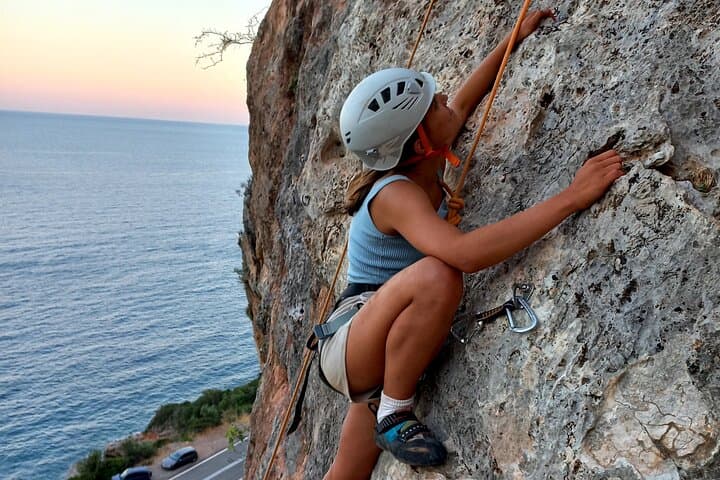
What the day feels like
Sun spills over the crimson limestone above Leonidio, and the cliffs wake like a living thing. The Aegean breathes from just down the road at Plaka, a salt-cool exhale that slips into the olive groves and narrow lanes of this Tsakonian town. Ropes whisper through belay devices. Chalk hangs in the air like a promise. Your instructor points to a pale seam that cuts up a sunlit face and grins—your line for the morning. The rock seems to nod in approval.
Leonidio sits three hours south of Athens on the Peloponnese’s deep southeastern edge, a town framed by steep red and gray walls that look painted by sunset even at noon. It’s one of Europe’s fastest-growing climbing hubs, with more than a thousand bolted routes fanning out across grades that welcome first-timers and keep experts honest. The stone here—hard, sculpted limestone—has a character you feel in your calves as much as your hands. Pockets and edges coax balance and precision, while rippled tufas ask you to trust your feet and lean into the rock’s rhythm. The cliff speaks; you answer, one move at a time.
Climbing in Leonidio isn’t just about vertical meters. This is Tsakonian country—the capital of a community with a distinct heritage and a rare descendant of the ancient Doric dialect still spoken by some locals. On Easter night, hundreds of handmade paper lanterns float skyward, carrying whispery flames past the cliffs into a dark that feels old and kind. In the streets, balconies bloom with bougainvillea, and bakeries sell braided koulourakia beside crates of the famed Tsakonian eggplant, a protected variety celebrated in summer festivals. The sea is always in the wings, nudging the town with salt and light.
Your session starts near the trailheads: dusty footpaths that rise from the village toward sectors with names that sound like characters—Mars, Twin Caves, Hot Rock, Sabaton. Approaches are short, usually five to twenty minutes, and the terrain trades between stone steps, goat tracks, and occasional scree. Limestone demands trust. It rewards careful feet and relaxed grip, and it punishes rushing. An instructor keeps the learning curve clean and safe: fitting gear, tying a rethreaded figure-eight, checking systems, and setting you on beginner-friendly lines where confidence grows from the ground up. The first stands are low-angle slabs with generous holds; the second route teases small pockets and asks for calm hips. Soon, the wall becomes a partner. It dares a high step, offers a hidden crimp, and quietly insists on breathing through it.
By late morning the cliffs warm, and the Aegean breeze stirs—especially in summer when the meltemi winds sweep the coast. Many sectors offer shade bands at different hours, so instructors will time your routes to chase cooler stone. Fall through spring brings crisp conditions and friction that makes you feel a little stronger than you are. Winter can be surprisingly good here, with sunny walls acting like radiant heaters, though rain showers sometimes pass through. Leonidio’s routes, bolted and maintained by a dedicated local and international community, are well protected; you clip solid hardware on lines thoughtfully set to flow with the rock’s features.
This is climbing with a view that won’t quit. Between burns, you lean back on your harness and—there it is—the blue glint of the Myrtoan Sea, the tight red canyon that squeezes the town, the white band of Elona Monastery clasped to the mountain like a swallow’s nest. The cliffs have presence. They push and encourage. When you find your balance, you move as the rock asks, and everything narrows to breath and footwork.
After lowering off, the day shifts from vertical to local. Plaka’s pebbled beach is five minutes away for a swim that resets the arms. The harbor’s tavernas serve grilled sardines, horta, and plates of melitzana prepared a dozen ways. In town, café tables collect climbers like magnets, route topos spread between freddo espressos, everyone comparing sectors and softening fingertips. There’s a rhythm to Leonidio that turns a single lesson into the start of an obsession—morning routes, seaside afternoons, village evenings.
What makes Leonidio unique isn’t just the density of high-quality limestone or the easy logistics—it’s the way mountain and sea co-author the experience. Few places let you climb world-class routes and then swim in clear, wind-bright water within the hour. Fewer still do it in a town that feels lived-in rather than packaged. You come for the climbing and stay because the place looks you in the eye.
Practicalities matter here. Bring a helmet; these cliffs are solid but wild, and instructors set the tone of safe habits early. Sun protection and plenty of water are essential, especially from May through September. Approach paths are rocky; sturdy approach shoes help. If you’re new to climbing, expect to learn belaying, movement basics, and how to read limestone’s subtle tells. If you have experience, your instructor can steer you to sectors that match your grade and style, from pocketed slabs to steep tufa jungles. Allow four hours for a lesson, including approach, warm-up, skills, and cool-down. And leave a little space afterward—Leonidio has a way of inviting a second session.
The best part? The cliffs will still be there tomorrow, waiting with the same steady challenge. In Leonidio, the rock doesn’t rush you. It guides, tests, and—if you listen—teaches.
Trail wisdom
Small choices, better day.
Chase the Shade
Ask your instructor to target north- or east-facing sectors in warmer months to keep friction and focus high.
Helmet On, Always
Limestone is solid but alpine; small pebbles can loosen. A helmet is standard practice for climbers and belayers.
Hydration Strategy
Carry at least 1.5–2 liters of water per person; refill in town before approaches—sources are limited at sectors.
Footwork First
On Leonidio’s limestone, quiet feet beat strong hands. Focus on edging and balance over pulling.
Local knowledge
Read the place, not just the route.
Watch for native species including Bearded vultures and hawks riding thermals, Goats navigating cliff bands.
Keep an eye out for wildlife during the transition between areas and habitats. Respect distance guidelines.
Stick to established paths to limit erosion, avoid brushing lichen on holds, and pack out all trash to protect sensitive Mediterranean flora.
Follow the guide's instructions on size limits, ethical handling, and leave-no-trace practices.
Elona Monastery viewpoint for dramatic cliff-and-sea panoramas. Evening swim at Plaka Beach’s northern end away from the harbor
Locally recommended viewpoints and quiet spots known best to local operators.
Leonidio is the cultural heart of Tsakonia, where the Tsakonian dialect—descended from ancient Doric—survives among locals.
Maritime roots and regional tradition shape the waterways and working coasts.
Seasonal guide
Four versions of the same landscape.
Spring
Best forCool temps and friction · Wildflowers on approaches
ChallengesUnsettled showers · Variable wind
March–May offers prime friction and colorful approaches. Pack a light layer for shade and breezy belays.
Summer
Best forEarly-morning sends · Post-climb swims
ChallengesMidday heat · Strong meltemi winds
Climb dawn and late afternoon, hit the beach midday. Prioritize shaded sectors, sun protection, and hydration.
Fall
Best forStable weather · All-day climbing windows
ChallengesPopular sectors can be busy · Shorter daylight late season
October–November is the sweet spot: crisp temps, reliable conditions, and lively climber energy in town.
Winter
Best forSunny-wall sessions · Quiet sectors
ChallengesCool mornings · Occasional rain
Choose south-facing sectors on clear days; conditions can be excellent with warm rock and empty routes.
Operator details
What the booking data adds.
Included
- ✓All Fees and Taxes
- ✓Use of climbing equipment
Good to know
- ✓Service animals allowed
- ✓Public transportation options are available nearby
- ✓Not recommended for travelers with spinal injuries
- ✓Not recommended for pregnant travelers
- ✓Not recommended for travelers with poor cardiovascular health
- ✓Suitable for all physical fitness levels
Pack with intention
What to bring.
Good to know
Common questions.
Yes. Instructors select beginner-friendly sectors and teach belaying, knots, safety checks, and basic movement.
Plan the edges
The details that make the day easier.
Leonidio hosts a unique Easter tradition where hundreds of handmade paper lanterns are released into the night sky—a Tsakonian custom dating back over a century.
After your session, head to Plaka for a swim, then try grilled sardines and Tsakonian eggplant at a seaside taverna. Back in town, sip a freddo espresso under bougainvillea and browse local produce stands—the sweet, striped Tsakonian eggplant is the star. If you visit around Easter, the lantern-lit sky is reason enough to linger after dinner.
- Closest airport
- Athens (ATH). Drive to Leonidio: ~3 hours via Corinth and Astros. Sector approaches: 5–20 minutes from town. Cell service: Generally good in town; spotty at cliff bases. Permits: None required for sport climbing; respect posted closures and local guidance.
These limestone cliffs are a community resource. Stay on established trails, minimize chalk use, keep noise down near villages and monasteries, and support route maintenance by donating to local climbing groups.
Explore by topic
Follow the threads.
Keep exploring
Make the story part of the trip.
Set out from Bass Harbor for a private, customizable day on Blue Hill Bay — lighthouses, puffins, seals, and the chance to feel Acadia from the water. Small groups, local captains, unforgettable views.
In four hours you can move from shaded canyon ferns to wind-scoured coastal ridgelines, guided by someone who knows where the light—and the hidden views—live. This private half-day hike on the Monterey Peninsula or Big Sur is compact, curated, and perfect for travelers who want depth without a multiday commitment.
 Related story
Beneath a sky of shifting light, Skaftafell’s ice reads like a map of time. This three-hour guided glacier hike mixes technical instruction with geology and culture: compact, safe, and unforgettable.