
What the day feels like
Anchorage wears winter like a secret it’s proud to share—the kind you only learn by stepping out into the quiet, when the sun hovers low and the cold breathes down the inlet. The day begins with a hush: a quick briefing, a check of batteries and hand warmers, and then the van noses south along Turnagain Arm. Outside, the Chugach Mountains hold their shoulders against the sky, charging the horizon with stark geometry. The tide slides in, slow but determined, pushing plates of pancake ice together until they chatter like glass. Winter here has a voice, and it isn’t shy.
This is the Anchorage Winter Wonderland Photo Tour, a half-day roam guided by Alaska Photo Treks through the city’s wild backyard, where pullouts double as front-row seats to a season that leans into light and shadow. The route shifts with conditions, but the promise stays the same: 4–5 locations, each with a different personality—frosted birch woods in Chugach State Park, blue-iced falls tucked into shady gullies, mountain amphitheaters where wind sculpts snow into delicate ridgelines, and the wide, moody stage of Cook Inlet’s coast. If the clouds part near sunset, the Arm tilts toward copper and rose, and the mountains glow as if lit from within.
Anchorage is a city that turns outdoors for its best angles. The tour capitalizes on that, keeping drives short and walks modest so the camera time is long. You might start near Potter Marsh, the boardwalk resting under a white duvet, bald eagles shouldering the wind over the flats. Or slip into a boreal pocket where birch and spruce stand rimmed in hoarfrost, each branch etched like a line drawing. Snow dampens sound, and the forest obliges, posing, waiting. Then the day pivots—the highway ribbons along the cliffs, and the Arm widens. Here, the tide makes the rules. It rushes in with a bore that dares paddlers in summer and sculpts photographic foregrounds in winter, its 30–40-foot range one of the largest in North America. The current huffs against the cold, and mist lifts, giving you layers to work with: mountains, inlet, ice, sky.
This isn’t just a point-and-shoot affair. Guides offer practical instruction as you go: how to expose for snow so it reads white, not gray; how to warm your hands without freezing your focus ring; when to ditch the polarizer before the sun dips too low. Winter light in Anchorage is generous to photographers—golden hour stretches across the afternoon, and shadows grow long enough to tell their own stories. Even a smartphone becomes a capable partner when you’re coaxed into tapping exposure compensation, bracing against a guardrail, letting the scene breathe.
The land itself has a way of setting context. These mountains—steep, fast to rise, closer to the sea than seems sensible—owe their drama to a geologic mash-up. The Chugach are a collage of ancient oceanic rocks lifted and shoved together by plate tectonics, the same restless forces that powered the 1964 Good Friday earthquake. Along this very corridor you’ll find framed views of Earthquake Park, where the land slumped and split; it’s a sobering lesson in the valley’s resilience and a reminder that the terrain, beautiful as it is, has teeth.
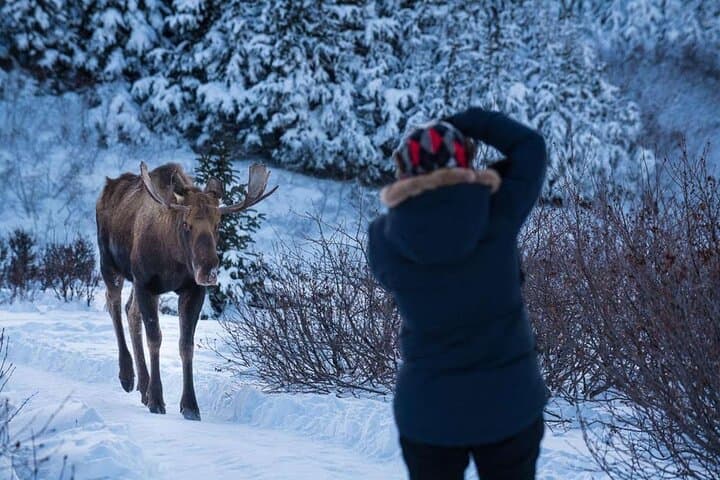
Wildlife doesn’t punch a clock, but winter simplifies the odds. Moose work the willows along the edges of town, heavy-limbed and unbothered. Dall sheep step down snow-choked gullies near Beluga Point, their coats almost indistinguishable from the slopes. Overhead, ravens edit the day’s news; out on the flats, eagles draft the wind. Your guide will emphasize distance and respect—these are not characters in your composition but neighbors with their own agendas.
If Anchorage is the base camp, the true stage is Chugach State Park, which sprawls over nearly half a million acres right outside the city. In winter, it swaps summer’s blues and greens for a restrained palette: white in a dozen textures, sky that can swing from slate to crystal, and water that skims into ice. One stop might reveal an icefall, a curtain of frozen motion that hums in the cold. Another, a pullout with scope—a place to shoot wide, to give the mountains room to breathe. The tour stitches these together with an eye for variety, not just views.
The utility of the day is its practicality. You don’t need to be a pro or haul a suitcase of lenses. You need traction on your boots, batteries kept warm in an inside pocket, and a willingness to let winter set the pace. The van offers heat between stops; the guide offers technical nudges and local context; the light does its thing. And that’s the quiet joy here: the way Anchorage’s everyday wild becomes legible, teachable, shared.
By the time the sun bows out—with a last slate-blue wash over the Arm or a surprise burst of amber—you’ll have a card full of proof: snow that reads sharp and bright, trees wearing crystal, ice that catches the sky. You’ll also have the know-how to carry into the rest of your Alaska trip: how to chase angles without chasing your tail, how to meter for winter, how to work with the weather rather than against it. The mountains don’t care if you got the shot. But they stand ready, shoulders squared, daring you to try again tomorrow.
Trail wisdom
Small choices, better day.
Overexpose the Snow (+0.7 to +1.3 EV)
Dial in positive exposure compensation so snow looks clean and white instead of dull gray.
Keep Batteries Warm
Store spares in an inner pocket; cold temps drain power fast. Rotate batteries between stops.
Use Traction on Foot
Microspikes or lugged soles make short, icy walks safer at pullouts and trailheads.
Mind the Tide and Tracks
Stay off the mudflats and keep distance from wildlife; both can be hazardous in winter.
Local knowledge
Read the place, not just the route.
Watch for native species including Moose, Bald eagles.
Keep an eye out for wildlife during the transition between areas and habitats. Respect distance guidelines.
Chugach State Park protects a vast, sensitive subarctic ecosystem. Stay on durable surfaces, pack out all trash, and give wildlife ample space year-round.
Follow the guide's instructions on size limits, ethical handling, and leave-no-trace practices.
Potter Marsh overlook for eagle activity and low-angle light. Earthquake Park bluff for wide Cook Inlet vistas and 1964 quake history
Locally recommended viewpoints and quiet spots known best to local operators.
Anchorage’s coastline still bears marks of the 1964 Good Friday earthquake, one of the most powerful on record, which reshaped parts of Turnagain Arm and the city’s bluffs.
Maritime roots and regional tradition shape the waterways and working coasts.
Seasonal guide
Four versions of the same landscape.
Spring
Best forHoarfrost mornings · Longer daylight
ChallengesBreakup ice and slick trails · Variable weather
Late March–May brings thawing days with lingering snow in shaded valleys. Expect mixed footing and dramatic freeze–thaw textures.
Summer
Best forExtended golden hours · Wildlife spotting along Turnagain Arm
ChallengesGlare and haze · Crowds at popular pullouts
While this tour focuses on winter, summer delivers vast views and more forgiving temps if you return for warm-season shooting.
Fall
Best forBirch gold foliage · First snow on peaks
ChallengesShortening days · Sudden storms
September–October paints the hillsides yellow and rolls out moody skies, a strong shoulder-season for landscape photographers.
Winter
Best forSnow textures and icefalls · Low, cinematic light
ChallengesCold batteries · Icy footing and wind along the Arm
December–February is prime for crisp air, pastel sunsets, and snow-blanketed scenes—the sweet spot for this photo tour.
Operator details
What the booking data adds.
Included
- ✓Tripods for smartphones and DSLR cameras
- ✓Snacks
- ✓Hotel pick up and drop off (if option selected)
- ✓Creative and technical photography instruction and support
- ✓Professional photographer guide
- ✓Natural history narrative en route
- ✓Coffee and/or Tea
Not included
- —Cameras
- —Gratuities
Good to know
- ✓Service animals allowed
- ✓Public transportation options are available nearby
- ✓Infants are required to sit on an adult’s lap
- ✓Not recommended for travelers with poor cardiovascular health
- ✓Suitable for all physical fitness levels
- ✓Not recommended for children under the age of 12
- ✓Not recommended for travelers with severe mobility limitations
Pack with intention
What to bring.
Good to know
Common questions.
No. The tour welcomes beginners to advanced shooters, with tailored instruction for smartphones and interchangeable-lens cameras.
Plan the edges
The details that make the day easier.
Turnagain Arm experiences one of the largest tidal ranges in North America—up to 40 feet—occasionally producing a surfable bore tide.
Warm up post-shoot at 49th State Brewing with halibut tacos and a local IPA, or grab a hearty bowl at Glacier Brewhouse. For breakfast the next day, Snow City Cafe is an Anchorage standby. If you’re still chasing views, the Tony Knowles Coastal Trail offers an easy stroll with big-sky vistas.
- Closest airport
- Ted Stevens Anchorage International (ANC). Typical meet-up: central Anchorage; most stops are 15–45 minutes’ drive. Cell service is good in town and spotty along Turnagain Arm. No permits needed for participants on a guided tour; parking fees, if any, are typically handled by the operator.
Turnagain Arm’s mudflats and coastal habitats are fragile and hazardous—stay off the flats, pack out everything, and give wildlife the right-of-way. Keep a respectful distance and follow your guide’s Leave No Trace guidance.
Explore by topic
Follow the threads.
Keep exploring
Make the story part of the trip.
In four hours you can move from shaded canyon ferns to wind-scoured coastal ridgelines, guided by someone who knows where the light—and the hidden views—live. This private half-day hike on the Monterey Peninsula or Big Sur is compact, curated, and perfect for travelers who want depth without a multiday commitment.
 Related story
Beneath a sky of shifting light, Skaftafell’s ice reads like a map of time. This three-hour guided glacier hike mixes technical instruction with geology and culture: compact, safe, and unforgettable.
 Related story
Lose the city for a few hours without leaving it: this 5-mile, 900-foot-gain Forest Park loop threads old-growth pockets, city viewpoints, and cultural landmarks for a compact taste of Portland’s wild side. Expect moss, roots, and stories.