
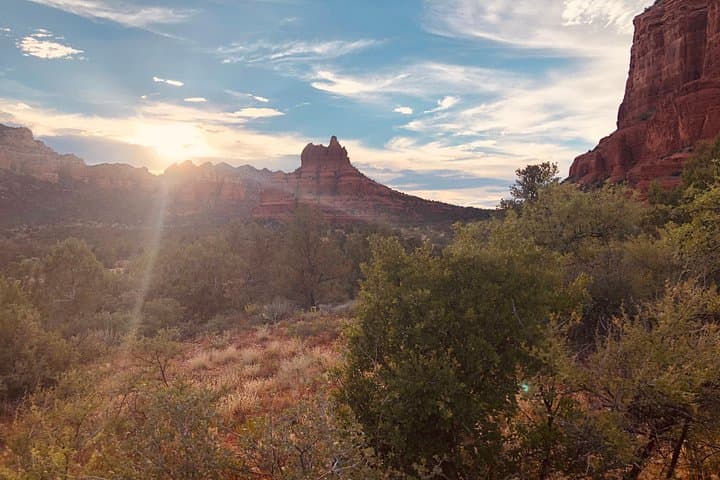
What the day feels like
The sandstone glows long before the sun calls it a day. Junipers twist like old storytellers beside the trail, their branches pointing toward a sky sliding from cobalt to tangerine. The rock underfoot keeps the afternoon’s heat, radiating through your soles while a cool desert breeze tugs at sleeves and whispers across the slickrock. As the guide leads the small group onto a wide shoulder of stone—the kind of perch that makes you breathe deeper—the buttes of Sedona seem to inhale with you. Shadows pour down the gullies. Cathedral spires sharpen. The air feels charged, as if the landscape is leaning in, curious about the people it’s about to meet.
This is the rhythm of a Sedona Sunset Vortex Tour: a slow ascent, some quiet reflection, and a show of light that feels personal. The path isn’t long or punishing; it’s a deliberate approach to the edge of evening. Depending on the guide’s plan and the night’s conditions, you may climb a slickrock dome near Bell Rock, walk a short ridge at Airport Mesa, or tuck into a knoll with a view of Cathedral Rock. Each spot holds its own reputation in Sedona’s storied vortex lore—places where many visitors say they sense an energy that calms or invigorates. Whether you believe in the metaphysical or not, the landscape does its part: wind slips along the stone with purpose, ravens ride the thermals like they wrote the rules, and the horizon opens wide enough to rearrange thoughts.
Geology sets the stage. Sedona’s red rock country is a layered mural of time, primarily the Schnebly Hill Formation—a rust-colored sandstone stained by iron oxide. Lifted by forces along the Mogollon Rim and carved by eons of water and wind, the city’s iconic buttes, spires, and mesas stand like monuments to patient change. Walk a hundred yards here and you move through millions of years, each ledge and wash a note in a slow, exacting symphony. The rock remembers the ocean that once drowned this desert, the rivers that braided through it, the uplift that tilted its tables to the sun.
Human history runs deep, too. The Sinagua people farmed and traded in the greater Verde Valley around 600–1400 CE, leaving cliff dwellings and rock art that still rest in nearby alcoves and museums. Yavapai and Apache communities have ties here that remain strong, and many guides emphasize respectful presence—no straying onto fragile crusts, no building cairns, no treating sacred landscapes like props. The modern vortex narrative pulsed into popularity in the 1980s and blended into Sedona’s identity, drawing travelers who come for meditation, yoga, and a different kind of summit: the one inside.
As the sun tips toward the Black Hills to the west, the guide might cue a short breathing practice—steady inhale, steadier exhale—so you meet the moment as the color turns syrup-thick. Juniper bark releases a clean, resinous scent. The last light hits Cathedral’s sandstone and it burns copper, then rose, then finally the quiet ember of twilight. The desert does what the desert always does: the air cools, the ground exhales its stored warmth, and the first planets blink awake. The view is the headline, but the descent in twilight becomes its own chapter, headlamps clicking on, steps sure and unhurried as the trail unwinds back toward the road.
The utility of a guided sunset tour in Sedona is simple. Timing is everything—and so is local knowledge. Many of the best vantage points require arriving 60–90 minutes before sunset to secure space, which also means navigating the area’s busy trailheads, variable parking rules, and intermittent cell service. A good guide reads weather and crowd patterns, pivots if monsoon storms build in summer, and chooses terrain that matches the group. The walking is typically 1–3 miles round-trip with modest elevation gain, but slickrock requires attentive footwork. Grippy shoes matter. So does layering; hot afternoons can give way to breezy, 50-degree evenings without warning, especially in shoulder seasons.
If your interest leans more spiritual than strenuous, that’s welcome here. Guides often incorporate simple grounding techniques, quiet moments, and time to journal or sit. If your priority is photography, the slickrock becomes a stable shooting platform, with sightlines to Sedona’s signature formations. If you just want an hour where the day’s noise drops out and the desert speaks, Sedona has a way of giving you that.
Spring and fall are the sweet spots: warm days, cool evenings, clear air. Summer seduces with long golden hours but bites with heat; monsoon season (typically July–September) can deliver powerful late-day storms and lightning—beautiful from afar, dangerous up close. Winter keeps crowds modest and the air razor-sharp; a dusting of snow on red rock can make a sunset feel otherworldly, but trails can ice up in shaded spots and daylight is short. Across seasons, one constant remains: the red rock is a generous companion if you treat it with care.
Practical notes come with the terrain. Hydration is non-negotiable, even for short walks. Plan at least one liter per person and add more in summer. Expect mixed footing: sections of dirt, rock steps, and broad, slanted slickrock that can feel like a tilted patio. Trekking poles aren’t mandatory, but many hikers appreciate them on the descent in low light. As for the vortex? The desert will decide how it speaks to you. For some, it’s a quiet pulse in the ribs; for others, it’s simply the kindness of a guide waiting at each bend, the laugh of a stranger becoming a friend, or the evening wind that seems to nudge everyone toward the same, open silence.
Sedona doesn’t promise epiphanies. It delivers edges, light, and space—the raw materials for whatever you’re seeking. When the last color drains and the rock cools to the touch, the walk out feels different, like the trail has shifted a half-inch to the left. It hasn’t. You have. Back at the trailhead, you’ll brush dust from your shoes and look once more at the darkening silhouettes. The buttes don’t perform anymore; they stand watch. Tomorrow they’ll do it again, steady and unbothered, waiting for the next traveler to show up with a pocket of questions and a willingness to listen.
Trail wisdom
Small choices, better day.
Arrive Early for Space
Plan to reach the viewpoint 60–90 minutes before sunset to secure a comfortable perch and watch the full color arc.
Footwork Matters on Slickrock
Wear shoes with real traction; sandstone slabs can be slanted and sandy, especially on the descent in twilight.
Watch the Weather
In monsoon season, afternoon storms build fast—lightning means immediate retreat from exposed viewpoints.
Pack a Small Headlamp
Sunsets end in darkness. A lightweight headlamp keeps hands free and steps confident on the hike out.
Local knowledge
Read the place, not just the route.
Watch for native species including Common raven, Mule deer.
Keep an eye out for wildlife during the transition between areas and habitats. Respect distance guidelines.
Cryptobiotic soils and desert varnish are easily damaged—stay on durable rock and established trails, leave no trace, and avoid building cairns.
Follow the guide's instructions on size limits, ethical handling, and leave-no-trace practices.
Doe Mountain’s mesa rim for broad, less crowded sunset panoramas. Baby Bell knoll near Bell Rock for quick access and big views
Locally recommended viewpoints and quiet spots known best to local operators.
The greater Verde Valley holds archaeological sites from the Sinagua culture (ca. 600–1400 CE), while contemporary Yavapai and Apache communities maintain enduring connections to the land.
Maritime roots and regional tradition shape the waterways and working coasts.
Seasonal guide
Four versions of the same landscape.
Spring
Best forMild temps · Wildflowers · Clear air
ChallengesGusty winds · Busy trailheads
Expect pleasant afternoons and cool evenings; arrive early to beat crowds and bring a light layer.
Summer
Best forLong golden hours · Vivid skies
ChallengesHigh heat · Monsoon lightning · Dehydration risk
Start later, hydrate aggressively, and be ready to pivot if storms build after 3 p.m.
Fall
Best forStable weather · Crisp sunsets · Fewer storms
ChallengesCool nights · Popular weekends
A prime season for color and comfort; pack a warmer layer and consider weekday tours.
Winter
Best forLow crowds · Crystal-clear air
ChallengesShort daylight · Icy patches in shade
Expect chilly evenings and occasional ice on north-facing trails; traction and headlamps help.
Operator details
What the booking data adds.
Included
- ✓Water bottles, home-made gluten-free cookies, chocolates and tea.
Good to know
- ✓Service animals allowed
- ✓Suitable for all physical fitness levels
Pack with intention
What to bring.
Good to know
Common questions.
Most routes are 1–3 miles round-trip with modest elevation gain on rocky terrain. Expect uneven footing and short, slanted slickrock sections.
Plan the edges
The details that make the day easier.
Sedona was designated an International Dark Sky Community in 2014, making its post-sunset stargazing especially vivid on clear nights.
Toast the evening at Sedona Beer Co. with a local pint, then head to Elote Café for modern Southwestern staples (call ahead—waits can be long). For a relaxed morning-after, grab a cold brew and breakfast burrito at Local Juicery and wander the galleries at Tlaquepaque Arts & Shopping Village.
- Closest airports
- Phoenix Sky Harbor (PHX, ~2 hours) and Flagstaff Pulliam (FLG, ~45 minutes). Many sunset viewpoints are 10–25 minutes from central Sedona by car. Cell service is decent in town but spotty on trails. If you drive independently, a Red Rock Pass is required at many trailheads; guided tours may handle access—confirm when booking.
Sedona’s desert crust and vegetation are fragile—stick to rock and established paths, pack out all trash, and skip stacking rocks. Nighttime wildlife is active after sunset; keep voices low and lights pointed down.
Explore by topic
Follow the threads.
Keep exploring
Make the story part of the trip.
Set out from Bass Harbor for a private, customizable day on Blue Hill Bay — lighthouses, puffins, seals, and the chance to feel Acadia from the water. Small groups, local captains, unforgettable views.
In four hours you can move from shaded canyon ferns to wind-scoured coastal ridgelines, guided by someone who knows where the light—and the hidden views—live. This private half-day hike on the Monterey Peninsula or Big Sur is compact, curated, and perfect for travelers who want depth without a multiday commitment.
 Related story
Beneath a sky of shifting light, Skaftafell’s ice reads like a map of time. This three-hour guided glacier hike mixes technical instruction with geology and culture: compact, safe, and unforgettable.