
What the day feels like
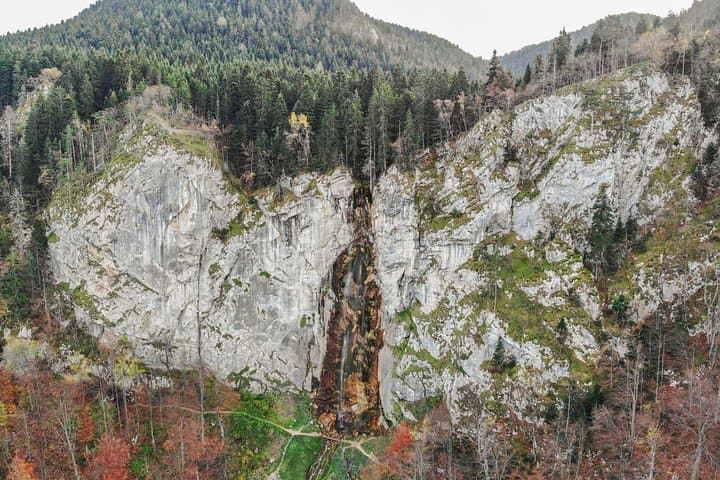
The first time you hear Skakavac you’ll feel it before you see it — a low, constant roar that threads through the pines and gathers itself into a vertical punctuation mark. The path from the trailhead slips immediately into shade: beech and fir lean over the track like quiet companions, their needles sighing as you move. For five kilometers the trail drops gently, a steady, easy rhythm, and the forest opens in a sudden, clean break to reveal the waterfall: a raw sheet of water falling 98 meters, silver against the green. Mist ghosts across your face, and a picnic lunch arranged on the rocks tastes like something earned.
There’s a clarity to Skakavac that feels almost deliberate. Geologically it’s a product of the Dinaric karst — the limestone backbone of Bosnia and Herzegovina — where water finds weakness and exploits it, carving vertical channels and leaving sharp cliffs. Skakavac sits where a mountain stream finds a lip and loses its patience, dropping through a narrow gorge to the valley below. The cascade is the tallest in the country, and its voice has long been a landmark for communities around Sarajevo.
The waterfall is also stitched into local memory. The slopes above Skakavac were traditional grazing lands and seasonal paths between villages; later, as Sarajevo grew, the waterfall became a weekend refuge for city dwellers. Today it’s part of a protected natural area, where conservation efforts try to balance access with the fragility of the riparian ecosystems. You’ll pass small signs of human history en route — shepherd’s cairns, a worn footbridge — reminders that this landscape has been lived in, not just observed.
Culturally, a day trip here folds neatly into a Sarajevo itinerary. The city’s Ottoman and Austro-Hungarian layers — cobbled bazaars, narrow coffeehouses, ćevapi stands — sit just 20–30 minutes away by car. That proximity is part of Skakavac’s appeal: it’s wild enough to feel remote, but close enough for a late lunch back in town and a beer in the old quarter. Locals still come for the waterfall’s cooling spray in summer and for the rugged vantage points in shoulder seasons.
The route on this escorted day tour is practical and purposeful. From the start you cover roughly 5 kilometers of mostly downhill trail to the main viewpoint — easy underfoot but with some wet, mossy sections — then enjoy your picnic with the waterfall in view. After that the group climbs a different trail about 3 kilometers long, which works a different set of muscles and rewards you with a top-side perspective of the fall before a final 2 kilometers of flat gravel returns you to the starting point. Total distance hovers around 10 kilometers with net elevation changes that are moderate; guide teams peg the total outing at 4–7 hours depending on group pace and photo stops.
On the practical side: footwear matters more than ultra-expensive kit. Sturdy hiking shoes with good tread will get you through muddy patches and the wet rocks at the viewing ledges. Trekking poles help on the steeper pull uphill and ease a creaky knee on the descent. Hydration is non-negotiable — carry at least 1.5–2 liters — and layers are essential because the microclimate near the waterfall is perceptibly colder than Sarajevo. This is a day hike with a picnic included, so expect a moderate level of exertion and a generous amount of time to pause and breathe.
Timing the day is part comfort and part strategy. Spring and early summer bring the fullest flow, the waterfall at its most dramatic from snowmelt. Late afternoon light softens the cliffs into warmer tones but can also cool you quickly in the spray. Weekends are busier; if you want quiet, aim for a weekday morning. Guides on the organized tours know the best viewing angles and the safest spots for a picnic, and they handle logistics you’d rather not: parking, a shaded lunch site, and the return route that avoids the slipperiest sections.
For photographers there are rewards and limits. The main viewpoint gives you a full-frame composition of the fall; the top-side trail gives scale and context. Fast shutter speeds freeze the crystalline vertical motion; slow exposures — with an ND filter — smooth the flow into silk, but you’ll need a tripod and some creativity to find stable ground in the spray zone. Respect roped-off areas: the rocks look inviting but can be treacherous.
If you’re planning this trip: go light, go prepared, and leave nothing behind. Pack a waterproof layer that breathes, a snack beyond the picnic if you’re especially hungry, and a small trash bag. The area is cared for by local conservation groups; sticking to the trail and packing out trash are more than manners, they’re part of keeping Skakavac as it should be: loud, natural, and honest.
In short, Skakavac is an excursion that rewards as much as it demands. It’s a day that lets you trade Sarajevo’s urban textures for the blunt simplicity of falling water and the smell of damp rock. And if you time it right, you’ll finish the hike with a clean, physical tiredness and a sense that you’ve stepped into a place where the landscape still has something to teach you.
Trail wisdom
Small choices, better day.
Sturdy footwear
Traction matters—choose hiking shoes or boots with good grip for wet rocks and mud
Bring a rain shell
Mist from the falls and unexpected showers can chill you quickly; a waterproof breathable jacket keeps you comfortable
Use trekking poles
Poles stabilize descents and help on the 3 km uphill return trail
Pack out all trash
Picnic waste attracts wildlife and degrades views—carry a small bag to take your rubbish with you
Local knowledge
Read the place, not just the route.
Watch for native species including Roe deer, Red fox.
Keep an eye out for wildlife during the transition between areas and habitats. Respect distance guidelines.
Visitors are asked to stick to marked trails, pack out all trash, and avoid disturbing stream and shoreline habitats to protect the fragile mosses and invertebrates that live here.
Follow the guide's instructions on size limits, ethical handling, and leave-no-trace practices.
Top-side viewpoint trail for a different angle on the falls. A small meadow downstream where locals picnic and swim in warm months
Locally recommended viewpoints and quiet spots known best to local operators.
The Skakavac area has long been used as seasonal grazing land and local pathways; more recently it has been protected as a nature area to preserve its riparian forests and biodiversity.
Maritime roots and regional tradition shape the waterways and working coasts.
Seasonal guide
Four versions of the same landscape.
Spring
Best forPeak water flow · Wildflowers · Cool hiking temperatures
ChallengesMud on trails · Cold spray near the falls
Spring snowmelt brings Skakavac to full voice; trails can be muddy but the falls are most dramatic.
Summer
Best forRefreshing cool-off · Long daylight hours
ChallengesCrowds on weekends · Warmer valley temperatures
Summer offers pleasant hiking temps and a cooling mist at the falls, but expect more visitors.
Fall
Best forAutumn color · Crisp air · Fewer crowds
ChallengesEarlier darkness · Variable water levels
Fall color adds warmth to the cliffs; water flow drops but the landscape is quieter.
Winter
Best forIcy scenery · Dramatic frozen sections
ChallengesSnow/ice on trails · Access can be limited
Winter creates dramatic ice formations but increases difficulty—bring crampons and check access.
Pack with intention
What to bring.
Good to know
Common questions.
Expect roughly 10 km total: about 5 km to the main viewpoint, 3 km uphill on the return trail for a top view, and 2 km of flat gravel back to the start.
Plan the edges
The details that make the day easier.
Skakavac is the tallest waterfall in Bosnia and Herzegovina, with a vertical drop of approximately 98 meters.
After the hike head back to Sarajevo’s Baščaršija for ćevapi and Bosnian coffee; the old town’s narrow alleys and market stalls make a satisfying contrast to the day’s forest quiet.
- Closest airport
- Sarajevo International Airport (SJJ); Trailhead driving distance: ~20–30 minutes from central Sarajevo; Cell service: patchy near the falls; Permits: none for day visits—organized tours handle access.
Skakavac lies within a protected natural area—pack out all trash, avoid stepping on moss and fragile vegetation, and follow marked trails to reduce erosion and habitat disturbance.
Explore by topic
Follow the threads.
Keep exploring
Make the story part of the trip.
 Related story
Less than two hours from Nairobi, Kereita Forest pairs hands-on canopy adventure with quiet montane trails and a sobering colonial history—perfect for families, teams, and curious travelers seeking a full-day pulse of nature.
Set out from Bass Harbor for a private, customizable day on Blue Hill Bay — lighthouses, puffins, seals, and the chance to feel Acadia from the water. Small groups, local captains, unforgettable views.
In four hours you can move from shaded canyon ferns to wind-scoured coastal ridgelines, guided by someone who knows where the light—and the hidden views—live. This private half-day hike on the Monterey Peninsula or Big Sur is compact, curated, and perfect for travelers who want depth without a multiday commitment.