
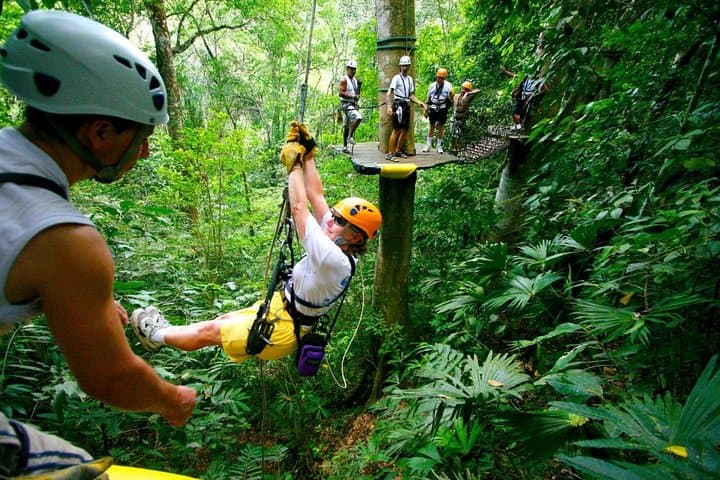
What the day feels like
You step off the platform with a breath held halfway between nerves and grin. Below, the rainforest is a layered green ocean; above, the next platform is a small knot of wood and rope tied to the world. The first cable hums as your harness takes the load and you give a controlled push. For a few heartbeats the canopy takes your weight and the Caribbean wind threads your face. The zipline here is not a gimmick — it is an invitation to read the forest from the treetops: howler monkeys announcing territory, bromeliads holding micro-rainforests in their cups, the canopy a mosaic of sunlight and shade. Later, the boat slips into the black-green ribbon of the Tortuguero canals, and the rainforest alters its mood entirely. The trees lean over water; the calls are softer; a caiman slips like a found shadow. The two halves of this tour — the adrenaline of heights and the hush of waterways — fold together into a single day that tells you more about Costa Rica's Caribbean coast than either could alone.
This is a coastal rainforest of contrasts. The zipline circuit you move through has 11 cables and 9 platforms, with heights up to 80 meters and cable lengths reaching 270 meters. It is engineered for thrill and sightlines: long pendulum runs that give you speed, shorter connectors that let you listen to birds, and certified guides who clip you in and narrate the forest. After the last landing, there is a short transfer to the canals, where a covered boat and a naturalist guide push silently through a braided network of waterways carved by rivers, tides, and time. The canals are a living library of wildlife — monkeys, sloths, iguanas, caimans, and toucans appear like footnotes to the landscape the guide reads from.
Tortuguero itself holds cultural and environmental history. The park was designated to protect the critically important nesting beaches for sea turtles, especially green turtles and leatherbacks. The human story here is a coastal meld of Afro-Caribbean communities, indigenous influences, and smallholder fishermen whose lives are tied to the tides and rivers. Geologically, the region is young: Caribbean lowlands built from riverine sediments and the slow push of coastal processes, which together create the labyrinth of channels you traverse on the boat segment.
Practicalities are straightforward, and that’s part of the appeal. This experience runs 4 to 5 hours and is priced from approximately 142 USD per person. It is built for mixed groups — first-time zippers and people who want wildlife without overnight travel can comfortably fit it into a single day. Guides are certified, helmets and harnesses are included, and the boat is covered and equipped with life jackets. Because the route threads protected habitat, the guides are also naturalists who point out behavior and help you read the ecological cues that matter for spotting animals.
When to go depends on what you want. The dry months between December and April make the zipline more pleasant and the forest less sodden; if you want nesting turtles, plan for the peak months of July to October. Even in the wet season, canals are productive for wildlife; the forest grows denser and insects increase, but so do the chances of seeing lush breeding activity and newborn birds.
If you are packing for the day, think layers and function. A light rain jacket will keep an unexpected shower from turning the zipline platforms slick. Closed-toe shoes with decent tread will see you through muddy boardwalks and platform ladders. Bring insect repellent and a lightweight daypack with water, a small snack, and your camera or binoculars. On the water, the guide’s knowledge is the real gear: listen, stay low, and let the boathold stillness work for you.
Safety and sustainability are part of the promise. Zipline operators maintain industry-standard harnesses and belay systems; guides train clients in simple protocols that keep lines clear and landings controlled. On canals, strict rules protect nesting and riverine animals: keep noise low, avoid flash photography when birds or turtles are present, and follow the guide’s suggestions for where to look and where not to disturb. Many operators in the area also funnel revenue back into local conservation and community education, so your participation helps the place you’re enjoying.
Expect moments of contrast. One minute you are a silhouette against an open sky, the next you are craning your neck to catch a sloth mid-chew while the boat skims lily pads. That alternation is what makes the combo so satisfying. The zipline is a conversation with gravity and forest structure; the canals are a study in patient observation. Together they craft a coherent sense of place: this is a wet, fertile corner of Costa Rica where the canopy carries legends and the water keeps the old rhythms.
For travelers who want a dense, efficient taste of the Caribbean rainforest, this is a practical and emotional fit. It delivers measurable thrills without excess exposure, and it rewards calm attention with wildlife encounters and local stories. Whether you are a first-time visitor to the region or a seasoned traveler looking to combine time in the air with slow waterborne observation, the zipline-plus-canal day is a tidy, memorable way to see why Tortuguero still matters to both biologists and curious travelers.
Trail wisdom
Small choices, better day.
Hydrate before you go
Bring at least 1 liter of water; the zipline run and humid canals dehydrate faster than you think.
Wear closed-toe shoes
Sturdy sneakers or trail shoes protect your feet on platforms, ladders, and muddy boardwalks.
Bring insect protection
Apply DEET or picaridin before the boat trip; mosquitoes are more active near water and in the evening.
Keep noise low on canals
Quiet observation increases wildlife sightings and reduces stress to animals.
Local knowledge
Read the place, not just the route.
Watch for native species including Three-toed sloth, Green sea turtles (seasonal sightings on nearby nesting beaches).
Keep an eye out for wildlife during the transition between areas and habitats. Respect distance guidelines.
Operators follow strict wildlife viewing protocols and many contribute to community education programs; visitors should avoid flash photography, stay on-board or on marked trails, and pack out trash.
Follow the guide's instructions on size limits, ethical handling, and leave-no-trace practices.
Early-morning canal runs that catch activity when birds are most vocal. Small community-run eateries in Limón serving Caribbean-style rice and beans with fresh fish
Locally recommended viewpoints and quiet spots known best to local operators.
Tortuguero National Park was established to protect critical sea turtle nesting beaches and coastal rainforest habitat, formalizing conservation efforts that began with local stewardship of turtles.
Maritime roots and regional tradition shape the waterways and working coasts.
Seasonal guide
Four versions of the same landscape.
Spring
Best forDry trails for the zipline · Early migratory birds
ChallengesOccasional afternoon showers as the green season approaches
March to May offers a balance of drier conditions for ziplines with increasing biological activity as rains return.
Summer
Best forLush rainforest foliage · Active insects and amphibians
ChallengesMore rain and muddy boardwalks · Higher mosquito activity
June to August is wetter and greener; wildlife can be abundant but expect short, heavy showers.
Fall
Best forPeak turtle nesting on nearby beaches · Fewer tourists during shoulder months
ChallengesHeavy rains and stronger river flows · Some boat routes change with tides
September to November brings peak nesting for certain turtle species and intense rainforest growth; accessibility can be weather-dependent.
Winter
Best forClearer skies and drier zipline runs · Easier travel logistics
ChallengesHigher tourist volume in December holidays
December to February is the drier season and often the most pleasant for combining ziplines and canal tours.
Operator details
What the booking data adds.
Included
- ✓Fresh Fruits
- ✓WiFi on board
- ✓Bottled water
- ✓Entrance fee to Zipline and Boat tour in Tortuguero Canal
- ✓Air-conditioned vehicle
- ✓Port pickup and drop-off
- ✓Bilingual tour guide
Not included
- —Food and drinks
- —Tips (optional)
Good to know
- ✓Suitable for all physical fitness levels
- ✓At time of booking, Cruise ship passengers must provide the following information at time of booking: ship name, docking time, disembarkation time and re-boarding time
Pack with intention
What to bring.
Good to know
Common questions.
The excursion lasts about 4 to 5 hours and combines an 11-cable zipline circuit with a guided boat ride through the Tortuguero canals; safety gear, a certified guide, and life jackets are included.
Plan the edges
The details that make the day easier.
Tortuguero National Park is one of the most important nesting sites in the Western Hemisphere for green sea turtles and also hosts leatherback nesting at certain times of year.
After the tour, head to Limón for Caribbean-influenced cuisine: try rondón or rice and beans with fresh fish, and look for local sodas serving fruit juices; small bars and cafes in town offer relaxed seafood plates and the chance to hear live calypso or salsa.
- Closest major airport
- Juan Santamaría Intl (SJO) in San José; Typical transfer: 3.5–4.5 hours to the Tortuguero region depending on route; Driving distance from Limón to tour centers: 30–90 minutes; Cell service: Patchy on canals, reliable in towns; Permits
- fees
- Park fees sometimes included, confirm with operator
This tour operates in protected rainforest and canal systems; follow guide instructions, avoid disturbing wildlife, pack out any trash, and consider operators that invest in local conservation and community programs.
Explore by topic
Follow the threads.
Keep exploring
Make the story part of the trip.
In four hours you can move from shaded canyon ferns to wind-scoured coastal ridgelines, guided by someone who knows where the light—and the hidden views—live. This private half-day hike on the Monterey Peninsula or Big Sur is compact, curated, and perfect for travelers who want depth without a multiday commitment.
 Related story
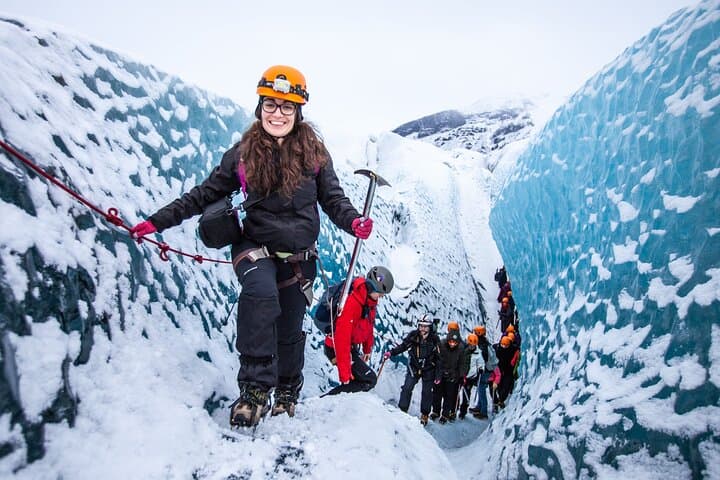
Beneath a sky of shifting light, Skaftafell’s ice reads like a map of time. This three-hour guided glacier hike mixes technical instruction with geology and culture: compact, safe, and unforgettable.
 Related story
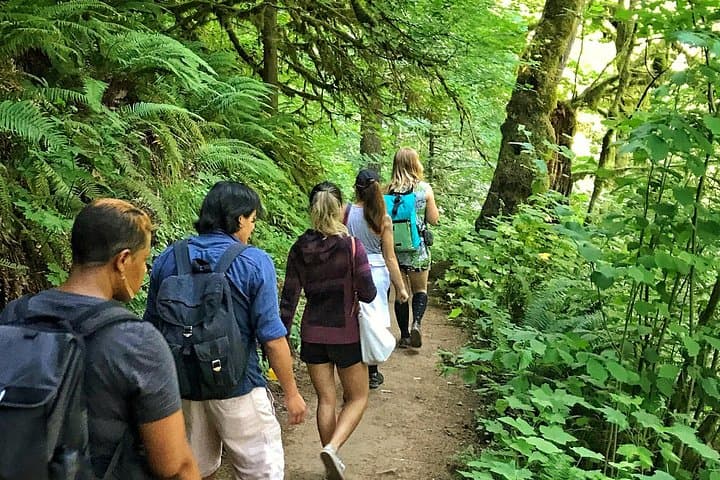
Lose the city for a few hours without leaving it: this 5-mile, 900-foot-gain Forest Park loop threads old-growth pockets, city viewpoints, and cultural landmarks for a compact taste of Portland’s wild side. Expect moss, roots, and stories.